

AI Keeps Repeating Itself in Roleplay: Fixes to Try
If your AI keeps repeating itself in roleplay, identify what repeats: your words, a phrase or gesture, or the same question ending. Try one change. Ask for a reaction instead of an echo, name a repeated phrase once, or give the character a decision. Read the next few replies before judging the result. Chat history, instructions and generation settings can contribute; a repeat alone does not reveal the cause.
Updated by the tempteo editorial team
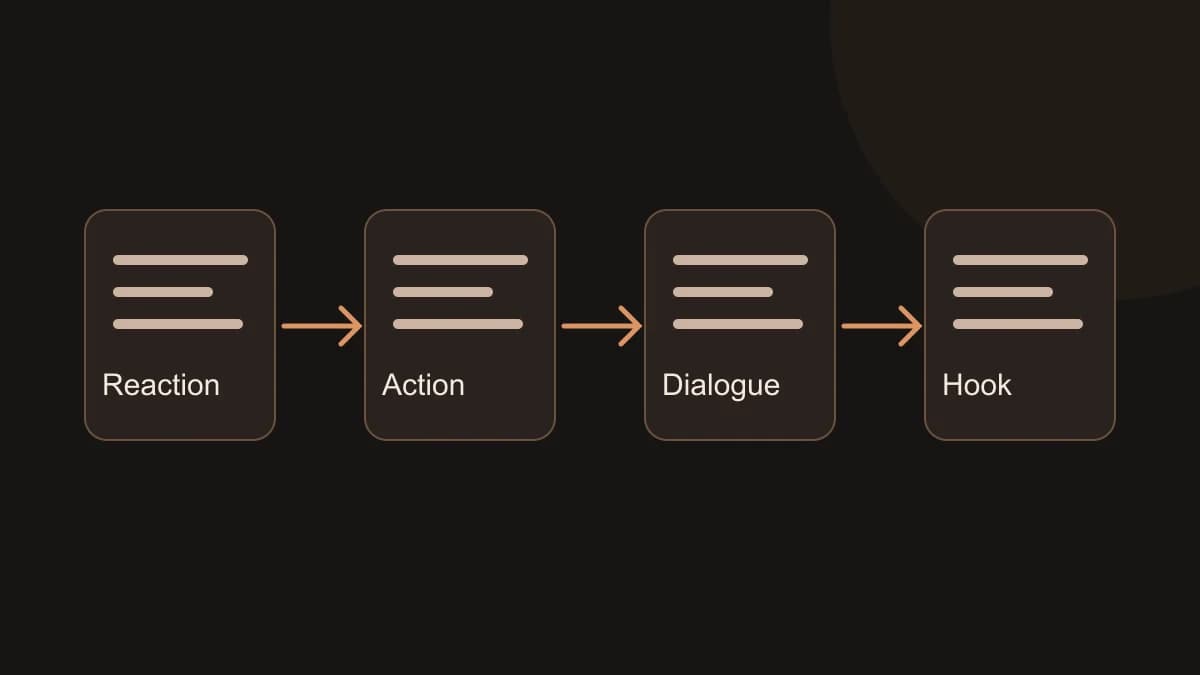
The radio scenes below are author-written illustrations, not recorded chats or tested fixes. No example demonstrates that a correction will stop a loop.
On this page
- Why does the AI repeat what I say?
- Why does the bot keep repeating the same phrases?
- Why does every reply follow the same pattern?
- Give the character one new decision
- Correct the repeat before adding another turn
- Name the phrase once in a short OOC note
- Try a time skip or a new place if the scene is stuck
- Pick one fix and check what changes
Why does the AI repeat what I say?
The examples use a fictional late-night radio show. You play Eli, 29, the new sound tech; the AI portrays Noor, 38, the host.
An echo repeats your message instead of answering it. Restating a detail can be useful once to clarify it. It becomes a problem when the reply adds no reaction, information or choice.
An echo can happen even after a clear instruction. Try asking what Noor wants to do about the clicking transmitter. Compare whether her next reply contributes a decision rather than another restatement.
Your message
Eli sets a coffee on the desk. "The transmitter in the back room is clicking again."
Echo reply
"The transmitter in the back room is clicking again?" Noor repeats, picking up the coffee. "Clicking, huh. That's strange."
Why does the bot keep repeating the same phrases?
A repeated phrase or gesture can appear even when the dialogue changes. In the examples, Noor keeps leaning back with a slow smile. That action no longer tells you anything new about the scene.
Earlier replies and character examples can be part of the next request to the model. Chub's prompting documentation describes character definitions and the chat history that fits within the model's context. Repeated wording there may contribute to more of the same. The model and its generation settings can also affect repetition. There is no fixed number of appearances after which a phrase becomes a habit.
In the three illustrations below, the dialogue changes while the gesture stays almost the same.
Illustrative reply 1
Noor leans back in her chair, a slow smile spreading across her face. "Another caller already."
Illustrative reply 2
Noor leans back in her chair, a slow smile spreading across her face. "You're learning fast, Eli."
Illustrative reply 3
Noor leans back, a slow smile spreading across her face. "Line two, then."
Why does every reply follow the same pattern?
Sometimes the words vary but every reply has the same shape: a gesture, a line of dialogue and a question returned to you. That can feel repetitive even when no sentence is duplicated.
A format instruction, example dialogue or recent chat pattern may influence the shape. Chub gives "End the response with a question" as an example instruction. Your own turns also become context. Ask for a different ending and check whether the response still answers the scene.
You do not need to ban all questions or make every reply longer. A useful question is fine. The problem is a routine ending that avoids the decision the character has been asked to make.
Reply
Noor adjusts her mic. "Nice fade on that last song. Where did you learn that?"
Next reply
Noor glances at the clock. "Ten minutes to the news. Want to take the next caller?"
Give the character one new decision
If the scene has stalled, give the character something specific to answer. In the radio scene, Eli can ask whether to take an unexpected caller instead of asking another vague question.
Keep the event small enough to respond to in one turn. You write Eli's action and question; Noor decides her answer. If you keep the existing scene, change only the request first so you can see whether that helped.
To try a new scene on tempteo, choose a character and an opening. The Use with button saves the opening as a draft in this browser; it does not send it. Sign in if asked, review the draft in the chat and send it when you are ready. If you already have a draft or your browser cannot save one, copy the opening instead. Keep an ongoing scene in its existing conversation and try a short correction before replacing its setup.
Before: nothing new
Eli nods. "Yeah, quiet night. What do you think?"
After: an event and a real question
Line four lights up. Eli checks the number and freezes. "Noor, it's the guy from last night. The one who asked for a song that doesn't exist. Do I put him through or not?"
Correct the repeat before adding another turn
When a reply repeats without adding anything useful, pause before answering it in character. Note the part you want changed. Continuing immediately may leave that wording in the context.
If your app offers Edit or Regenerate for AI text, you can trim the unwanted line or request another version. Check what the control actually changes. tempteo currently has neither control for an AI text reply. Send a short OOC (out-of-character) correction asking Noor to react to the clicking transmitter rather than echo Eli's words.
An OOC message does not remove earlier replies. If the same problem returns, check your own instructions and examples for that wording. You can then try a scene change and note that you changed the setup too.
Illustrative alternative reply
Noor is out of her chair before you finish. "Again? Watch the board. If it's the relay, we lose the signal in about four minutes."
Name the phrase once in a short OOC note
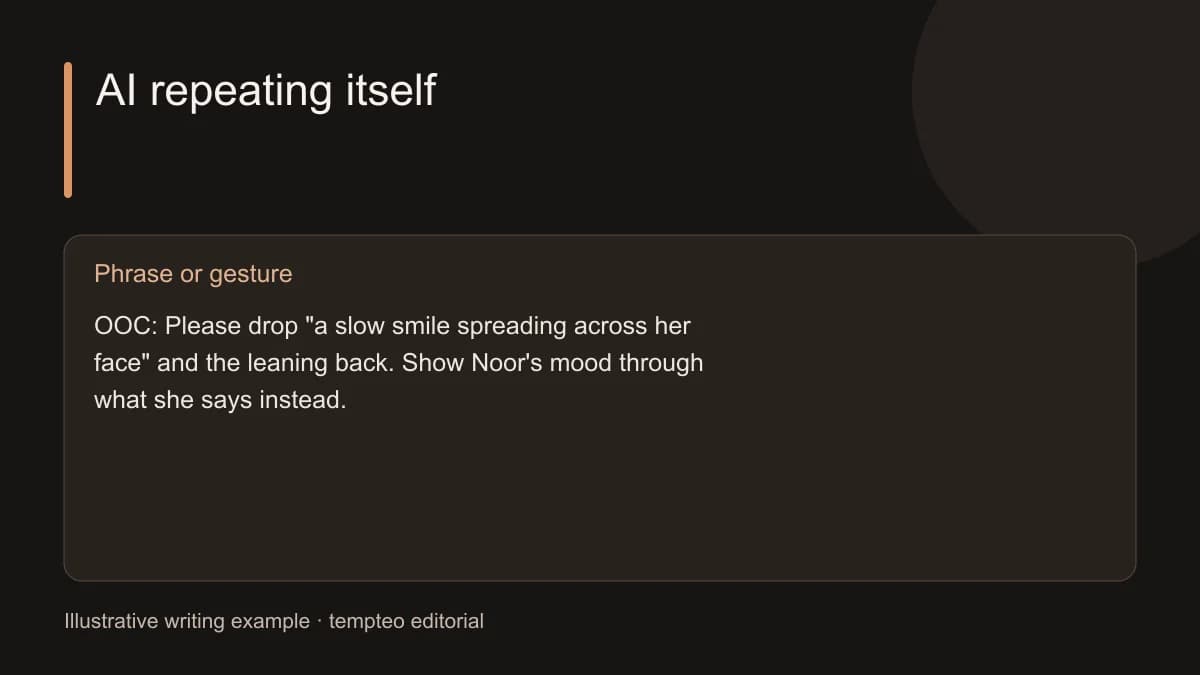
Quote the unwanted phrase once and say what you want instead. "Show Noor's mood through her dialogue" is a clearer direction than "Stop repeating yourself." For an echo, ask for a reaction. For a recurring question ending, ask the character to finish on an action when that fits.
Try one note first. Repeatedly pasting the same complaint adds more copies of the phrase to the conversation and makes the comparison harder. On tempteo Copy puts the text on your clipboard; read it before sending it in the chat.
Phrase or gesture
OOC: Please drop "a slow smile spreading across her face" and the leaning back. Show Noor's mood through what she says instead.
Reply structure
OOC: For Noor's next reply, answer Eli's question about the clicking transmitter. End on Noor's decision or action instead of adding another question to Eli. Leave Eli's next move to me.
Echoing
OOC: No need to repeat what Eli says. React to it and move on.
Try a time skip or a new place if the scene is stuck
If the conversation has exhausted its current task, agree on a time skip or a new location. Say where the scene resumes and what the character can respond to. Leave the result open instead of supplying a completed plot.
The radio examples move from the studio to a fire escape or to the next evening at the transmitter site. After the transition, check whether the repeated phrase returns. Earlier messages may still be part of the context.
To resume the same scene after a break, use a recap of the last accepted moment instead of inventing a new setting.
Time skip in character
An hour later the show is off the air. Eli and Noor sit on the fire escape with the last of the coffee. Down on the street, a parked car has its radio tuned to their station, playing nothing but static, and someone is sitting inside.
Scene change out of character
OOC: Let's skip to the next evening. Noor and Eli drive out to the transmitter site because the signal dropped overnight. Start with Noor unlocking the gate.
Pick one fix and check what changes
For an echo, ask for a decision or reaction. For a stock phrase, name it once and ask for another way to show the mood. For a repeated structure, request a different ending. If the scene has stalled, add one event or agree on a transition.
Check the next two or three replies as a small practical sample. Did the exact phrase return? Did the character add relevant information? Did the reply leave Eli's choices to you? Keep checking over later turns.
If it continues, save the sent instruction and the repeated part in your own notes. In an app that exposes generation settings, check its official guidance before changing them; availability and effects vary. Do not assume a repetition-penalty slider, reset button or different model is available in tempteo. If the conversation stops being useful, you can pause it rather than keep sending corrections.