Build and run a fair AI mystery with a clue sheet
Fix what happened before the investigation starts. Give the investigator evidence they can use to test that explanation. A clue sheet separates what someone observed from what a witness claims and what the player currently suspects. The missing star plate is a fictional disk used to project a particular night sky. Use the player sheet to investigate, or the author section to run the case. The author section contains the answer.
Updated by the tempteo editorial team
The writing examples below are invented. They illustrate the advice and are not recorded chat results.
On this page
Choose who holds the answer
Author and player notes are not technically protected secrets. If you want to discover an unknown solution, keep the answer outside your chat; an instruction to withhold it cannot protect it once sent. The AI also cannot reliably build evidence around a fixed answer it has never received.
For this fixed case, a facilitator can keep the author sheet and provide the relevant clue when you choose an action. The AI can portray the witnesses and surroundings using that supplied material. The facilitator checks any extra evidence before it enters the case. If you are playing alone and read the author sheet, you are knowingly dramatizing an investigation. If you give the AI only an unanswered premise, treat the result as an improvised mystery rather than pretending its solution was fixed in advance.
Keep only revealed information in the player note. The worksheets below label their author portions, so a facilitator can share the player portion separately.
Player sheet: the empty mount
At 16:40, the Harbor Planetarium's plate P7 is missing from its display mount. Tonight's demonstration starts at 18:00. The plate is valuable to the exhibit, but no one has been hurt. You play Ellis, a volunteer asked to establish what happened and recover it without making an unsupported accusation. The AI portrays these staff members:
Blank suspect record
- Person: [ ]
- Why they interest Ellis: [ ]
- Opening statement, still only testimony: [ ]
Filled suspects
Ada, projection technician
- Person: Ada, projection technician
- Why they interest Ellis: Can remove and service plates
- Opening statement, still only testimony: "I was preparing tonight's demonstration."
Ben, events coordinator
- Person: Ben, events coordinator
- Why they interest Ellis: Wants to use P7 in a promotional photograph
- Opening statement, still only testimony: "I asked to borrow it. I didn't get permission."
Cleo, collections assistant
- Person: Cleo, collections assistant
- Why they interest Ellis: Checks loans and storage
- Opening statement, still only testimony: "I returned the visitor loan at four."
Ellis initially knows only that the mount is empty and that P7 was displayed at 16:00. Available checks include the mount, staff records, the service room and interviews. Asking to inspect a relevant place should reveal its prepared observations; this case does not require a hidden password or a successful dice roll.
Copy this player starter after adapting the roles to your chosen chat. It contains the opening facts, not the author solution:
OOC scene message
OOC: A non-graphic investigation at Harbor Planetarium. I play Ellis, a volunteer. Portray Ada, Ben and Cleo with named dialogue. Leave Ellis's choices to me. Use only the case facts and revealed clues supplied for this scene. Any proposed new evidence needs confirmation before becoming canon. Start at 16:40 beside the empty P7 mount. Do not solve the case in the opening. Ellis looks at the empty mount. "Before anyone blames anyone else, what was here at four?"
The facilitator now supplies only the observation or witness fact appropriate to Ellis's next action. A generated reply might still add something unsupported; read it before continuing.
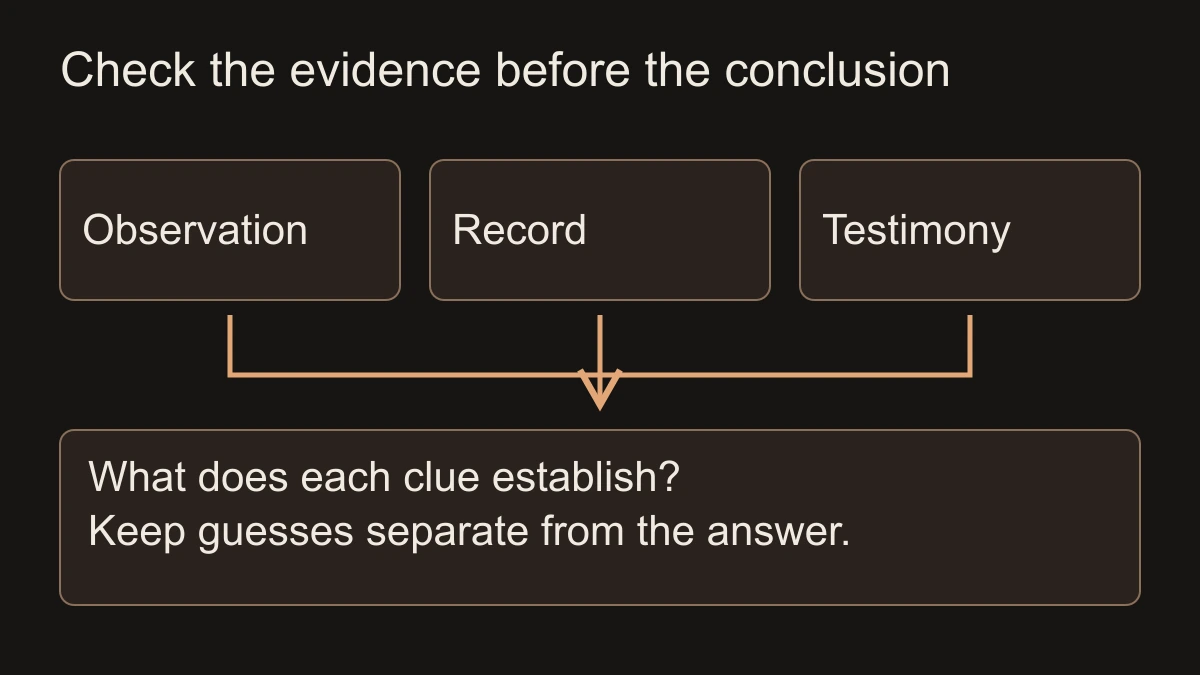
Record a clue before interpreting it
This is a filled player sheet midway through the investigation. It contains spoilers for those particular clues, but not the final recovery.
Blank player clue record
- ID and origin: [ ]
- Observation or testimony: [ ]
- What it establishes: [ ]
- Hypothesis and next check: [ ]
Filled player clues
O1: mount inspection
- ID and origin: O1, mount inspection
- Observation or testimony: Latch intact; curved moisture mark under the rim
- What it establishes: No visible forced entry; moisture was present
- Hypothesis and next check: Service removal? Check the maintenance desk
T1: Ada interview
- ID and origin: T1, Ada interview
- Observation or testimony: Ada says she stayed in the booth after 16:00
- What it establishes: Her account, not a verified location
- Hypothesis and next check: Compare the service sign-out
O2: signed service record
- ID and origin: O2, signed service record
- Observation or testimony: Ada signed out P7 for drying at 16:12
- What it establishes: Recorded removal by Ada
- Hypothesis and next check: Ask where drying takes place
T2: Cleo interview
- ID and origin: T2, Cleo interview
- Observation or testimony: Cleo saw Ada carry a flat padded sleeve toward the service room at 16:14
- What it establishes: Cleo reports a movement, not the sleeve's contents
- Hypothesis and next check: Inspect that room; compare O2
O3: events desk
- ID and origin: O3, events desk
- Observation or testimony: Ben's unapproved photo request remains on the desk; continuous event footage shows him in the foyer from 16:05 to 16:30
- What it establishes: Ben's request is motive to ask, but the removal interval puts him elsewhere
- Hypothesis and next check: Do not convert desire into guilt
Leave "What it establishes" narrow. An intact latch does not prove that no authorized person removed the plate. A padded sleeve does not prove what was inside it. Combine records, objects and testimony before changing a suspicion into a conclusion.
Justin Alexander's Three Clue Rule recommends preparing several clues for conclusions players need to reach. This case adapts that author technique with three prepared leads to the service room.
Author sheet: fixed explanation and evidence paths
Spoilers begin here. Ada removed P7 at 16:12 after noticing condensation beneath it. She put it in the service room's drying cabinet, shelf B, and signed the service register. She forgot the public "under maintenance" card. Embarrassed by the missing card, she initially claims she stayed in the booth, contradicting her signed removal. Ben did not take P7. Cleo carried a different loan to storage. Do not change this explanation to match the player's first guess.
The case timeline is fixed:
Blank author timeline entry
- Time: [ ]
- Event: [ ]
Filled fixed timeline
16:00
- Time: 16:00
- Event: P7 is displayed; Cleo returns a separate visitor loan to storage
16:05
- Time: 16:05
- Event: Ben begins setting up in the foyer; event footage covers him until 16:30
16:10
- Time: 16:10
- Event: Ada notices condensation beneath P7
16:12
- Time: 16:12
- Event: Ada removes P7 and signs it out for drying
16:14
- Time: 16:14
- Event: Cleo sees Ada carry a padded sleeve toward the service room
16:16
- Time: 16:16
- Event: Ada places P7 on shelf B; the cabinet records the insertion
16:20
- Time: 16:20
- Event: Ada returns to the booth without placing the maintenance card
16:40
- Time: 16:40
- Event: Ellis begins the investigation
Prepare three independently accessible leads to the service room: the signed register names the drying destination; Cleo's testimony identifies the corridor; a service-room intake receipt at the maintenance desk lists P7 and shelf B. Losing one conversation does not remove the other routes. The moisture mark supplies an additional reason to ask about maintenance.
Inside the service room, three checks converge on recovery: the cabinet log lists P7 at 16:16; the object on shelf B bears P7's engraved identifier; Ada's drying note describes the condensation. The engraved identifier establishes which object was recovered. The note and moisture mark explain the maintenance motive. Ada can acknowledge the omission once Ellis presents the service record; a confession is not the sole route to finding the plate.
Ben's photo request remains a plausible early suspicion. It has a prepared check, the foyer footage, rather than an endless chain of new accusations. Cleo's loan has a separate inventory number, L2, and a storage receipt at 16:00. Those records distinguish her ordinary task from P7's later movement.
Play from observation to justified resolution
The following exchange assumes the facilitator has released the relevant facts at each step.
Your turn as Ellis
"I'd like to examine the mount before interviewing anyone."
Illustrative AI reply
The latch closes smoothly. A curved moisture mark lies beneath the lower rim. Ada folds her arms. "It wasn't like that yesterday." The reply stops before Ellis chooses a next check.
Your turn as Ellis
"I record moisture, not theft. Is there a maintenance sign-out?"
Illustrative AI reply
The desk register has a 16:12 entry in Ada's name: P7, drying, service room. Ada looks at the blank maintenance-card holder beside the mount. "I should have put the card there."
Your turn as Ellis
"I'll check the service room. Cleo, did you see anyone use that corridor?"
Illustrative AI reply
Cleo points toward it. "Ada, with a flat sleeve, at about fourteen past. I didn't see inside." She collects the intake receipt from the maintenance desk and brings it to the service-room doorway. The receipt points to shelf B. The cabinet log records P7's insertion at 16:16. The cabinet is available to inspect.
Your turn as Ellis
"I open shelf B and compare the engraved identifier with P7's inventory entry."
Illustrative AI reply
The identifiers match. Ada's note beside the plate reads "Dry after condensation check." Ada stays by the doorway. "I removed it. Then I went back to the booth and forgot the card. I should have said so immediately."
Your turn as Ellis
"P7 was taken for maintenance, not a photograph or a loan. The signed removal, cabinet entry and matching plate agree. Let's correct the display notice before deciding whether it's ready for tonight."
Illustrative AI reply
Cleo records the recovered location. Ben takes his photo request back to the events desk. Ada writes the missing notice. P7 stays in the cabinet until its condition is checked; recovering it does not automatically establish that it is ready to use.
The resolution accounts for the object, the timing, the misleading account and the other suspects. It does not depend on Ellis guessing Ada's name early.
When the investigation stalls or a clue contradicts canon
If Ellis fixates on Ben, use the existing footage check. If Ellis cannot find a next action, have Cleo bring the already prepared intake receipt from the maintenance desk: "You asked about where plates go. This might help." It adds an available route, not a new culprit. A gentler hint can ask which record would distinguish removal from borrowing. Give the player the choice of a hint or the full solution.
An incorrect generated reply might say:
Illustrative scene excerpt: Ben produces P7 from his bag. "I broke the mount at 16:25."
That conflicts with the intact latch, signed drying record and fixed custody. Do not accept it merely because it sounds dramatic. Send:
OOC correction
OOC: Reject the bag discovery and broken mount. P7's prepared custody is the drying cabinet, shelf B, entered at 16:16. The latch is intact. Resume from the last valid clue, the service-room intake receipt, before Ellis opens the cabinet. Leave Ellis's next action open.
A corrected illustrative continuation is:
Illustrative scene excerpt: The receipt still points to shelf B. Ben remains in the foyer. Ada stands beside the service-room door. The cabinet has not yet been opened by Ellis.
The correction adds a message; it does not erase the mistaken reply. If the next answer repeats the contradiction, stop and re-supply the small set of accepted clues instead of investigating the invented bag. For general repairs beyond this case, use the continuity guide.
Update your manual player sheet after each accepted clue and check new evidence before using it. The roleplay setup template covers the broader opening; roleplay AI chat is a possible place to send an adapted scene message.
Copy a starter or worksheet
These manual notes include the author solution. Share the player starter separately. Keep an unknown answer outside the investigator's chat.
Blank player portion
- Case and start time: [ ] - Investigator controlled by reader: [ ] - Known opening facts: [ ] - Suspects and initial testimony: [ ] - Available places and records to check: [ ] Reusable player clue record - ID: [ ] - Origin: [ ] - Observation / testimony: [ ] - Narrow supported fact: [ ] - Hypothesis: [ ] - Next check: [ ] - Accepted / rejected: [ ] - Resolution proposed: [ ] - Independent evidence supporting it: [ ] - Alternative explanation ruled out by: [ ] - Still unknown: [ ]
Blank player starter, share separately
OOC: I play [investigator]. Portray [witnesses] with named dialogue. Start at [time/place] with [known opening facts]. Use only supplied case facts and revealed clues; confirm proposed new evidence before accepting it. Leave my choices open and do not solve the case in the opening.
Blank author portion, keep separate
- Fixed explanation, person, motive, method and object destination: [ ] - Timeline: [ ] - Conclusion required / three separately accessible leads: [ ] - Recovery checks: [ ] - Misleading suspicion and fair disproof: [ ] - Stalled route using a prepared clue: [ ] - Last accepted clue and contradiction repair: [ ] The redundant-clue preparation adapts Justin Alexander's Three Clue Rule, an author technique for preparing several evidence paths.
Filled player portion, midway through the star-plate case
Case: Harbor Planetarium P7; 16:40. Reader controls Ellis. P7 present at 16:00, absent at 16:40; tonight's demonstration at 18:00. AI portrays Ada, Ben and Cleo. Ada says she was preparing the show; Ben says he requested a photo loan; Cleo says she returned a visitor loan at four. Inspect mount, records, foyer footage or service room. Reusable player clue fields - ID: [ ] - Origin: [ ] - Observation / testimony: [ ] - Narrow supported fact: [ ] - Hypothesis: [ ] - Next check: [ ] - Accepted / rejected: [ ] Filled midway clues O1 - ID: O1 - Origin: Mount - Observation / testimony: Intact latch; moisture mark - Narrow supported fact: No visible forced entry - Hypothesis: Maintenance? - Next check: Register - Accepted / rejected: Accepted observation T1 - ID: T1 - Origin: Ada - Observation / testimony: Stayed in booth after four - Narrow supported fact: Claimed location only - Hypothesis: Booth claim false? - Next check: Sign-out - Accepted / rejected: Accepted as testimony only O2 - ID: O2 - Origin: Register - Observation / testimony: Ada signed P7 out for drying at 16:12 - Narrow supported fact: Recorded removal - Hypothesis: Plate in service room? - Next check: Cabinet - Accepted / rejected: Accepted record T2 - ID: T2 - Origin: Cleo - Observation / testimony: Ada with padded sleeve at 16:14 - Narrow supported fact: Reported movement - Hypothesis: Sleeve held P7? - Next check: Intake receipt - Accepted / rejected: Accepted as testimony only O3 - ID: O3 - Origin: Events desk - Observation / testimony: Ben in foyer 16:05 to 16:30 on continuous footage - Narrow supported fact: Ben elsewhere during removal - Hypothesis: Photo suspicion weakened - Next check: Plate identity - Accepted / rejected: Accepted record
Filled player starter, share separately
OOC: A non-graphic investigation at Harbor Planetarium. I play Ellis, a volunteer. Portray Ada, Ben and Cleo with named dialogue. Leave Ellis's choices to me. Use only the case facts and revealed clues supplied for this scene. Any proposed new evidence needs confirmation before becoming canon. Start at 16:40 beside the empty P7 mount. Do not solve the case in the opening. Ellis looks at the empty mount. "Before anyone blames anyone else, what was here at four?"
Filled author portion, spoilers
Explanation: Ada moved P7 for drying after condensation, signed out, forgot the maintenance card, then falsely claimed she stayed in the booth after 16:00 out of embarrassment. Ben's photo request was unapproved. Cleo's separate loan was L2. Timeline: 16:00 display and L2 return; 16:05 Ben foyer setup begins; 16:10 Ada sees condensation; 16:12 Ada removes and signs P7 out; 16:14 Cleo sees sleeve; 16:16 cabinet insertion; 16:20 Ada returns to booth; 16:30 foyer footage ends; 16:40 discovery. Service-room paths: signed register names destination; Cleo names corridor; maintenance-desk intake receipt names P7 and shelf B. Recovery checks: cabinet entry, engraved P7 identifier, drying note. Motive checks: moisture mark and note. Alternative checks: Ben's footage and Cleo's L2 receipt. Played route: Cleo collects the intake receipt at the maintenance desk and brings it to the service-room doorway before Ellis inspects shelf B. Stalled route: Cleo brings the same prepared receipt from the maintenance desk, without naming a culprit. Filled final player conclusion after inspection: P7 recovered on shelf B; identifier matches inventory. Ada's removal and cabinet records agree. Maintenance explains the moisture. No support for Ben taking it or Cleo confusing loans. Condition for tonight's use remains unverified in the fiction. Repair: reject an invented P7 in Ben's bag and broken latch; resume from the intake receipt before Ellis opens shelf B. The ordinary OOC message changes requested continuation, not earlier history or saved memory.

