Use dice in AI roleplay without letting the chat invent the roll
Write down what each result means before you roll. Roll a physical die yourself, choose the agreed consequence, then ask the AI to narrate only that result. The AI supplies the scene's words; you supply the die result and remain the judge of what changes. You can use the same method in an ordinary tempteo text chat without a native dice tool.
Updated by the tempteo editorial team
The writing examples below are invented. They illustrate the advice and are not recorded chat results.
On this page
Agree on the stakes before the die lands
Name one uncertain action, give each result a consequence, and freeze that table before rolling. You can then check the narration against a rule you agreed in advance. Do not ask the narrator to decide afterward whether a low result secretly counts as success.
This is an original teaching exercise with an illustrative result, not a recorded AI response or a recommended tabletop game's rules. All you need is a physical six-sided die and somewhere to keep the table. If you do not have a die, choose a consequence deliberately and call it a choice, not a random roll.
- Action: the one thing your character is trying now.
- Stakes: what success gets and what a setback changes.
- Mapping: what every possible die result means.
- Authority: you read the die and select the row; the AI narrates within it.
Keep a character decision out of the random part. A die can decide whether a fictional hoist lifts a flag, but it does not choose whether your character wants to take the risk. If you first need a scene and a player role, use the opening-prompt guide.
Worked setup: raise the blue signal flag
You play Rowan at a fictional harbor signal tower. Iris, the tower keeper, belongs to the narrator. The next ferry is approaching, the blue flag is down, and the hoist rope is frayed. A latch holds the flag once it reaches the top. Rowan has chosen to try the hoist. Whether it works is the only uncertainty for this roll.
Starting facts to keep beside the chat
Player: Rowan. Narrator-controlled character: Iris. The blue flag is down. The hoist rope is frayed. A latch holds the flag at the top. The approaching ferry has not passed the tower. Rowan has chosen to try the hoist. No one has yet repaired or broken the rope.
Use one six-sided die. Agree on the following complete mapping before rolling. Each row states whether the flag rises and what happens to the hoist. Compare the narration with that row before accepting the next turn.
- 1 or 2 - Setback: the flag stays down and the hoist jams. The rope does not break. Rowan must choose a different way to send a signal.
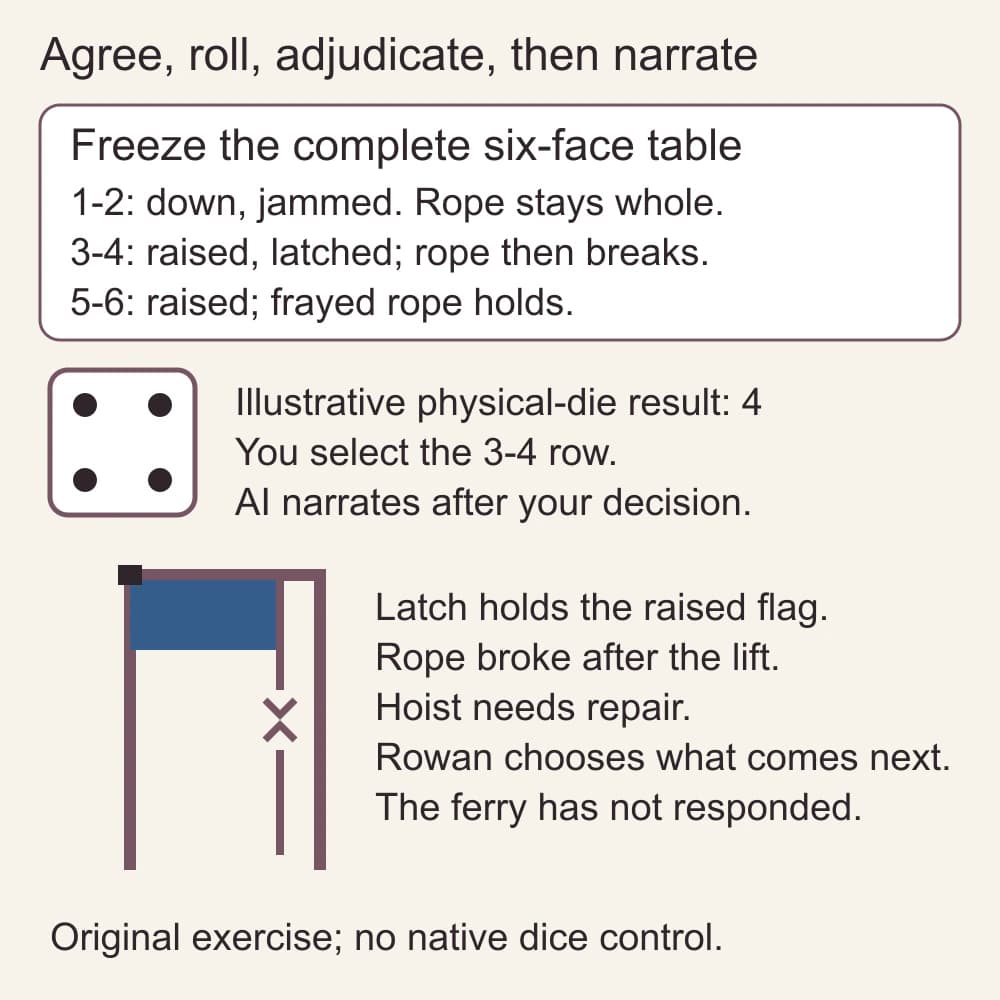
- 3 or 4 - Success with a cost: the flag rises, but the flag latches at the top and the rope then breaks. The flag is raised; the broken hoist needs repair before it can be used again.
- 5 or 6 - Clean success: the flag rises and the frayed rope holds. The flag is raised; the hoist is still usable, though the rope remains frayed.
There are no hidden modifiers in this exercise, no second die and no reroll triggered by an answer you dislike. You can invent different stakes for another scene, but keep the new table separate from this already resolved action. For a choice that changes the plot without chance, see the meaningful-choices workshop.
Roll outside the chat, then report what you saw
Roll the physical die yourself. Read it before opening the next AI turn, and copy the result next to your table. The example below uses an illustrative result of 4; no physical die was rolled to produce this article.
Illustrative roll record
Action: try the flag hoist. Die result: 4. Selected row: 3 or 4 - success with a cost. Accepted state: blue flag raised; hoist rope broken. Still unresolved: Rowan's next choice and what happens when the ferry crew sees the signal.
This record is the source for the narration. If a physical die lands awkwardly and you cannot read it, follow a reroll rule agreed before play, or pause and make a deliberate choice. Do not let the narrator claim it has seen a physical result you have not supplied.
In tempteo, put the next instruction into the ordinary text message box, read it, then send it. No /roll command, probability setting or automatic dice integration is assumed here. Some other tools have real mechanisms of their own: the documented roll macro. A feature in another app is not a tempteo control.
Narration request after your roll
I rolled a physical six-sided die and got 4. Our agreed 3-or-4 result is: the blue flag rises and latches at the top, then the hoist rope breaks. Narrate only that result in two short sentences. You may describe Iris and the tower, but do not choose Rowan's next action, invent another roll, repair the rope or say the ferry has already responded. Leave Rowan's next decision to me.
Check the narration against the chosen row
The die result is settled. The next check is whether the prose respects it. Compare the reply with the small roll record, not with a general feeling that the scene sounds exciting.
Illustrative continuation that fits the result: The blue flag catches the evening wind and locks at the top as the rope parts beneath the hoist. Iris grips the rail and looks from the raised flag to the approaching ferry, waiting for Rowan's decision.
- Flag: raised, as the 3-or-4 row requires.
- Rope: broken after the lift, not intact and not repaired.
- Ferry: still approaching; its response has not been decided.
- Rowan: no new action or private thought assigned by the narrator.
- Chance: no extra roll, modifier or reroll inserted.
If the reply instead says the flag never rose, it uses the wrong row. If it says the rope holds, it removes the agreed cost. Mark the mismatch before accepting another turn. A short correction can name the exact state, but a whole repair dialogue would duplicate the player-control guide. Use that owner if the narrator repeatedly takes over your role.
You are not testing whether the AI can generate a fair sequence of random numbers. You are checking whether it can narrate a result you already adjudicated. A claimed number in a chat reply does not, by itself, give you an auditable physical roll.
Continue without rolling away the cost
For the illustrative 4, the flag remains raised and the hoist is broken. Keep both facts as you choose the next turn. Rowan might call to the ferry, ask Iris about a spare rope, or leave the signal flying while checking the damaged mechanism. Those are player choices, not retroactive changes to the roll.
State note for the next turn
Accepted result: the blue flag is raised; the hoist rope is broken. Rowan's next choice: ask Iris whether there is a spare rope. Do not lower the flag, repair the hoist or invent the ferry's response without another established event.
Resolve a genuinely new uncertain action with a new table if you want to use chance again. Do not roll repeatedly on the original hoist attempt until it yields your favorite result. If you want the cost to lead to a useful next choice rather than a dead end, the fail-forward workshop picks up from an accepted outcome. That guide handles the continuation; this one keeps the chance decision outside the narrator.
Real tabletop systems use their own stakes, modifiers and ways to resolve consequences. For example, the action-roll reference explains its game's procedure. The simple mapping here is an original exercise, not that system's rulebook and not a claim that all roleplay must use dice.
Use chance only where you actually want it
Use this method for a small uncertainty when more than one consequence would make an interesting scene. Keep it out of your character's consent, identity and decisions. If the scene needs a planned emotional turn, decide that turn yourself and ask for the narration you want instead of wrapping it in an invented random test.
A physical die does not guarantee fair narration, permanent memory or obedience to the prompt. Keep the selected row and resulting state where you can reread them. You may need to correct a later reply that forgets the broken hoist. Keep the selected outcome in your next state note before continuing.
For rule-checked play with no chance involved, the two text games provide different exercises. You do not need a new roll for every line of a conversation. Once the flag is up, write Rowan's next choice and let the scene continue from the facts you kept.

