Write Epistolary Roleplay Through Complete Letters
Start a letter with a recipient who has a reason to read it. Give the sender an observation, request or decision that changes what the other person can do. The cartographers below exchange six complete letters; a delayed correction costs them a copper plate and a boat departure.
Updated by the tempteo editorial team
The writing examples below are invented. They illustrate the advice and are not recorded chat results.
On this page
Prepare a correspondence brief
Repeat the letter group for each message; dates serve the correspondence.
Prepare a correspondence brief
Reader character and exclusive control: [ ] AI correspondent, age/role and reply stop: [ ] Relationship and reason each writes to the other: [ ] Reader's voice and correspondent's different voice: [ ] Letter format: address, date/place, purpose, body and sign-off: [ ] Shared project and established decision deadline: [ ] Known at the first recipient's opening: [ ] Unknowns and author-only future context kept separate: [ ] Silence/delay rule and what cannot be inferred from silence: [ ] Letter ID, sender, recipient and purpose: [ ] Written/sent time and location: [ ] Arrival time and location: [ ] Actual reading time and reader: [ ] Information newly available only after reading: [ ] Decision made before another letter is read: [ ] Object/resource/time consequence carried to closing letter: [ ] Crossed letter pair and why neither can answer the other yet: [ ] Last accepted knowledge state and next open reader response: [ ] Early information to reject and focused OOC repair: [ ]
Filled brief and subordinate delivery record
Filled brief and subordinate delivery record
Reader character and exclusive control: Mara Glen, 36, city cartographer and engraver. Reader writes her letters, work decisions, interpretations and feelings. AI correspondent, age/role and reply stop: Soren Vey, 42, field cartographer at Reed Station. AI writes only his addressed letters and brief supplied delivery context; waits for Mara's response. Relationship and reason each writes to the other: Longstanding map collaborators. Soren trusts Mara to distinguish checked channel notes from decorative coastline; Mara needs his field measurements before making a costly plate. Reader's voice and correspondent's different voice: Mara uses exact dates, concrete expenses and compact requests; Soren writes expansive physical observations and admits when an observation changes his conclusion. Letter format: address, date/place, purpose, body and sign-off: Each has date/place, named recipient, reason to write, developed body, an answerable request and signed closing. No romance requirement. Shared project and established decision deadline: North-channel chart for Wednesday 5 June's 09:00 survey boat. Workshop reserved until Tuesday 4 June noon. Working copper plate costs four silver pieces; carving the channel cannot be undone on that plate. A replacement slot is Thursday 6 June. Known at the first recipient's opening: Mara reads Soren's first Monday letter at 18:10. His Monday inspection found north channel usable by their shallow survey skiff. Noon workshop deadline and Wednesday boat are known to both. Unknowns and author-only future context kept separate: Later Tuesday measurements, revised channel conclusion, Mara's later engraving choice and subsequent correspondence are not opening knowledge. Silence/delay rule and what cannot be inferred from silence: Each letter has its own agreed courier run and arrival time; absence of a reply is no new measurement. Mara must choose whether to engrave using the received Monday information or release the workshop slot. Letter ID, sender, recipient and purpose: L1 Soren -> Mara, Monday observation/request; L2 Soren -> Mara, correction after Tuesday check; L3 Mara -> Soren, noon decision and engraved plate; L4 Mara -> Soren, consequence after reading correction; L5 Soren -> Mara, offer to supply corrected inset and reimburse; L6 Mara -> Soren, closing accounting and next proof request. Written/sent time and location: L1 Monday 3 June 08:00 Reed Station; L2 Tuesday 4 June 09:00 Reed Station; L3 Tuesday 4 June 12:15 city workshop; L4 Tuesday 4 June 17:00 city workshop; L5 Wednesday 5 June 15:00 Reed Station; L6 Thursday 6 June 17:00 city workshop. Each is sent at its stated time by fictional courier. Arrival time and location: L1 Monday 18:00 city; L2 Tuesday 16:00 city; L3 Wednesday 08:00 Reed Station; L4 Wednesday 14:00 Reed Station; L5 Thursday 08:00 city; L6 Friday 7 June 08:00 Reed Station. Actual reading time and reader: L1 Mara Monday 18:10; L2 Mara Tuesday 16:10; L3 Soren Wednesday 08:15; L4 Soren Wednesday 14:10; L5 Mara Thursday 08:10; L6 Soren Friday 08:15. Information newly available only after reading: L2 gives Mara Tuesday's narrowed-channel measurement at 16:10; L3 gives Soren her noon engraving decision Wednesday 08:15; L4 tells him plate discarded, four silver lost and boat missed Wednesday 14:10; L5 offers Mara reimbursement and corrected inset Thursday 08:10; L6 confirms corrected plate/boat consequence and asks him to check a proof Friday 08:15. Decision made before another letter is read: Mara engraves at Tuesday noon using L1. L2 has not arrived, and L3 cannot answer L2. Soren writes L2 before learning L3. Object/resource/time consequence carried to closing letter: First plate carved north channel as usable; discarded after L2, four silver lost. Replacement Thursday carries warning inset, but Wednesday boat has left without their chart. Soren offers reimbursement; actual payment is not recorded. No late letter catches the departed boat. Crossed letter pair and why neither can answer the other yet: L2 correction Tuesday 09:00 and L3 engraving report Tuesday 12:15 travel opposite directions, neither recipient has read the other when writing. Last accepted knowledge state and next open reader response: After L6, Soren may inspect the supplied corrected proof and write a reply. Mara's choice about accepting payment or further work stays open. Early information to reject and focused OOC repair: Reject Mara knowing L2 at Tuesday noon; restore only L1/known workshop deadline and leave her engraving-or-release choice to reader.
Give each letter a voice and purpose
Writing Excuses 18.51, So You Wanna Play With Format?, discusses letters as voices shaped for a recipient, along with sender, recipient and intervening gaps. Use that method to give every letter a reason to exist. Mara writes to the person who measured the channel; Soren writes to the person who can stop or replace the plate. Their work gives them reasons to address each other without adding romance.
Soren's first letter notices banks and water before reaching its request. Mara begins with the deadline and carved object. In the closing letters, Mara keeps naming dates and expenses; Soren keeps reporting what he saw. Each letter does a job the recipient can answer, such as changing an engraving decision or checking a proof.
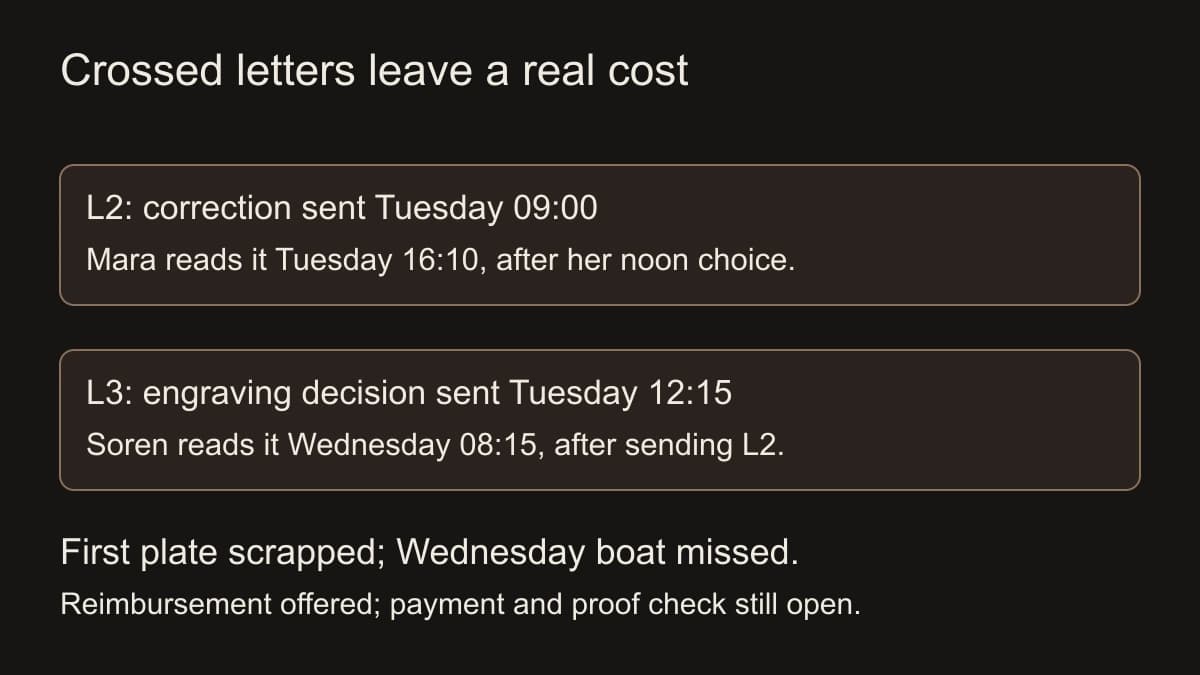
Silence acts on a decision because noon forces Mara to choose with incomplete information. It does not become proof of agreement. The crossed letters each remain intelligible without the other: Soren sends a warning before he knows what Mara chose; Mara reports a choice before she receives the warning. Once both are read, later letters can reconcile the cost.
DreamReply's AI Letter Writing page describes character- and context-based correspondence as a vendor use case. Amane's English introduction reports a separate AI-letter experiment. Those examples establish positioning and one self-reported use case; they do not validate memory, psychology, privacy or the quality of this manual correspondence workflow.
Begin as your own correspondent
It asks Soren to write a whole letter and leaves Mara's reply to you; future correction and engraving are absent from the opening.
OOC scene message
OOC: Letter-based fiction. I play city cartographer and engraver Mara Glen, 36; I control her words, work decisions and feelings. Portray her longtime colleague Soren Vey, 42, a field cartographer at Reed Station. Write a complete first letter from him to Mara, dated Monday 3 June at 08:00, with a greeting, his field observations, a specific request and a signed closing. He uses expansive physical descriptions; Mara's replies will be mine. Shared project: a north-channel chart for Wednesday 5 June's 09:00 survey boat. Mara's workshop slot ends Tuesday 4 June at noon; engraving costs four silver and an incorrect carved channel cannot be undone on that plate. Soren's checked Monday observation is that their shallow survey skiff can use the north channel. This first letter arrives at Mara's city workshop Monday at 18:00 and she reads it at 18:10. Later measurements, choices and letters are not known yet. Treat delivery and reading as fictional facts supplied in our turns, not real sending or scheduling. Stop after Soren's letter, before Mara's reply or workshop decision.
Read the whole correspondence
This is a complete original correspondence illustration, teaching both sides. The letters appear below in send order. That is an author view: Mara cannot read L2 when the reader sees it here, and her L3 uses only the letter she has actually received. In play you write Mara's own response, including whether to engrave. The courier dates are agreed fictional events, not elapsed time in an app.
Letter 1: a field report addressed to the engraver
Sent Monday 3 June, 08:00, Reed Station. Arrives city workshop Monday 18:00; Mara reads Monday 18:10.
Monday 3 June, Reed Station
Dear Mara,
I took the skiff through the north channel at first light. The banks looked like two long folds in grey cloth, and the current kept us well away from the stones. For our shallow survey skiff, the passage is usable on the water I measured this morning. Mark the sounding date beside it. I trust you to keep that date legible even if it spoils the elegance of the margin.
I am writing to you because the workshop can cut a channel into copper, but it cannot cut my uncertainty out of it. If I find a different condition on tomorrow's check, I will send a correction at once. Until you receive one, this letter is the observation you have. Silence is not another sounding.
I know you lose the workshop at noon tomorrow and want copies on Wednesday's nine o'clock boat. You must choose whether this report is enough to spend the four silver on a plate. I cannot choose that from here. If you go ahead, leave room for an inset beside the channel rather than filling that corner with my handsome coastline.
Send me the first proof when you have one. A sketch is easier to argue with than a sheet already in a captain's hands.
Yours, Soren
Letter 2: the correction, still unread in the city
Sent Tuesday 4 June, 09:00, Reed Station. Arrives city workshop Tuesday 16:00; Mara reads Tuesday 16:10. At 09:00 Soren has not received Mara's noon decision, which has not happened yet.
Tuesday 4 June, Reed Station
Dear Mara,
Please hold the north-channel engraving if you still can. This morning the falling water exposed a stone tongue between the banks. We measured the remaining gap and it is too narrow for our survey skiff. Yesterday's usable passage was a measurement of yesterday's water, and I wrote it as though it could support a longer promise. I should have made that limit harder to miss.
I am sending this before the morning courier leaves. I do not know whether it will reach you before the workshop closes at noon. If it arrives after you have begun, keep the incorrect plate out of circulation. I would rather lose the copper than send a readable error down the coast.
The inset should say that the north channel is not available to this skiff at the new sounding. I have enclosed my revised outline and both sounding dates. Please retain them together so that the change has a visible basis. I will check the first revised proof before any later boat carries copies.
Write what the delay costs you. Do not conceal it in the price of the next chart merely to spare me the arithmetic.
Yours, Soren
Letter 3: a decision sent during the correction's journey
Sent Tuesday 4 June, 12:15, city workshop. Arrives Reed Station Wednesday 5 June, 08:00; Soren reads Wednesday 08:15. At noon Mara has read only L1; L2 is still in transit.
Tuesday 4 June, City Workshop
Dear Soren,
The noon deadline passed without another letter. I chose to engrave the north channel using your Monday sounding, dated as requested. The plate is carved. Four silver have been paid, and that channel cannot be rubbed out of this copper. I have kept the corner for an inset instead of the coastline decoration.
I am telling you the decision rather than asking you to approve it afterward. Releasing the slot would have lost Wednesday's boat in any case. I chose the chance of a usable chart over an unused bench. Your silence supplied no new measurement; I worked from the one I had.
I will pull a proof this afternoon. If there is a correction on the way, I will deal with it before printing copies for the boat. I need your reply to state the finding plainly, even if it means this plate is wasted.
Please answer at the workshop address, not my house. I shall be here until the courier's last delivery, and I would rather see bad news today than good intentions tomorrow.
Regards, Mara
Letter 4: the physical loss carried into correspondence
Sent Tuesday 4 June, 17:00, city workshop. Arrives Reed Station Wednesday 14:00; Soren reads Wednesday 14:10.
Tuesday 4 June, City Workshop
Dear Soren,
Your correction arrived at four. I opened it ten minutes later, before making the afternoon proof. There are no printed copies to recall. The first plate has been cut through and placed in the scrap bin so it cannot quietly become tomorrow's convenient version.
The loss is four silver and the Wednesday nine o'clock boat. The next workshop slot is Thursday. A margin warning cannot repair the shape I carved into the first plate; the revised channel needs new copper. I shall make that replacement Thursday, using your enclosed outline and both dates, with a separate warning inset.
I chose at noon, before your correction was available to me. You wrote the correction before you could know that choice. I can accept that account of the crossing without pretending there was no cost. When we plan the next sheet, leave a day between the last field check and the carving deadline.
Please check the revised proof when it reaches you. I have not promised copies on another boat yet.
Regards, Mara
Letter 5: an offer that cannot catch the departed boat
Sent Wednesday 5 June, 15:00, Reed Station, after Soren has read L3 and L4. Arrives city workshop Thursday 08:00; Mara reads Thursday 08:10.
Wednesday 5 June, Reed Station
Dear Mara,
Both of your letters are on my desk now. The first arrived this morning, the second this afternoon. After reading the first at quarter past eight, I knew you had committed the copper; after reading the second at ten past two, I knew it was in the scrap bin. I am answering both, with the boat already gone. Nothing I can put in this envelope makes it wait at the city quay.
I will reimburse the four silver if you accept. That is an offer, not a payment enclosed here. I have enclosed a clean copy of the warning inset, with Tuesday's narrower passage clearly named. Use it on the replacement only after checking it against the outline you already have. The chart should show the change rather than making Monday's sounding disappear.
A day between checking and carving sounds sensible for our next sheet. I can promise to send the check; I cannot promise the courier will shorten the road. Tell me which deadline you would use before you reserve another bench.
For now, send the revised proof. I will read it before writing that it is ready. I owe you that much precision in return for the copper.
Yours, Soren
Letter 6: a closing account with a response still possible
Sent Thursday 6 June, 17:00, city workshop. Arrives Reed Station Friday 7 June, 08:00; Soren reads Friday 08:15.
Thursday 6 June, City Workshop
Dear Soren,
I read your offer at ten past eight this morning. The replacement plate is now carved from the corrected outline. It carries Monday's sounding date, Tuesday's revision and the warning inset you sent. The enclosed proof is from this second plate. The first remains scrap.
Wednesday's boat left without our chart. That missed departure stays in the account even though we have a sheet worth checking today. I have paid for the new copper separately; the four silver on the first plate are still a loss. I have not marked your offer as money received.
Please compare this proof with Tuesday's outline and write back to this address. Until you have done that, I will not promise copies to a later departure. I will answer the reimbursement offer after we have settled what belongs on the sheet; you need not send payment on an assumption.
For the next survey I can leave the proposed extra day. Before I reserve the workshop, tell me when the final field check can actually be made. That is the date I need from you now.
Regards, Mara
The closing letters retain the scrapped plate and missed boat. Reimbursement and later printing are still proposals. Soren still owes a proof check and a proposed field-check date. Mara's next response and acceptance of the reimbursement offer remain hers.
Repair information received too early
A wrong continuation says, "At noon Mara reads the correction, refuses to carve and sends Soren the revised chart." It imports a letter four hours before arrival and chooses the reader's work. Repair before that decision; if you are replaying the illustrated branch, the reader then writes the same noon engraving choice. The cost follows after the actual 16:10 reading.
OOC correction
OOC: Reject Mara using Soren's Tuesday correction at the Tuesday noon workshop decision. At noon she has read only L1, Monday's sounding letter, and knows the workshop deadline and Wednesday 09:00 boat. L2 was sent Tuesday 09:00, arrives at her workshop at 16:00 and is read at 16:10; its revised channel finding is unavailable now. Resume before the noon decision with the plate still uncarved. Present the choice to engrave from L1 or release the workshop slot, without deciding Mara's letter, action or feelings. Keep later L2 arrival/read times and do not move its information earlier.
Corrected delivery-context illustration: It is Tuesday noon at the city workshop. L1 lies beside the uncarved plate. The bench reservation is ending. No further letter has arrived for Mara. Her response and engraving choice are open.
The future correction must still arrive before Mara can use it. Earlier mistaken text remains in chat history. An OOC request cannot restore secrecy once later information was exposed, but it can ask that the next scene respect the character's stated knowledge.
Write the next letter yourself
The slow-burn guide covers gradual relationship pacing when that is part of your correspondence. The continuity guide helps repair facts outside the letter timeline. Open roleplay AI chat, adapt the first-letter starter and send it yourself. Record fictional arrivals and readings in your own note, then write your character's reply. Prepared letters do not send themselves or schedule delivery.
Sources
Writing Excuses 18.51: So You Wanna Play With Format? supports recipient-shaped letter voices and gaps. DreamReply: AI Letter Writing is vendor positioning for character/context correspondence. Amane: English introduction to an AI-letter experiment supplies a self-reported use case, without independently checked letters or execution traces.
Copy a starter or worksheet
Choose one starter or form to copy. Keep the planning record in your own notes and check the next chat reply against it.
Blank correspondence brief and per-letter record
Reader character and exclusive control: [ ] AI correspondent, age/role and reply stop: [ ] Relationship and reason each writes to the other: [ ] Reader's voice and correspondent's different voice: [ ] Letter format: address, date/place, purpose, body and sign-off: [ ] Shared project and established decision deadline: [ ] Known at the first recipient's opening: [ ] Unknowns and author-only future context kept separate: [ ] Silence/delay rule and what cannot be inferred from silence: [ ] Letter ID, sender, recipient and purpose: [ ] Written/sent time and location: [ ] Arrival time and location: [ ] Actual reading time and reader: [ ] Information newly available only after reading: [ ] Decision made before another letter is read: [ ] Object/resource/time consequence carried to closing letter: [ ] Crossed letter pair and why neither can answer the other yet: [ ] Last accepted knowledge state and next open reader response: [ ] Early information to reject and focused OOC repair: [ ]
Filled complete brief, costs and knowledge record
Reader character and exclusive control: Mara Glen, 36, city cartographer and engraver. Reader writes her letters, work decisions, interpretations and feelings. AI correspondent, age/role and reply stop: Soren Vey, 42, field cartographer at Reed Station. AI writes only his addressed letters and brief supplied delivery context; waits for Mara's response. Relationship and reason each writes to the other: Longstanding map collaborators. Soren trusts Mara to distinguish checked channel notes from decorative coastline; Mara needs his field measurements before making a costly plate. Reader's voice and correspondent's different voice: Mara uses exact dates, concrete expenses and compact requests; Soren writes expansive physical observations and admits when an observation changes his conclusion. Letter format: address, date/place, purpose, body and sign-off: Each has date/place, named recipient, reason to write, developed body, an answerable request and signed closing. No romance requirement. Shared project and established decision deadline: North-channel chart for Wednesday 5 June's 09:00 survey boat. Workshop reserved until Tuesday 4 June noon. Working copper plate costs four silver pieces; carving the channel cannot be undone on that plate. A replacement slot is Thursday 6 June. Known at the first recipient's opening: Mara reads Soren's first Monday letter at 18:10. His Monday inspection found north channel usable by their shallow survey skiff. Noon workshop deadline and Wednesday boat are known to both. Unknowns and author-only future context kept separate: Later Tuesday measurements, revised channel conclusion, Mara's later engraving choice and subsequent correspondence are not opening knowledge. Silence/delay rule and what cannot be inferred from silence: Each letter has its own agreed courier run and arrival time; absence of a reply is no new measurement. Mara must choose whether to engrave using the received Monday information or release the workshop slot. Letter ID, sender, recipient and purpose: L1 Soren -> Mara, Monday observation/request; L2 Soren -> Mara, correction after Tuesday check; L3 Mara -> Soren, noon decision and engraved plate; L4 Mara -> Soren, consequence after reading correction; L5 Soren -> Mara, offer to supply corrected inset and reimburse; L6 Mara -> Soren, closing accounting and next proof request. Written/sent time and location: L1 Monday 3 June 08:00 Reed Station; L2 Tuesday 4 June 09:00 Reed Station; L3 Tuesday 4 June 12:15 city workshop; L4 Tuesday 4 June 17:00 city workshop; L5 Wednesday 5 June 15:00 Reed Station; L6 Thursday 6 June 17:00 city workshop. Each is sent at its stated time by fictional courier. Arrival time and location: L1 Monday 18:00 city; L2 Tuesday 16:00 city; L3 Wednesday 08:00 Reed Station; L4 Wednesday 14:00 Reed Station; L5 Thursday 08:00 city; L6 Friday 7 June 08:00 Reed Station. Actual reading time and reader: L1 Mara Monday 18:10; L2 Mara Tuesday 16:10; L3 Soren Wednesday 08:15; L4 Soren Wednesday 14:10; L5 Mara Thursday 08:10; L6 Soren Friday 08:15. Information newly available only after reading: L2 gives Mara Tuesday's narrowed-channel measurement at 16:10; L3 gives Soren her noon engraving decision Wednesday 08:15; L4 tells him plate discarded, four silver lost and boat missed Wednesday 14:10; L5 offers Mara reimbursement and corrected inset Thursday 08:10; L6 confirms corrected plate/boat consequence and asks him to check a proof Friday 08:15. Decision made before another letter is read: Mara engraves at Tuesday noon using L1. L2 has not arrived, and L3 cannot answer L2. Soren writes L2 before learning L3. Object/resource/time consequence carried to closing letter: First plate carved north channel as usable; discarded after L2, four silver lost. Replacement Thursday carries warning inset, but Wednesday boat has left without their chart. Soren offers reimbursement; actual payment is not recorded. No late letter catches the departed boat. Crossed letter pair and why neither can answer the other yet: L2 correction Tuesday 09:00 and L3 engraving report Tuesday 12:15 travel opposite directions, neither recipient has read the other when writing. Last accepted knowledge state and next open reader response: After L6, Soren may inspect the supplied corrected proof and write a reply. Mara's choice about accepting payment or further work stays open. Early information to reject and focused OOC repair: Reject Mara knowing L2 at Tuesday noon; restore only L1/known workshop deadline and leave her engraving-or-release choice to reader.
Independent first-letter starter
OOC: Letter-based fiction. I play city cartographer and engraver Mara Glen, 36; I control her words, work decisions and feelings. Portray her longtime colleague Soren Vey, 42, a field cartographer at Reed Station. Write a complete first letter from him to Mara, dated Monday 3 June at 08:00, with a greeting, his field observations, a specific request and a signed closing. He uses expansive physical descriptions; Mara's replies will be mine. Shared project: a north-channel chart for Wednesday 5 June's 09:00 survey boat. Mara's workshop slot ends Tuesday 4 June at noon; engraving costs four silver and an incorrect carved channel cannot be undone on that plate. Soren's checked Monday observation is that their shallow survey skiff can use the north channel. This first letter arrives at Mara's city workshop Monday at 18:00 and she reads it at 18:10. Later measurements, choices and letters are not known yet. Treat delivery and reading as fictional facts supplied in our turns, not real sending or scheduling. Stop after Soren's letter, before Mara's reply or workshop decision.
A wrong continuation says, "At noon Mara reads the correction, refuses to carve and sends Soren the revised chart." It imports a letter four hours before arrival and chooses the reader's work. Repair before that decision; if you are replaying the illustrated branch, the reader then writes the same noon engraving choice. The cost follows after the actual 16:10 reading.
Focused early-information repair
OOC: Reject Mara using Soren's Tuesday correction at the Tuesday noon workshop decision. At noon she has read only L1, Monday's sounding letter, and knows the workshop deadline and Wednesday 09:00 boat. L2 was sent Tuesday 09:00, arrives at her workshop at 16:00 and is read at 16:10; its revised channel finding is unavailable now. Resume before the noon decision with the plate still uncarved. Present the choice to engrave from L1 or release the workshop slot, without deciding Mara's letter, action or feelings. Keep later L2 arrival/read times and do not move its information earlier.
Corrected delivery-context illustration: It is Tuesday noon at the city workshop. L1 lies beside the uncarved plate. The bench reservation is ending. No further letter has arrived for Mara. Her response and engraving choice are open. The future correction must still arrive before Mara can use it. Earlier mistaken text remains in chat history. An OOC request cannot restore secrecy once later information was exposed, but it can ask that the next scene respect the character's stated knowledge.

