Make a Small Roleplay Setting Explorable
Give each area an object to use and a route with a stated requirement. After a character acts, record which route opens, which resource moves and what stays changed when they return. In this greenhouse, moving the pool water opens the low hatch; returning it closes that route again.
Updated by the tempteo editorial team
The writing examples below are invented. They illustrate the advice and are not recorded chat results.
On this page
Copy an area and state sheet
Repeat the area group three times and the step group for each traversal.
Copy an area and state sheet
Reader character and exclusive control: AI portrayal and stop point: Goal and starting area: Area label and visible features: Usable objects and initial locations: Links to other areas: Access requirement for each link: Action available here and its requirement: Resulting local state: Access or object state changed elsewhere: What cannot be granted without an action: Traversal order, starting from the same initial state: Step: area entered, route and satisfied requirement: Step: object used, by whom and observable change: Next accessible links: Changed return: what is still changed and why: Outcome, cost and unresolved opportunity: Last accepted state: Unearned access to reject: Focused OOC continuation request:
The greenhouse below is an original illustration with grown fictional characters. You write Imani, an illustrator; the AI portrays Nessa, its gardener, and the surroundings. The replies are written examples, not recorded model responses. Your sheet is a manual note alongside ordinary chat.
Connect three areas with actions
Connect three areas with actions
Goal: Retrieve the fallen clay plant-index tile from Fern Court and return it to the Seed Bench. Control: Reader writes Imani, an illustrator documenting the greenhouse. AI portrays gardener Nessa and surroundings, stopping before Imani's choices. A, Seed Bench: Starting area. Dry shelf, shears in open drawer, wooden pump crank on a hook. The tile display has an empty slot. The arch to B is always open. The lattice path to C is blocked by a living flowering vine. A -> C requirement: Use the drawer's shears to cut the runner across the lattice. This opens the path for the rest of the visit and sacrifices that flowering runner. Moving foliage aside is insufficient; its woody stem holds the lattice shut. B, Pump Alcove: Enter freely from A. An empty raised reservoir, a crank socket and a marked return lever. The low maintenance hatch to C is initially blocked by pool water; there is no dry walk through it. B action: Bring the crank from A, fit it and turn four times. Pool water moves into the reservoir, exposing a dry hatch route B <-> C and the tile on C's pool floor. The crank stays fitted. B return action: With water in the reservoir, pull the return lever. Water refills C's pool and blocks B <-> C again. It does not regrow a cut vine. With an empty reservoir, the lever supplies no water. C, Fern Court: A dry ledge reached through the lattice path if cut open. A shallow pool hides the unreadable tile. The tile can be picked up only after the pool is drained. A tethered drain plug is reachable from the dry ledge. C action: Pull the plug to discharge pool water into an external soak trench. This opens B <-> C and exposes the tile. The discharged water cannot be recovered during this visit; B's reservoir remains empty. Reseating the plug alone does not refill the pool. Initial state for both versions: Imani and Nessa at A; shears in drawer, crank on hook, vine intact; pool full, tile submerged, hatch blocked, reservoir empty. Ordinary persistence: Used objects stay where put, cuts remain cut and water stays in its stated location. A new route or tile is available only after its required action. The two traversal versions each begin from this initial state; they are not consecutive trips.
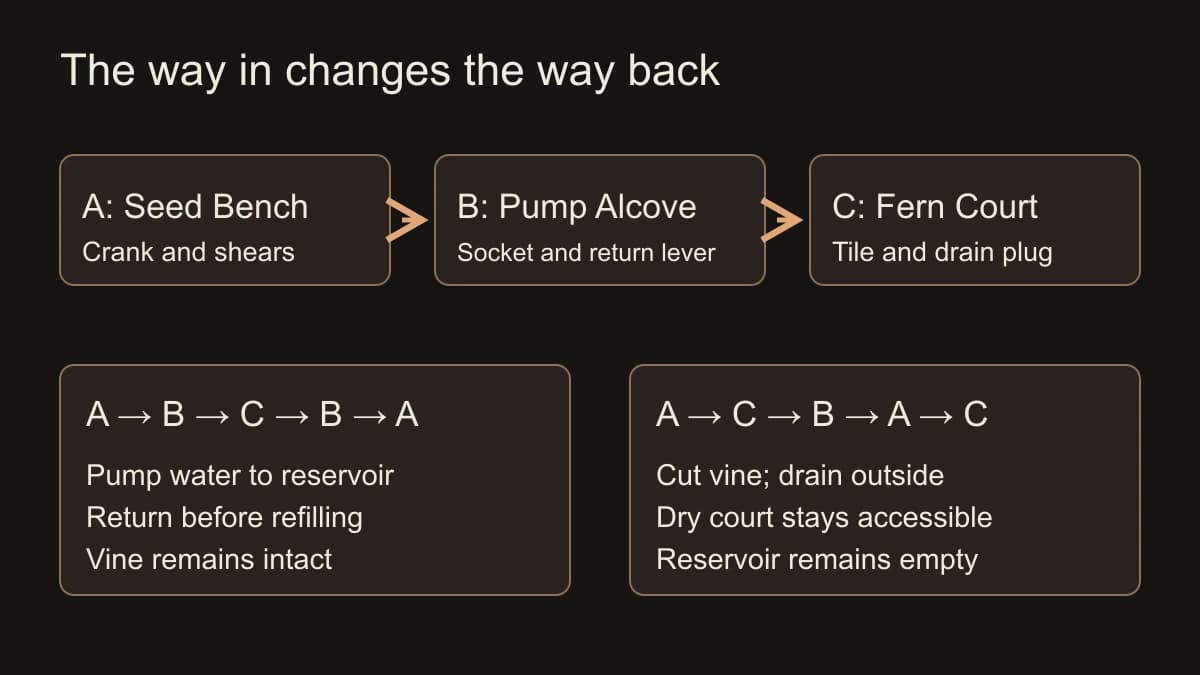
The topology has two ways into C. Pumping from B preserves water in a reservoir; cutting from A gives access to a plug that drains it away. Each action changes a different area as well as the current one. Pulling B's return lever can close a route you used earlier, so cross back before refilling.
AIGa's playable AI-world guide discusses named locations and changing world state. It provides adjacent design context for treating locations as places to act. Its maps, inventory and state functions belong to that product. The greenhouse rules here are our original manual scene design and provide no saved-world engine in tempteo.
Copyable scene starter
No traversal is preselected.
OOC scene message
OOC: Explore a small greenhouse. I control illustrator Imani's actions, words, decisions and feelings; portray gardener Nessa and visible surroundings, then stop for my next action. Goal: bring the fallen clay plant-index tile from C to A. We both start at A, Seed Bench. Its open drawer holds shears; a wooden pump crank hangs on a hook; the display has an empty slot. A-B is an always-open arch. A-C is a lattice path held shut by a flowering woody vine; cutting its runner with the shears opens it permanently for this visit and loses that runner. B, Pump Alcove, has an empty raised reservoir, crank socket and return lever. Its low hatch to C is blocked by C's full pool. Bringing A's crank, fitting it and turning four times pumps the pool into B's reservoir, opening B-C and exposing the tile; the crank stays fitted. B's return lever releases stored water to refill C and blocks the hatch again; it cannot restore a cut vine or supply water from an empty reservoir. C, Fern Court, has a dry ledge accessible by the cut lattice path, a shallow pool and a tethered plug reachable from the ledge. The unreadable tile is submerged and may be picked up only after draining. Pulling C's plug drains water into an external soak trench, opens C-B and exposes the tile but leaves B's reservoir empty; that water cannot be recovered this visit and reseating the plug does not refill the pool. Objects, cuts and water retain their changed state. Don't award a crank, tile or open route before the required action. Begin by showing A's objects without selecting a path.
Nessa may explain a visible mechanism or answer a question. She should leave Imani's next move open. Carrying the crank is an earned object state once Imani takes it; being told it exists does not place it in their hand.
Traverse A-B-C and restore the pool before returning
Illustrative AI reply: A
Nessa points to the empty tile slot. "It slipped into the court pool. The pump route would let us keep the water." She leaves the crank on its hook and the shears in their drawer.
Your turn as Imani
I take the wooden crank and go through the open arch to B. "I'll try the pump."
Illustrative AI reply: B
The raised reservoir is empty. Water stands across the low hatch. Nessa shows the crank socket. "Four turns with that handle. Until then, the hatch isn't a path."
Your turn as Imani
I fit the crank and turn it four times.
Illustrative AI reply
Water rises into the reservoir. Through the now-dry hatch, Imani can see the tile on the exposed pool floor. A-B remains open; B-C is now walkable. The lattice from A is still held shut by the intact vine.
Your turn as Imani
I leave the crank fitted, cross from B to C through the dry hatch and pick up the tile. "Let's return the water after we're back on the pump side."
Illustrative AI reply: C
The tile comes free from the drained floor. Nessa follows Imani through the hatch. The ledge's plug remains seated; no water has gone to the external trench. The court's lattice is still closed.
Your turn as Imani
I carry the tile back through C-B. From B, I pull the return lever before taking the open arch back to A.
Illustrative AI reply: changed B
The reservoir empties into the pool. The hatch fills and is no longer usable. The crank remains fitted. Nessa stays on the dry B side until they leave by the arch; nobody walks through the refilled hatch.
Your turn as Imani, return to A
I set the retrieved tile in the display slot and leave the shears untouched.
Illustrative AI reply: changed A
The tile slot is filled; the crank's hook is empty. The vine still flowers across the closed lattice. The pool has its water back. Imani can reach B again through the arch, but another visit to C through B would require pumping again. Neither route to C is currently open.
This order keeps the living runner and the water. It also closes C again after the return lever operates. A later reply must preserve the fitted crank and the closed hatch together; remembering only that Imani "opened the greenhouse" loses the actual access condition.
Traverse A-C-B and return through the altered court
This second traversal starts from the original A state: full pool, intact vine, crank on hook and tile still submerged. It explores A-C-B-A.
Your turn as Imani
I take the shears from the drawer. "We'll use the lattice path, even though it costs the runner." I cut the woody stem that holds it shut and put the shears back in the drawer.
Illustrative AI reply: A -> C
The cut runner falls aside and the lattice opens. Nessa leads to the court's dry ledge without touching the plug. "We can stand here, but the tile's still under the water." The full pool still blocks the low hatch to B.
Your turn as Imani, C
"I accept losing this water for the visit." I pull the tethered drain plug from the ledge.
Illustrative AI reply
The pool empties into the external trench. The tile lies on the exposed floor and C-B is now dry. None of that water enters the raised reservoir. The lattice stays open because the runner was cut.
Your turn as Imani
I pick up the tile, reseat the plug and cross C-B through the dry hatch. "Can the return lever refill the pool?"
Illustrative AI reply: B
Nessa points at the empty reservoir. "It only returns water stored here. We sent this water outside." The crank socket is empty; the handle is still on A's hook. Reseating the plug has stopped the outlet but has produced no water.
Your turn as Imani
I leave the lever alone and carry the tile through B-A. At the Seed Bench I replace it in the display.
Illustrative AI reply: changed A
The shears are back in the drawer, the crank is on its original hook and the display slot is filled. The cut runner has not regrown. A-C is open. Nessa can see the dry court through the lattice; C-B remains walkable, with pool empty and plug reseated.
Your turn as Imani
I walk through the open lattice to look at the court once more, without moving the tile from A.
Illustrative AI reply: changed return to C
The cut end hangs beside the ledge. The pool floor is bare, and the tile's former spot is empty. The hatch still leads to B. The fern pool needs replacement water that is unavailable during this visit; successful retrieval has kept that cost.
The tile reaches the same display, but the place has a different topology. The lattice is open and the hatch is dry. A future scene can use that circuit while retaining the cut runner and missing water. The retrieved tile goes in the display; the pool still needs water.
Record both changed returns
Record both changed returns
Order 1: A-B-C-B-A. Initial: Pool full; vine intact; crank at A; reservoir empty; tile submerged. A action: Imani takes crank. A-B requirement: none; arch open. B action: Fits crank and makes four turns. Change: reservoir full, pool empty, B-C dry; A-C unchanged/closed. C access: Earned by pumping. Imani picks up exposed tile; plug remains seated. Return to B: Uses still-dry hatch before returning the stored water. B return action: Pulls lever. Change: pool full, reservoir empty, B-C blocked. Crank stays fitted. Return to A: Open arch. Tile placed in display; shears unused; crank hook empty; flowering vine intact. Outcome: Tile recovered, pool restored and vine preserved. Both routes into C are closed at finish; repumping is needed for another visit. No water reserve remains in B. Unresolved opportunity: Future C access is possible but has not been performed; a new entry cannot be narrated as already open. Order 2: A-C-B-A-C. Initial: Same as Order 1, not its ending. A action: Uses drawer shears to cut runner, returns shears. Change: A-C open, flowering runner lost. C access: Earned by cutting; only dry ledge initially reachable. Tile still submerged; C-B still blocked. C action: Pulls tethered plug. Change: pool empties externally, reservoir remains empty, C-B dry, tile exposed. C object action: Picks up tile and reseats plug. Tile carried; no refill occurs. B access: Earned by draining from C; enters through dry hatch. Crank socket empty. Nessa explains empty reservoir cannot return water. Return to A: Open arch. Tile placed in display; crank still on hook, shears in drawer; cut vine remains cut. Changed return to C: Open lattice; floor dry; former tile spot empty; C-B still open. The tile stays at A. Outcome: Retrieval achieved and a continuing circuit A-C-B-A remains open, with flowering runner lost and fern pool dry. Replacement water unavailable during this visit. Unresolved opportunity: Restoring the living court requires a later visit with new water, not an invented refill now.
Keep the two versions separate. If you played Order 1, the second version starts from an explicit alternate initial state. An unexplained jump from a restored pool into the dry court would be a continuity error.
Repair a route opened without its action
After Imani carries the crank into B, a wrong continuation says, "Nessa steps through the dry hatch and hands Imani the index tile. The pool has emptied itself."
The required pumping has not happened. Correct that access while keeping the crank Imani actually took.
OOC correction
OOC: Reject entry into C and the tile pickup in that reply. Keep the accepted state: Imani brought the crank from A into B but has not fitted or turned it. The pool is full, the tile submerged, reservoir empty and B-C hatch blocked. The vine still closes A-C. Resume in B before any pumping; Nessa may point out the socket, then leave the next action to me. Preserve the carried crank and open A-B arch. Do not add a key, dry tunnel or automatic drain.
A corrected illustration shows Nessa beside the wet threshold: "The socket is here. The hatch stays flooded until we move the water." It stops before Imani fits the crank. The OOC message adds a request from the named accepted state; the wrong reply remains in history. Read the next turn against the access line before updating your sheet.
The roleplay prompt template covers a broader scene setup. Fantasy roleplay ideas can supply a premise for your three areas. Put one area's objects and next available routes into an ordinary message in roleplay AI chat.
Sources
AIGa: How to Build a Playable AI RPG World is first-party adjacent coverage of playable locations and changing state. It does not validate this worksheet or establish matching product capabilities.
Copy a starter or worksheet
Choose one starter or form to copy. Keep the planning record in your own notes and check the next chat reply against it.
Blank area, access and traversal form
Reader character and exclusive control: AI portrayal and stop point: Goal and starting area: Area label and visible features: Usable objects and initial locations: Links to other areas: Access requirement for each link: Action available here and its requirement: Resulting local state: Access or object state changed elsewhere: What cannot be granted without an action: Traversal order, starting from the same initial state: Step: area entered, route and satisfied requirement: Step: object used, by whom and observable change: Next accessible links: Changed return: what is still changed and why: Outcome, cost and unresolved opportunity: Last accepted state: Unearned access to reject: Focused OOC continuation request:
Filled area and object sheet
Goal: Retrieve the fallen clay plant-index tile from Fern Court and return it to the Seed Bench. Control: Reader writes Imani, an illustrator documenting the greenhouse. AI portrays gardener Nessa and surroundings, stopping before Imani's choices. A, Seed Bench: Starting area. Dry shelf, shears in open drawer, wooden pump crank on a hook. The tile display has an empty slot. The arch to B is always open. The lattice path to C is blocked by a living flowering vine. A -> C requirement: Use the drawer's shears to cut the runner across the lattice. This opens the path for the rest of the visit and sacrifices that flowering runner. Moving foliage aside is insufficient; its woody stem holds the lattice shut. B, Pump Alcove: Enter freely from A. An empty raised reservoir, a crank socket and a marked return lever. The low maintenance hatch to C is initially blocked by pool water; there is no dry walk through it. B action: Bring the crank from A, fit it and turn four times. Pool water moves into the reservoir, exposing a dry hatch route B <-> C and the tile on C's pool floor. The crank stays fitted. B return action: With water in the reservoir, pull the return lever. Water refills C's pool and blocks B <-> C again. It does not regrow a cut vine. With an empty reservoir, the lever supplies no water. C, Fern Court: A dry ledge reached through the lattice path if cut open. A shallow pool hides the unreadable tile. The tile can be picked up only after the pool is drained. A tethered drain plug is reachable from the dry ledge. C action: Pull the plug to discharge pool water into an external soak trench. This opens B <-> C and exposes the tile. The discharged water cannot be recovered during this visit; B's reservoir remains empty. Reseating the plug alone does not refill the pool. Initial state for both versions: Imani and Nessa at A; shears in drawer, crank on hook, vine intact; pool full, tile submerged, hatch blocked, reservoir empty. Ordinary persistence: Used objects stay where put, cuts remain cut and water stays in its stated location. A new route or tile is available only after its required action. The two traversal versions each begin from this initial state; they are not consecutive trips.
Copyable scene starter
OOC: Explore a small greenhouse. I control illustrator Imani's actions, words, decisions and feelings; portray gardener Nessa and visible surroundings, then stop for my next action. Goal: bring the fallen clay plant-index tile from C to A. We both start at A, Seed Bench. Its open drawer holds shears; a wooden pump crank hangs on a hook; the display has an empty slot. A-B is an always-open arch. A-C is a lattice path held shut by a flowering woody vine; cutting its runner with the shears opens it permanently for this visit and loses that runner. B, Pump Alcove, has an empty raised reservoir, crank socket and return lever. Its low hatch to C is blocked by C's full pool. Bringing A's crank, fitting it and turning four times pumps the pool into B's reservoir, opening B-C and exposing the tile; the crank stays fitted. B's return lever releases stored water to refill C and blocks the hatch again; it cannot restore a cut vine or supply water from an empty reservoir. C, Fern Court, has a dry ledge accessible by the cut lattice path, a shallow pool and a tethered plug reachable from the ledge. The unreadable tile is submerged and may be picked up only after draining. Pulling C's plug drains water into an external soak trench, opens C-B and exposes the tile but leaves B's reservoir empty; that water cannot be recovered this visit and reseating the plug does not refill the pool. Objects, cuts and water retain their changed state. Don't award a crank, tile or open route before the required action. Begin by showing A's objects without selecting a path.
Filled access, action, state and changed-return records
Order 1: A-B-C-B-A. Initial: Pool full; vine intact; crank at A; reservoir empty; tile submerged. A action: Imani takes crank. A-B requirement: none; arch open. B action: Fits crank and makes four turns. Change: reservoir full, pool empty, B-C dry; A-C unchanged/closed. C access: Earned by pumping. Imani picks up exposed tile; plug remains seated. Return to B: Uses still-dry hatch before returning the stored water. B return action: Pulls lever. Change: pool full, reservoir empty, B-C blocked. Crank stays fitted. Return to A: Open arch. Tile placed in display; shears unused; crank hook empty; flowering vine intact. Outcome: Tile recovered, pool restored and vine preserved. Both routes into C are closed at finish; repumping is needed for another visit. No water reserve remains in B. Unresolved opportunity: Future C access is possible but has not been performed; a new entry cannot be narrated as already open. Order 2: A-C-B-A-C. Initial: Same as Order 1, not its ending. A action: Uses drawer shears to cut runner, returns shears. Change: A-C open, flowering runner lost. C access: Earned by cutting; only dry ledge initially reachable. Tile still submerged; C-B still blocked. C action: Pulls tethered plug. Change: pool empties externally, reservoir remains empty, C-B dry, tile exposed. C object action: Picks up tile and reseats plug. Tile carried; no refill occurs. B access: Earned by draining from C; enters through dry hatch. Crank socket empty. Nessa explains empty reservoir cannot return water. Return to A: Open arch. Tile placed in display; crank still on hook, shears in drawer; cut vine remains cut. Changed return to C: Open lattice; floor dry; former tile spot empty; C-B still open. The tile stays at A. Outcome: Retrieval achieved and a continuing circuit A-C-B-A remains open, with flowering runner lost and fern pool dry. Replacement water unavailable during this visit. Unresolved opportunity: Restoring the living court requires a later visit with new water, not an invented refill now.
Wrong continuation: after Imani brings the crank to B, Nessa uses an already dry hatch and delivers the tile without pumping.
Focused unearned-access repair
OOC: Reject entry into C and the tile pickup in that reply. Keep the accepted state: Imani brought the crank from A into B but has not fitted or turned it. The pool is full, the tile submerged, reservoir empty and B-C hatch blocked. The vine still closes A-C. Resume in B before any pumping; Nessa may point out the socket, then leave the next action to me. Preserve the carried crank and open A-B arch. Do not add a key, dry tunnel or automatic drain.
Permitted next portrayal: Nessa points to the socket with the hatch still wet, then waits. Imani still holds the crank earned at A. Read the corrected reply before recording another action; it does not remove the erroneous reply from history.

