Practice asking for clarification in English with AI
When an instruction is unclear, ask about the missing detail and repeat the answer in your own words. An AI character can play the other speaker while you rehearse. Try the three short exchanges below, covering a deadline, an entrance and an item to bring.
Updated by the tempteo editorial team
The writing examples below are invented. They illustrate the advice and are not recorded chat results.
On this page
Set up a short roleplay
Choose one uncertainty, such as what 'by Friday' means. Write down the intended answer, give it to the character, and ask it to start with the unclear instruction. You write your own questions and replies.
Knowing the answer lets you focus on wording. This is practice, rather than a blind test. The character may reveal the answer early or change the facts, so keep your notes handy. All three exchanges below are invented examples.
clarification starter
OOC: Help me practice asking for clarification in English. You are an event coordinator; I write my own replies. Start with: "Please send me the volunteer list in our event chat by Friday." The fixed answer is before 12 noon on Friday, in our shared local time. Begin with only that instruction. Wait for my question, answer using those facts, then wait for my confirmation. After I finish, check whether I understood. Save wording feedback for the end and do not give me a language level.
Ask about the detail you need
Instead of 'I don't understand', name the part that is unclear. If you understand the words but need a deadline, ask for a time. If two entrances could fit, name both.
A question about permission and a question about timing can get different answers: 'Can I send it Friday?' and 'What time on Friday do you need it?' Ask whichever resolves your uncertainty. If the answer still leaves something unclear, ask again before confirming.
- Meaning: What do you mean by the final version?
- Choice: Do you mean the entrance near the cafe or beside the bicycle racks?
- Deadline: Is Friday acceptable, and what time do you need it?
- Repetition: Could you repeat the part about where we meet?
- Confirmation: So I should bring only the printed list, correct?
1. Pin down a deadline
The fixed answer is to send the volunteer list in the event chat before 12 noon on Friday. The speakers share a local time zone. The follow-up resolves what 'by Friday' means, and the confirmation repeats the action and cutoff.
In a real exchange across time zones, clarify the zone too. Before noon means earlier than noon, rather than at noon or Friday evening.
Example: complete exchange: deadline
AI: Please send me the volunteer list in our event chat by Friday. You: Is Friday acceptable, and what time do you need the list? AI: Friday is fine, but I need it before 12 noon, in our shared local time. You: So I should send the volunteer list in the event chat before 12 noon on Friday. Is that right? AI: Yes, that is right.
2. Correct a misunderstanding
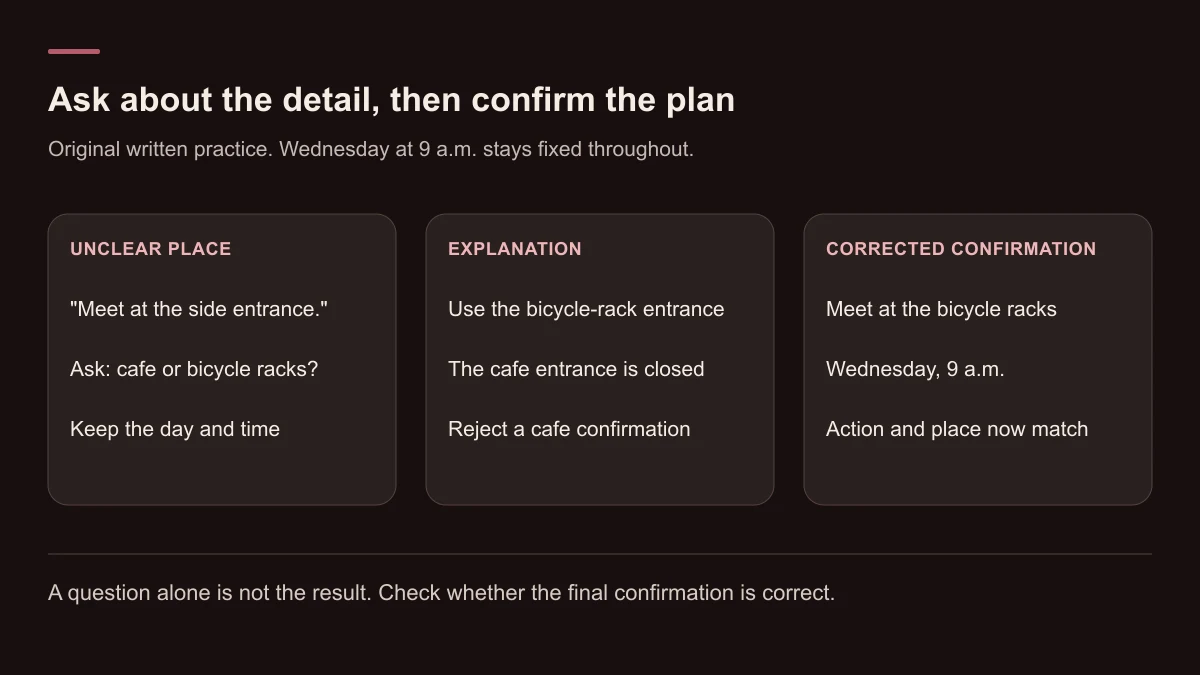
The plan is Wednesday at 9 a.m., at the entrance beside the bicycle racks. The cafe entrance is closed. Here the learner asks a useful question but then repeats the wrong place. The final reply corrects the entrance while keeping the day and time.
Example: complete exchange: wrong entrance repaired
AI: Meet me at the side entrance on Wednesday at 9 a.m. You: Do you mean the entrance near the cafe or the one beside the bicycle racks? AI: The one beside the bicycle racks. The cafe entrance will be closed. You: Okay, I'll wait at the cafe on Wednesday at 9 a.m. AI: Not the cafe. Please use the entrance beside the bicycle racks. You: Thanks for correcting me. I'll meet you at the entrance beside the bicycle racks on Wednesday at 9 a.m., not at the cafe. AI: Yes, that matches the plan.
3. Ask which item to bring
The coordinator needs only the printed list at the welcome desk on Thursday at 10 a.m. The list and laptop are on a table; the folders are in a cupboard. Asking about 'materials' tells you which item to take and which to leave.
Example: complete exchange: item
AI: Could you bring the materials to the welcome desk on Thursday at 10 a.m.? You: Which materials do you need: the printed list, the folders or the laptop? AI: Just the printed list. Leave the folders in the cupboard and the laptop on the table. You: I'll bring only the printed list to the welcome desk on Thursday at 10 a.m. The folders and laptop will stay where they are. Is that right? AI: Yes, just the printed list.
Check the meaning, then improve the wording
Compare your final confirmation with the scenario notes: action, time, place and item. For the entrance example, it should say bicycle racks, Wednesday and 9 a.m. If an essential detail was never specified, ask for it.
If the character changes noon to evening or accepts the closed cafe, point out the change and restate the original facts. That is a change to the scenario, rather than a language error you made. If it keeps happening, use the printed exchange or practice with a person.
Once the meaning matches, ask for one shorter or more natural question. Check that the rewrite still asks the same thing. For a grammar judgment or formal assessment, use a teacher or reliable language reference.
check-understanding worksheet
Scenario and fixed answer: Detail I needed to clarify: My question: Speaker's explanation: My final confirmation: Do the action, time, place and item match? Anything still unclear? Mistake and correction, if any: Did the AI change the facts? One wording change to check:
focused-feedback request
OOC: Compare my final confirmation with the original scenario and your explanation. Check the action, time, place and item, and quote any mismatch. Then suggest one shorter question that keeps my meaning. Do not give an exam grade or CEFR level.
Try it with a tempteo character
Choose a character, open a text chat and send the starter. If it writes your reply, ask for the coordinator's line only. Request another scenario when you want another round. These are instructions for an ordinary chat, rather than a teacher mode.
Ross Thorburn's September 2024 Hong Kong TESOL article discusses role cards, clarification questions and reflection, and recommends checking AI-generated materials. It provides teaching background for these exercises; it does not measure results on tempteo.
This exercise practices written exchanges. It cannot assess listening, pronunciation, exam readiness or a certified language level. For more everyday situations, see conversation practice with AI.

