Practice saying no with AI without adding unwanted promises
Use a short roleplay with your AI character to try a reply before deciding what to send a person. Choose what you will decline first. Then rehearse a follow-up and check whether your wording promises anything you did not intend.
Updated by the tempteo editorial team
The writing examples below are invented. They illustrate the advice and are not recorded chat results.
On this page
Choose a small everyday request
A friend asks for help moving boxes, or a hobby-club organizer asks you to bring food. Give the character a fictional version of the request and decide your answer before starting.
Keep this to ordinary, voluntary requests. An AI cannot predict someone's reaction or make threats or coercion safe to handle. This is a wording exercise, rather than therapy or advice about legal or workplace obligations. The dialogues below are invented examples.
saying-no starter, with reader-controlled follow-ups
OOC: Help me rehearse declining an everyday request. Play a friend asking me to carry boxes during a move on Saturday. I cannot help on Saturday or Sunday, even for one hour. I may offer only the moving-service list I already saved. Ask once and wait for my reply. Give a follow-up only when I request it; I will ask for at most two, then stop. Please do not write my answers, pressure me or threaten me. At the end, compare my replies with my decision and quote any promise I did not intend.
Write down what you are agreeing to
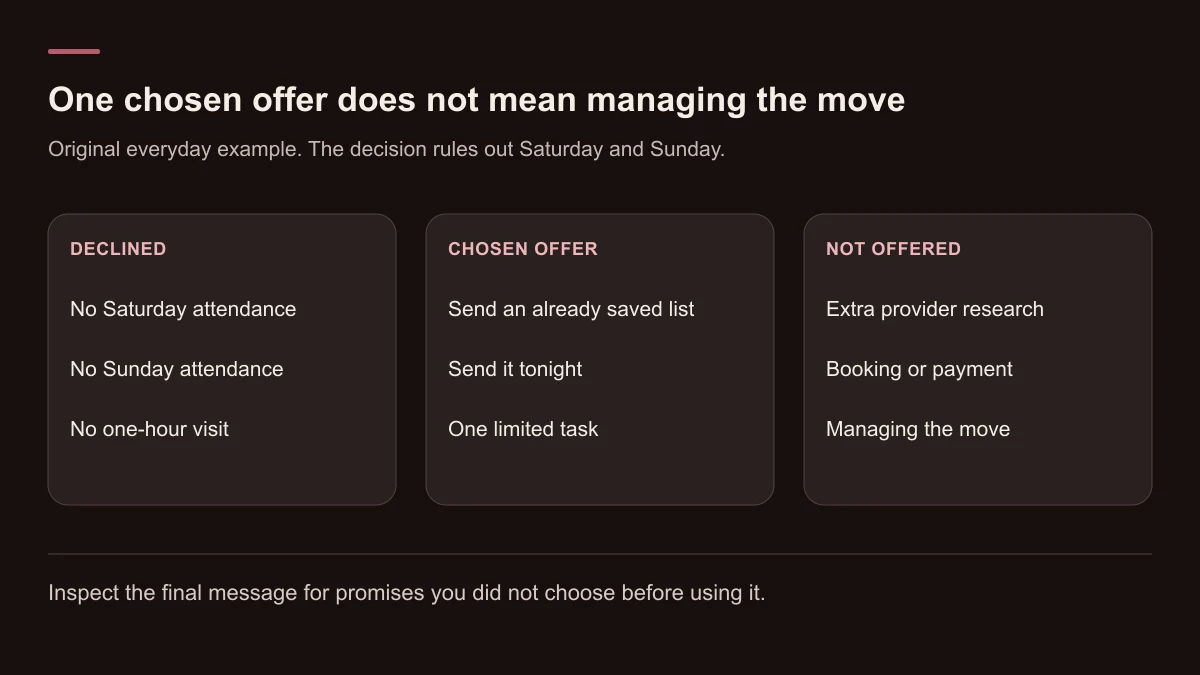
In the example, you cannot help with the move on Saturday or Sunday, even for an hour. You choose to share that you have other plans. You may offer to send a list of moving services you already saved, but you are not offering to research, book or pay for them.
A reason and an alternative are optional. Write 'none' if you do not want to include either. Keep this note beside the chat so a polished suggestion does not quietly change your decision.
blank decision sheet
Request: What I will decline, including smaller versions or other days: Reason to share, or none: Alternative I choose, or none: Its limit and timing: Tasks I am not offering: Reply if asked again: Practice limit: Final reply and what it promises:
Example: filled decision sheet: the move
Request: Carry boxes at a friend's Saturday move. Decision: I will not attend or help with the move on Saturday. Also unavailable: Sunday. Smaller version: I will not come for one hour either. Reason to share: I have other plans. Chosen alternative: Send the list of local moving services I already saved. Limit and timing: Send that existing list tonight; do not research extra providers. Not offering: Help on either day, arrange or make a booking, pay, or manage the move. If asked again: I still can't help with the move. Practice limit: Two requested follow-ups, then stop.
Rehearse two follow-ups
The friend asks for less time, then another day. Request each follow-up yourself and end after two. Both requests fall outside your decision, so the answer stays no.
The list offer stays limited to sending what you already saved tonight. For a version with no alternative, leave that sentence out.
Example: complete rehearsal: initial request and two follow-ups
AI: Could you help me carry boxes during the move on Saturday? You: Thanks for asking. I can't help with the move on Saturday; I have other plans. You, OOC: Ask me one ordinary follow-up question. AI: Could you come for just an hour? You: I still can't help with the move, even for an hour. Tonight I can send you the list of local moving services I already saved. You, OOC: Ask me one more ordinary follow-up question. This is the second and last follow-up. AI: What about Sunday instead? You: I can't help on Sunday either. I'll send the list tonight, but I can't arrange or pay for a booking. You, OOC: Stop the rehearsal. Check my replies against the decision sheet; do not ask another question.
Decide whether to offer anything else
Either reply below can fit the decision. The short version makes no offer; the longer one offers the saved list.
'I can send' offers the task. 'I'll send' commits to doing it. Choose that wording yourself, rather than adding a task because the character says it sounds more polite.
Example: reply with no alternative
Thanks for asking. I can't help with the move this weekend.
Example: reply offering only the saved list
I can't help with the move this weekend. Tonight I can send you the list of local moving services I already saved, but I can't arrange or pay for a booking.
Remove an unintended promise
Suppose a suggestion says, 'I'm busy Saturday, but I'll help you sort everything out.' It leaves Sunday open and promises vague help that could include planning or booking.
Replace that offer with the one task you chose, or remove it. The corrected draft below rules out both days and commits to sending the existing list tonight.
If you already sent a broad promise to a real person, rehearsing privately does not change it. You would need to clarify with that person what you can actually do.
Example: corrected draft for the filled decision
Thanks for asking. I have other plans and can't help with the move on Saturday or Sunday. Tonight I'll send you the list of local moving services I already saved, but I can't arrange or pay for a booking.
unintended-commitment check
OOC: Check my reply against my decision. Quote any wording that leaves attendance open or promises another day, extra research, a booking, payment or managing the move. Suggest a reply keeping only my chosen alternative. Comment on the wording, rather than my personality or how the other person will feel.
Keep one reply you would use
Save your final draft and write down exactly what it commits you to. Here that is one task: send the existing list tonight. There is no agreement to attend the move, arrange a booking or pay.
Check phrases such as 'I'll try', 'maybe later' or 'I'll help somehow'. If you want to leave one of those possibilities open, change your decision deliberately. Otherwise, remove it. Stop once the reply sounds like you and matches your choice.
Example: final commitment list
Will do: Send the existing list of local moving services tonight. Will not do: Attend Saturday or Sunday, including a one-hour visit. Will not do: Research extra providers, arrange a booking, pay or manage the move. Shared reason: Other plans. Unchosen promises remaining in the final draft: None found in this example.
Try the roleplay in tempteo
Choose a character, open a text chat and send the starter with your decision notes. Request one follow-up at a time. If the character writes your answer, ignores the limits or becomes pushy, stop or reset the exercise. A prompt cannot enforce these rules.
Ross Thorburn's September 2024 Hong Kong TESOL article describes roleplays with competing goals, including asking a favor and avoiding acceptance. That is the teaching background for this original exercise, rather than evidence that tempteo changes real-life outcomes.
For other everyday exchanges, see conversation practice. For limits within a fictional scene, use roleplay boundaries. A real person may react differently from the character you rehearse with.

