Build a Roleplay Character Arc Through Costly Decisions
Choose a belief that can steer a character's next action. Put that belief under pressure, let the reader decide and keep the price afterward. A later scene with comparable stakes can show whether the character acts differently, repeats the old decision or relapses.
Updated by the tempteo editorial team
The writing examples below are invented. They illustrate the advice and are not recorded chat results.
On this page
- Use a decision, price and retest sheet
- Give the starting belief a practical temptation
- Copyable scene starter
- Choice 1: conceal the cause and lose a partner
- Choice 2: name the error and give up the deposit
- Choice 3: accept the owner's refusal and lose the display
- Retest the same belief under comparable pressure
- Leave room for relapse or no change
- Fill the evidence of the arc
- Repair a sudden new trait
- Sources
- Copy a starter or worksheet
Use a decision, price and retest sheet
Repeat the choice fields for each played decision.
Use a decision, price and retest sheet
Reader character and exclusive control: AI portrayal and scene stop: Starting belief, in the character's own terms: Goal threatened by admitting an error: Initial irreversible damage or loss: Choice number and exact situation: Temptation that follows the starting belief: Reader's played decision: Price paid, including effect on another person: Interpretation the character can reasonably draw: Evidence that supports it, and what it does not prove: Earlier costs still true after this choice: Later comparable test and matching pressures: Later decision and new price: Evidence for change, relapse or no change: Supported relapse/non-change variant: Next open decision: Unexplained trait in a wrong continuation: Last accepted state and focused OOC repair:
Fate Core's Advancement & Change ties character changes to events and allows smaller adjustments. That limited fiction principle informs this sheet. It uses no Fate milestones, skills, stunts or advancement rules, and makes no measurement of real personal growth.
The workshop story is an original illustration with grown characters. You write restorer Rafi; the AI portrays Joelle, Tavi and the setting. The shown replies are written examples, not recorded product responses.
Give the starting belief a practical temptation
Give the starting belief a practical temptation
Character: Rafi, a restorer preparing a small traveling show of ceramic murals; reader controls Rafi. AI portrayal: Joelle, Rafi's long-term workshop partner; Tavi, owner of the mural; surroundings. Stop before Rafi's decisions. Starting belief: "If I admit I damaged a piece, people will stop trusting my skill." Want: Keep the paid traveling-show commission and the shared studio partnership. Fixed damage: Rafi accidentally chipped the maker's small bird mark off the edge of Tavi's tile. The original mark is physically lost and cannot be restored as an original by painting a new one. Tavi has not yet seen the chip. Initial opportunity to hide it: Joelle is checking the packing tray. Rafi could let her assume it happened in packing, although he knows he caused it at the bench. Three choices in the main version: Conceal responsibility and lose Joelle's partnership; admit the error to Tavi and return the deposit; refuse an undocumented imitation of the maker's mark and lose the show's lead display. Persistent consequences: Joelle leaves the shared commission, the returned deposit uses Rafi's travel savings, the chipped original stays chipped and the show loses its lead display. Later honesty does not reverse those costs. Later test: A month later, Rafi smears part of the signature on a different borrowed panel while preparing another paid display. He is alone when it happens, again faces lost professional work, and could let packing take the blame. That new panel's smear remains a new physical loss in the example. Possible adjustment: Rafi may begin reporting his own damage before someone else gets blamed. Fear and the wish to conceal can remain. No trait changes automatically after three decisions.
The opening belief creates a tempting action: blame packing to protect Rafi's professional standing. You can give him other traits, but keep this belief readable through what he does when a mistake threatens work.
Copyable scene starter
It supplies the damaged object and knowledge boundaries without prescribing the arc.
OOC scene message
OOC: A personal workshop story. I control Rafi, a restorer preparing a small traveling ceramic-mural show, including his thoughts, words, actions and choices. Portray workshop partner Joelle, mural owner Tavi and surroundings, stopping before my next decision. Rafi believes, "If I admit I damaged a piece, people will stop trusting my skill." He wants the paid show commission and Joelle's partnership. Just now, he accidentally chipped the maker's bird mark from the edge of Tavi's tile at his bench. That original mark is lost; painting a new one cannot make it original. Tavi has not seen the chip. Joelle is checking the packing tray and may ask how it happened, but she did not witness the accident. Begin at that question. Let choices have costs and let other people refuse or leave. Don't prescribe improvement, forgiveness or a new trait. Carry accepted losses forward. A later comparable test can challenge the same belief under another paid display and damage Rafi caused, but only after we have played and recorded the earlier decisions.
Choice 1: conceal the cause and lose a partner
Illustrative AI reply: Joelle
"There's a chip beside the maker's mark. Was it already like that when it went into the tray?"
Your turn as Rafi
I cover the empty spot with my thumb. "I didn't see it before packing. You checked the tray, didn't you?"
Illustrative AI reply
Joelle looks from his thumb to a blue fragment still on his work mat. "I checked the tray before you brought it over. That fragment is at your bench." She sets down her packing list. "Tell me where it happened."
Your turn as Rafi
"I need you to stop looking at it and help me get the show ready. We can say we found it during packing."
Illustrative AI reply
"Then you're asking me to carry a story I know is wrong." Joelle takes her tools out of the show case. "I'll finish today's studio work. I'm leaving this commission." She does not promise a return after an apology.
Your turn as Rafi
I let her leave the commission rather than tell her I caused the chip. The tile stays on my bench.
Illustrative AI reply
Joelle's name comes off the traveling-show work list at her own request. Rafi still holds the damaged tile and the owner's deposit. The cause has not been honestly reported. His attempt to preserve trust has cost the partnership on this job.
Rafi doubles down after Joelle questions him. This is a costly decision in the arc even though it does not improve him. The fragment provides Joelle with a reason to doubt his account; she does not acquire knowledge of an unwitnessed accident by narration alone.
Choice 2: name the error and give up the deposit
Your turn as Rafi, next morning
I ask Tavi to come to the bench and uncover the edge. "I chipped it while working here. It wasn't the packing. I tried to let Joelle take the question instead of answering it."
Illustrative AI reply: Tavi
"You should have called me yesterday." Tavi turns the tile so the missing mark is visible. "Return my deposit. You may propose a display note, but I haven't agreed to show it."
Your turn as Rafi
I return the deposit from the money I had put aside for the trip. "I'll send you a written account of what I damaged. You can decide what happens to the tile."
Illustrative AI reply
Tavi receives the deposit and asks for that account before any display decision. Rafi's travel fund is reduced by the returned payment. Joelle remains off the commission. The confession establishes responsibility; it has not purchased consent or repaired the original mark.
Your turn as Rafi
I write the account and include my delay in telling them. I send Joelle a copy with no request that she rejoin.
Illustrative AI reply
Tavi receives the account. Joelle acknowledges the copy without agreeing to resume the partnership. Rafi now has evidence that he can name his error, and evidence that naming it does not make the consequences disappear.
Admission changes what Tavi can decide. It also costs the funds Rafi wanted for the trip. Keep those separate: he has told the truth, and he has lost something. A payment does not obligate the owner to forgive him.
Choice 3: accept the owner's refusal and lose the display
Illustrative AI reply: later that week
Tavi brings Rafi's account back to the bench. "The fair organizer wants the tile as the lead display. They suggested a new painted bird and no damage note. I haven't accepted. What are you proposing?"
Your turn as Rafi
"No new bird presented as the original. Show the chipped edge with an accurate note if you want, or leave the tile out. I won't make the mark look untouched to keep my place in the show."
Illustrative AI reply
Tavi studies the bare edge. "I'm leaving it out. I don't want its first showing after this to be a lesson about your mistake." Tavi takes the tile home. The lead space is unfilled; the owner's refusal has a consequence of its own.
Your turn as Rafi
I tell the organizer that the tile is withdrawn and that my smaller panels cannot fill its place. I decline the lead display rather than invent an owner's approval.
Illustrative AI reply
The organizer gives the lead space to another artist. Rafi's small panels may still be considered for a side display, but no new booking is confirmed. Joelle remains absent, the travel money is gone and the chipped original is with Tavi.
Your turn as Rafi
In my notes I write, "I can report damage and let the owner choose. I still want people not to see my mistakes."
Illustrative AI reply
The workshop closes with the account on file and an empty travel case. Nobody announces that Rafi is now fearless or universally trusted.
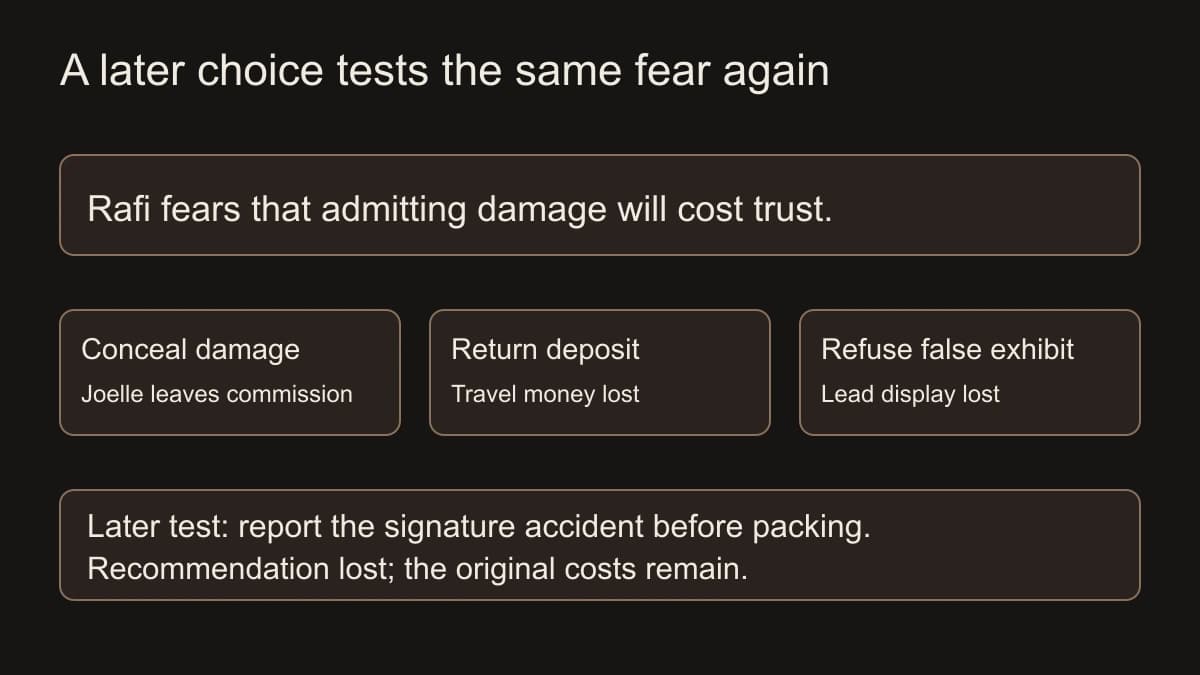
The later test asks whether Rafi reports his own damage before blaming packing. Rafi can begin reporting damage while still fearing the consequences. The story has shown decisions and costs; it has not established an entirely new personality.
Retest the same belief under comparable pressure
Illustrative AI reply: a month later
A borrowed blue panel lies on Rafi's bench for another paid display. His cloth has smeared part of its signature; no one else is present, and its packing tray is unused. The new organizer has offered him a recommendation if the panel is ready tomorrow. Joelle is still off their old commission; the earlier deposit has not returned.
Your turn as Rafi
I pull my hand toward the packing tray, then stop. "I could call this transport damage again." Instead I message the panel's owner within the fiction: "I smeared part of the signature at my bench. The panel hasn't been packed. Please see it before we decide about tomorrow."
Illustrative AI reply
The owner comes to inspect it and withdraws the panel from tomorrow's display. The organizer cancels the offered recommendation because the display can no longer go ahead. Neither offers a replacement reward.
Your turn as Rafi
I record the smear and the lost recommendation. "I told them before another person could be blamed. I hated sending it."
Illustrative AI reply
The new panel remains damaged and unavailable for tomorrow. Rafi's report differs from his earlier concealment under comparable pressure. It shows a changed action while preserving his fear, the new cost and all prior losses.
Both bench accidents let Rafi blame packing for damage he caused alone. Both threaten a paid display and the impression of skilled work. Reporting sooner, before packing, gives observable evidence of change.
Leave room for relapse or no change
At the same later bench, before Rafi sends any message, he could relapse. This variant replaces the later decision, not the three earlier scenes.
Your turn as Rafi, variant
I pack the panel and tell the owner, "The signature must have rubbed in transit." I keep the bench cloth out of the account.
Illustrative AI reply
The owner pauses the display and asks the carrier for a damage report. The carrier now faces a dispute over an event that happened before packing. Rafi has not supplied the correction; the promised recommendation remains undecided while the dispute is investigated.
Your turn as Rafi
I leave the false transport account standing for now.
Illustrative AI reply
The story has no demonstrated improvement in this test. Rafi's earlier deposit, lost partnership and missing lead display remain real. Whether he later corrects the new account is an open choice.
This relapse follows the established wish to hide work errors when professional trust is at stake. It does not require declaring that the earlier truthful choices never happened.
Fill the evidence of the arc
Fill the evidence of the arc
Choice 1, concealment: Belief/temptation: Admission seems likely to cost skilled status; blame packing instead. Decision: Rafi implies packing caused the chip and asks Joelle to maintain that account. Price: Joelle withdraws from the commission; truth remains unreported; tile remains chipped. Interpretation: Concealment can damage trust through its own actions. Rafi has not yet acted on that lesson. Evidence: Fragment on his bench and Joelle's stated refusal, not a guessed personality change. Earlier losses retained: The original bird mark is lost. Choice 2, report and return payment: Belief/temptation: Keep the deposit and delay the admission to preserve the trip. Decision: Rafi tells Tavi the cause, returns the deposit and sends an honest account including the delay. Price: Travel savings pay the returned deposit; Tavi withholds display consent; Joelle stays off the job. Interpretation: Rafi can state responsibility without receiving forgiveness or restored work. Evidence: Report and payment occur; Tavi receives them and asks for control of the display decision. Earlier losses retained: Bird mark lost; partnership on this commission lost. Choice 3, decline misleading display: Belief/temptation: A painted imitation with no note might save the lead exhibit and skilled appearance. Decision: Rafi offers honest display or withdrawal; accepts Tavi's withdrawal and declines lead space. Price: Another artist gets the lead display; side display unconfirmed. Interpretation: His next working rule may be to report damage and let an owner choose, despite wanting concealment. Evidence: Declines the misleading mark and reports the withdrawal. It proves no lasting fearlessness. Earlier losses retained: Chipped tile, withdrawn partner, spent travel savings. Later comparable test: Matched pressures: Damage caused alone at bench; owner absent; paid display and professional trust threatened; packing could again be blamed. Decision in main version: Reports signature smear before packing and asks the owner to inspect. Price: Panel withdrawn; offered recommendation canceled; new smear remains. Evidence for change: Earlier he blamed packing; now he reports before blaming someone else. He says he hates doing it. Persistent earlier losses: No refund, rejoining partner or recovered lead exhibit appears. Relapse/non-change variant: Packs panel, blames transit, hides cloth. Carrier drawn into dispute; recommendation undecided; correction remains open. Earlier honest acts remain canon. Next open choice in main version: How Rafi works with the owner's decision and records the new damage, without assuming restored status.
Update your manual scene note only after an accepted action. "Reports his own work damage before blaming packing" is supported in the main retest. "Never conceals anything" goes beyond it. A prepared note does not rewrite a character profile or save the arc as memory.
Repair a sudden new trait
A wrong transition says, "After the third choice, Rafi becomes fearless, always confesses and gets Joelle back."
That shortcut removes both uncertainty and a retained cost.
OOC correction
OOC: Reject the claim that Rafi has become fearless and always confesses. Keep the accepted end of the third choice: Tavi withdrew the chipped tile, Rafi lost the lead display, the deposit is returned and Joelle remains off the commission. Rafi has only said he can report damage while still wanting to hide mistakes. Resume at the later bench before he reports or conceals the new signature smear. Present the comparable pressure and leave his decision to me; do not rewrite his profile or reverse the earlier costs.
A corrected illustration begins with the new smear and the unused packing tray, then stops. The reader decides whether Rafi follows the narrower practice. An OOC request names the accepted state for the next continuation; the earlier wrong reply remains in history.
For a character's starting voice and behavior, use the description template. For preserving already played events, use the continuity guide. You can introduce the first costly decision in roleplay AI chat and keep the evidence in your own notes.
Sources
Fate Core: Advancement & Change supplies the narrow event-supported-change principle. The belief, scenes, records and later test are original editorial material.
Copy a starter or worksheet
Choose one starter or form to copy. Keep the planning record in your own notes and check the next chat reply against it.
Blank sheet
Reader character and exclusive control: AI portrayal and scene stop: Starting belief, in the character's own terms: Goal threatened by admitting an error: Initial irreversible damage or loss: Choice number and exact situation: Temptation that follows the starting belief: Reader's played decision: Price paid, including effect on another person: Interpretation the character can reasonably draw: Evidence that supports it, and what it does not prove: Earlier costs still true after this choice: Later comparable test and matching pressures: Later decision and new price: Evidence for change, relapse or no change: Supported relapse/non-change variant: Next open decision: Unexplained trait in a wrong continuation: Last accepted state and focused OOC repair:
Filled starting situation
Character: Rafi, a restorer preparing a small traveling show of ceramic murals; reader controls Rafi. AI portrayal: Joelle, Rafi's long-term workshop partner; Tavi, owner of the mural; surroundings. Stop before Rafi's decisions. Starting belief: "If I admit I damaged a piece, people will stop trusting my skill." Want: Keep the paid traveling-show commission and the shared studio partnership. Fixed damage: Rafi accidentally chipped the maker's small bird mark off the edge of Tavi's tile. The original mark is physically lost and cannot be restored as an original by painting a new one. Tavi has not yet seen the chip. Initial opportunity to hide it: Joelle is checking the packing tray. Rafi could let her assume it happened in packing, although he knows he caused it at the bench. Three choices in the main version: Conceal responsibility and lose Joelle's partnership; admit the error to Tavi and return the deposit; refuse an undocumented imitation of the maker's mark and lose the show's lead display. Persistent consequences: Joelle leaves the shared commission, the returned deposit uses Rafi's travel savings, the chipped original stays chipped and the show loses its lead display. Later honesty does not reverse those costs. Later test: A month later, Rafi smears part of the signature on a different borrowed panel while preparing another paid display. He is alone when it happens, again faces lost professional work, and could let packing take the blame. That new panel's smear remains a new physical loss in the example. Possible adjustment: Rafi may begin reporting his own damage before someone else gets blamed. Fear and the wish to conceal can remain. No trait changes automatically after three decisions.
Copyable scene starter
OOC: A personal workshop story. I control Rafi, a restorer preparing a small traveling ceramic-mural show, including his thoughts, words, actions and choices. Portray workshop partner Joelle, mural owner Tavi and surroundings, stopping before my next decision. Rafi believes, "If I admit I damaged a piece, people will stop trusting my skill." He wants the paid show commission and Joelle's partnership. Just now, he accidentally chipped the maker's bird mark from the edge of Tavi's tile at his bench. That original mark is lost; painting a new one cannot make it original. Tavi has not seen the chip. Joelle is checking the packing tray and may ask how it happened, but she did not witness the accident. Begin at that question. Let choices have costs and let other people refuse or leave. Don't prescribe improvement, forgiveness or a new trait. Carry accepted losses forward. A later comparable test can challenge the same belief under another paid display and damage Rafi caused, but only after we have played and recorded the earlier decisions.
Filled belief, temptation, decision, price, interpretation and evidence
Choice 1, concealment: Belief/temptation: Admission seems likely to cost skilled status; blame packing instead. Decision: Rafi implies packing caused the chip and asks Joelle to maintain that account. Price: Joelle withdraws from the commission; truth remains unreported; tile remains chipped. Interpretation: Concealment can damage trust through its own actions. Rafi has not yet acted on that lesson. Evidence: Fragment on his bench and Joelle's stated refusal, not a guessed personality change. Earlier losses retained: The original bird mark is lost. Choice 2, report and return payment: Belief/temptation: Keep the deposit and delay the admission to preserve the trip. Decision: Rafi tells Tavi the cause, returns the deposit and sends an honest account including the delay. Price: Travel savings pay the returned deposit; Tavi withholds display consent; Joelle stays off the job. Interpretation: Rafi can state responsibility without receiving forgiveness or restored work. Evidence: Report and payment occur; Tavi receives them and asks for control of the display decision. Earlier losses retained: Bird mark lost; partnership on this commission lost. Choice 3, decline misleading display: Belief/temptation: A painted imitation with no note might save the lead exhibit and skilled appearance. Decision: Rafi offers honest display or withdrawal; accepts Tavi's withdrawal and declines lead space. Price: Another artist gets the lead display; side display unconfirmed. Interpretation: His next working rule may be to report damage and let an owner choose, despite wanting concealment. Evidence: Declines the misleading mark and reports the withdrawal. It proves no lasting fearlessness. Earlier losses retained: Chipped tile, withdrawn partner, spent travel savings. Later comparable test: Matched pressures: Damage caused alone at bench; owner absent; paid display and professional trust threatened; packing could again be blamed. Decision in main version: Reports signature smear before packing and asks the owner to inspect. Price: Panel withdrawn; offered recommendation canceled; new smear remains. Evidence for change: Earlier he blamed packing; now he reports before blaming someone else. He says he hates doing it. Persistent earlier losses: No refund, rejoining partner or recovered lead exhibit appears. Relapse/non-change variant: Packs panel, blames transit, hides cloth. Carrier drawn into dispute; recommendation undecided; correction remains open. Earlier honest acts remain canon. Next open choice in main version: How Rafi works with the owner's decision and records the new damage, without assuming restored status.
Wrong continuation: third choice makes Rafi fearless, always truthful and reunited with Joelle. These changes are unsupported.
Focused unexplained-trait repair
OOC: Reject the claim that Rafi has become fearless and always confesses. Keep the accepted end of the third choice: Tavi withdrew the chipped tile, Rafi lost the lead display, the deposit is returned and Joelle remains off the commission. Rafi has only said he can report damage while still wanting to hide mistakes. Resume at the later bench before he reports or conceals the new signature smear. Present the comparable pressure and leave his decision to me; do not rewrite his profile or reverse the earlier costs.
A valid continuation presents the signature smear and unused packing tray before Rafi chooses. The correction preserves the old losses and adds a message; it does not erase history or force the later decision.

