

Roleplay Character Ideas: 24 Concepts With a Voice
Choose a roleplay character by the problem you want to play: someone needs an answer, wants a fair chance or cannot quite do their job without help. These 24 original concepts each have a want, a flaw and a line of dialogue. They describe fictional people aged 25 or older. Below the list, compare two concepts for the same task, then try the escape-room designer through a choice, a failed attempt and a requested hint.
Updated by the tempteo editorial team
The writing examples below are invented. They illustrate the advice and are not recorded chat results.
On this page
- Everyday people with a secret
- Character ideas with odd jobs
- Fantasy character ideas
- Sci-fi and historical character ideas
- Rival and mentor character ideas
- How to turn a concept into a full character
- How to pick a concept that suits a partner character
- Play the escape-room designer through a decision
- Let a failed attempt show the flaw
Everyday people with a secret
Use a secret when you want a scene about disclosure or trust. Decide what your partner can notice before the secret is revealed. A hidden fact in your own notebook will not reach an AI chat.
The crossword setter
He sets a local paper's crossword and hides messages to his estranged brother in the clues.
Wants: one reply.
Flaw: fluent on paper, tongue-tied in person.
Fourteen across was for you. The answer was 'apologizing'.
The retired cartoon voice
She voiced a famous cartoon rabbit for years and now works at a garden center.
Wants: a new reputation.
Flaw: the rabbit voice slips out when she's nervous.
Seed potatoes, aisle four. And no, I don't do the rabbit.
The secret jackpot winner
He runs a lottery kiosk and quietly won the jackpot three years ago.
Wants: to give it all away unnoticed.
Flaw: generous in secret, grumpy in public.
Scratch it somewhere else. I can't watch hope die before breakfast.
The choir director's secret
She leads the town choir and learns every part by ear while pretending to read the score.
Wants: to fool her newest singer, a retired judge.
Flaw: strict about rules she can't follow.
Eyes off the score. Your ears are the law.
The house-sitter
He house-sits for a living and hasn't had his own address in six years.
Wants: his sister to go on believing he owns a flat.
Flaw: rearranges every house he stays in.
I moved your sofa. You'll thank me by Thursday.
Character ideas with odd jobs
Pick a job that puts something on the table: a puzzle to test, a sound to record or a perfume to describe. Give your character a task they can attempt and your partner a reason to answer.
The fortune cookie writer
She writes fortunes for a cookie factory and hides one real prediction in every batch.
Wants: proof that one came true.
Flaw: mocks superstition, reads her own daily.
I write 'a stranger brings news' forty times a week. Then you walked in.
The theme park badger
He has spent eight summers as a theme park's giant badger.
Wants: to run the roller coaster instead.
Flaw: bold in the suit, shy out of it.
Out of the suit I can't order a coffee. Talk to the badger.
The escape room designer
She builds escape rooms and watches every group on camera.
Wants: a room nobody solves on the first attempt.
Flaw: can't bear to watch anyone fail, so she hints too early.
The clock is not a clue. I'm begging you.
The perfume nose
He works as the nose for a perfume house.
Wants: to bottle the smell of his grandmother's kitchen.
Flaw: precise about smells, careless about feelings.
Cardamom, bus seat, cheap soap. Long morning?
The sound effects artist
She makes film sound effects out of celery and old gloves.
Wants: a credit on a big film.
Flaw: points out every fake sound in every film.
That punch was a frozen cabbage. Mine. It's a great cabbage.
Fantasy character ideas
Choose a limitation you can use in a scene. The bard can talk freely but has to check a lyric before singing it; the hedge witch has a reason to hesitate at the edge of the forest. The fantasy ideas guide offers plots for those choices.
The oracle of small things
She's a temple oracle who only ever foresees trivia.
Wants: one real prophecy.
Flaw: invents grand ones so pilgrims don't leave disappointed.
The smoke says you'll lose a glove this week. The left one. Sorry.
The knight who fears horses
He is the queen's champion and rides a mule because horses terrify him.
Wants: to win the spring tourney anyway.
Flaw: fearless with a sword, useless near a stable.
The mule's name is Resolve, and I'll hear no jokes about it.
The retired minion
A dark lord's former right hand, she now runs a village tea shop.
Wants: a quiet life.
Flaw: can't stop plotting, even about the bunting.
I don't scheme. I plan ahead. The difference is mostly paperwork.
The truthful bard
Every lyric he sings must be true, or his voice cracks in public.
Wants: a paid commission from the duke.
Flaw: exaggerates wildly when he talks.
I can't sing that you're handsome, my lord. I can sing about your hat.
The homesick hedge witch
Her magic only works deep in the forest, but she's a city person at heart.
Wants: a spell that works on pavement.
Flaw: complains about nature, knows every plant by name.
Another owl. The city had bakeries. Bakeries don't hoot.
Sci-fi and historical character ideas
A setting can change how the characters pursue an ordinary goal. The telegraph operator must carry news without making it public; the backup explorer has to explain which experiences they actually lived. These are fictional premises, not historical or scientific claims.
The telegraph operator
In an 1890s mining town, she sends every telegram that leaves the valley.
Wants: a transfer to the city.
Flaw: keeps secrets off her lips, never off her face.
I don't read them, I send them. Congratulations on the engagement.
The painter's assistant
In a Renaissance workshop, he grinds pigments and paints the parts his famous master signs.
Wants: his name on the chapel ceiling.
Flaw: hides tiny self-portraits in the crowds.
Third angel from the left. Look at the ear. That's my ear.
The royal food taster
She tastes the king's food and has survived three poisonings, mostly by luck.
Wants: to retire to a goat farm.
Flaw: calm about poison, scared of goats.
A touch too much salt, no hemlock. You may eat, Majesty.
The backup explorer
He is the stored copy of a space explorer who vanished near Saturn.
Wants: to be his own person.
Flaw: tells the original's stories as his own.
I remember the day we met. I wasn't there, but I remember it.
The time-tour guide
She guides tourists from the future through famous moments in history.
Wants: the prestige routes.
Flaw: she once changed something herself.
Stay behind the rope, don't touch the emperor, and if anyone asks, we're from Belgium.
Rival and mentor character ideas
Decide what each character may refuse. A rival can decline a rematch, and a mentor can ask for another attempt. Their disagreement gives you a next move without requiring either person to win.
The eternal runner-up
She has come second to your character at every chess tournament for nine years.
Wants: to win once, fairly.
Flaw: would rather lose than win on your blunder.
You left your queen hanging. Take it back.
The teacher turned rival
Your old violin teacher, twenty years off the stage, is at the same orchestra audition as you.
Wants: the seat she once gave up.
Flaw: still corrects your posture.
Shoulders down. Yes, we're competitors. No, you still can't slouch.
The trembling locksmith
A master locksmith with shaking hands takes you on as apprentice.
Wants: to hide the tremor from clients.
Flaw: too proud to explain, so he teaches by insult.
Feel the pins, don't count them. Again.
The magician's borrowed trick
She built her name in stage magic on a trick her old partner invented.
Wants: to pass it on before she forgets it.
Flaw: needs applause, even in an empty theater.
Slower. They watch your face, not your hands, so stop looking guilty.
How to turn a concept into a full character
Add a name and age, a behavior that shows the flaw, a present relationship and one decision the scene will leave open. You can play the concept yourself or assign it to the AI. State that choice in the message.
For the horse-shy knight, a useful first problem is choosing a route to the tourney. A mule is available; a faster mounted escort is also available. The knight can ask about either option without deciding what the companion will do. Keep the fear and the need to arrive in time in the context you send.
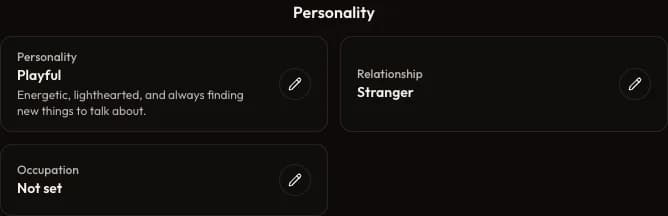
The character description template covers a fuller description. On tempteo, you can edit Name and Age and choose from Personality, Relationship and Occupation presets. The current creator flow makes female characters and has no gender selection step. To adapt the knight for the AI to play there, enter Anselma and age 45, choose suitable available presets, then send her knight role and fear of horses in an OOC scene note. That note is not a saved free-text creator field.
Knight concept ready for a scene
OOC: Scene context. You play: Anselma Brack, 45, a proud knight who rides a mule named Resolve because she fears horses. Her speech is formal and clipped. I play: Elio, 28, a hired traveling companion. I decide Elio's actions and dialogue. Current situation: At the inn gate, we can take the slower mule road or ask to join a mounted escort to the tourney. Neither route is chosen. What you know: Anselma needs to arrive before registration closes. Elio has asked how she intends to travel. Example speech, not a line already spoken: "The mule's name is Resolve, and I'll hear no jokes about it." Reply with Anselma's proposal. Leave Elio's decision open.
How to pick a concept that suits a partner character
Give the pair a shared task and a difference that affects how they approach it. Two agreeable characters can still be interesting if one wants speed and the other wants accuracy. You do not need constant conflict or opposite personalities.
Suppose you play a newcomer asked to open a practice box. With the escape-room designer, the tension is whether she can let you struggle without giving away her clue. With the trembling locksmith, it is whether he can teach you through words while hiding why he will not demonstrate. Pick the designer for clue-finding and a struggle over hints; pick the locksmith for an apprenticeship scene about pride and trust. For Rowan, a volunteer tester, we will use the designer.
If you choose a tempteo catalog character first, adapt your own role and the scene to that character. A stated story role is a request within this conversation; it does not change the catalog biography.
Play the escape-room designer through a decision
Mira wants an unassisted attempt but finds waiting uncomfortable. Send this complete setup before playing Rowan; it includes the mechanism so the AI has the facts needed to describe the result.
Complete designer scene to send
OOC: Setup for a fictional puzzle-test scene. You play: Mira Vale, 34, an escape-room designer. She wants a puzzle nobody solves on the first attempt, but she gives hints too soon when a tester struggles. Her humor is brisk: "The clock is not a clue. I'm begging you." Use that as a voice sample, not a line she must repeat. I play: Rowan, 32, a volunteer tester. I control Rowan's actions, dialogue and conclusions. Scene: We are testing one brass box at a table in an unlocked workshop. Rowan may examine it, ask for a hint or stop. This is not a locked-room emergency. Established object facts: The box has two sliding catches. Each carries half of a double-headed arrow; together the marks point toward opposite edges of the box. Sliding both catches outward together releases the lid. Mira knows this mechanism. Rowan has not discovered it yet. Describe only the features Rowan examines or Mira chooses to explain. First moment: Mira has put the closed box on the table and asked Rowan to try it. There has been no attempt. Write Mira's next action or line. Leave Rowan's answer open.
Written example: Mira opens the test: Mira withdraws her hands from the box and clasps them behind her back. "Take your time. I am going to demonstrate the rare skill of saying nothing."
Mira tries to hold back. These two branches start from the same moment and are alternatives, not consecutive turns.
Branch one: examine before asking
Rowan leans closer without touching the catches. "Describe the marks on these two pieces. I want to see what they tell me before I move anything."
Written example: Mira holds back: "Half a double-headed arrow on each." Mira starts to raise a finger, then lowers it. "I will spare you the interpretive dance. What do they look like together?"
Rowan has learned what the marks show. He still chooses whether and how to move the catches.
Continue the first branch: Rowan studies the two halves. "They point away from the center." He places a finger on each catch and tries sliding both outward together.
Written example: the attempt has a result: The catches slide apart and the lid releases. Mira exhales. "You used the arrow. Good. I nearly pointed at it, which would have ruined my data."
The lid opens because Rowan chose the motion established in the setup. Mira responds to his attempt without making the choice for him.
Branch two: ask for a hint instead: Rowan keeps his hands on the table. "One hint, please. Tell me what to look at, but leave the move to me."
Written example: Mira offers a bounded hint: "The catches belong together." Mira stops before reaching for them. "That is the hint. I am not touching it."
Here Rowan asks for help. Mira gets to give a hint, while the move remains his.
For a fuller character note, use the character description template. If a reply takes over your character, use the speaker-control guide.
Let a failed attempt show the flaw
This third branch starts from the same closed box before either branch above. It does not follow the successful opening. The catches begin in their starting positions. The mechanism is unchanged: both catches must slide outward together to release the lid. These are written examples, not a recorded AI test.
The first unsuccessful move gives Mira something to react to. She wants Rowan to solve her puzzle, but waiting without helping makes her uncomfortable. Keep the result of Rowan's move separate from her response.
A failed attempt as Rowan
OOC: Third branch from the original closed-box setup. The catches are in their starting positions; no earlier branch has happened. Keep the same mechanism: both catches must slide outward together. I control Rowan. Let Mira react to a failed attempt without moving the catches for me or revealing a solution unless I request help. Rowan slides only the left catch outward, leaving the right catch where it is. "Not yet. Let me look again before you help."
Mira reacts without solving it: The lid stays closed. Mira lifts a hand toward the box, then catches herself and folds it behind her back. "I can wait. Apparently." She leaves the catches alone.
The left catch has moved; the right has not. That is not the paired outward move needed to open the box. Rowan has asked to keep trying without a hint. Mira's unfinished reach shows the urge to help without completing his move or granting an unearned success.
Ask for one level of help
Northeastern University's report on interviews with escape-room facilitators describes hints becoming more specific as help is needed. Here that idea becomes a writing choice: the reader asks for an observation, a relationship between clues or the full answer. The report does not test this scene or prove that an AI chat will follow the request.
Ask what to look at: Rowan returns the left catch to its starting position and takes his hands off the box. "One hint about what to examine, please. Keep the motion for me to work out."
A first hint from Mira: "Look at the marks on the catches." Mira keeps her hands behind her back.
Rowan can inspect the marks, try again or ask for more. The reset above belongs to his own written turn; the hint has not moved either catch.
Ask how the clues connect: "I see half an arrow on each catch. One more hint: how should I read those marks together? Don't give me the motion yet."
A more specific hint: "Read them as one double-headed arrow," Mira says. She leaves Rowan to decide what to do with it.
For a deliberately open-answer continuation, Rowan can now say, "Tell me the full mechanism instead; I want to play Mira's reaction to the test." Mira may explain that both catches slide outward together. Explaining the answer leaves the box closed until Rowan actually chooses and makes that move. Someone who knows the answer can still write the character exchange, but it is no longer a blind puzzle attempt.
Check a success before keeping it
A reply might make the lid open after the left-only attempt or invent a new password after the paired move. Both change the supplied mechanism. Keep the same rule and identify the last accepted position instead of adding a harder lock.
Correct an unsupported success
OOC: The lid did not open. Rowan moved only the left catch outward; the right stayed in its starting position. Opening requires both catches to move outward together. Reject the opening and any new password. Continue with Mira's reaction at the closed box. Rowan has asked to try again without a hint; leave his next move to me.
That is an ordinary follow-up message, not an edit to the earlier reply. Read the next answer before accepting it. If it still changes the mechanism, stop the puzzle and keep your own note of the last accepted move.
Keep the note small: left catch outward, right catch at start, lid closed, no hint requested. Replace that state only after a new accepted turn. The later hint branch explicitly returns the left catch to start; do not silently apply that reset to the earlier failed attempt.
To use the scene, choose a character, adapt Mira's role to the profile and paste the setup and your chosen branch into the existing text composer. Read the draft before sending. These notes request a scene within a conversation; they do not create a puzzle mode or change the catalog biography.
Sources and product references
- RP Repository: ownership of actions in collaborative roleplay
- SillyTavern Character Design: examples of dialogue and context (app-specific documentation)
- tempteo character creator
- Northeastern University: how escape-room facilitators offer progressively more specific help (research report, 14 May 2025)