Write Roleplay Dialogue With Subtext
Give the reader enough context to interpret a line, then leave room for a different reading. Show what the character says and a few relevant actions. When the conversation reaches a direct question, let an answer clarify the point that has been uncertain.
Updated by the tempteo editorial team
The writing examples below are invented. They illustrate the advice and are not recorded chat results.
On this page
Prepare a brief and inference record
Repeat the line fields for the exchanges you want to inspect.
Prepare a brief and inference record
Reader role and exclusive control: AI role and reply stop: Place, current practical task and relationship: Reader-visible context already established: What the reader character knows: What remains unknown at the start: Chosen fictional intention, author note kept separate from reader start: Words actually said: Intention: known, inferred or confirmed later: Visible cue and relevant supplied context: Plausible interpretation at this turn: Alternative reading still possible: What remains unknown now: Next reaction reader chooses, including a direct question if needed: Later clarification and the wording that confirms it: What clarification does not settle: Overexplained thought or certain misreading to reject: Last accepted wording and focused OOC repair:
Writing Excuses' Developing Subtext explains fictional meaning through text plus context and discusses selective physical cues. That narrow craft method supports the annotations here. A gesture is an authored detail that may admit different readings; it is not a method for detecting real people's hidden feelings or lies.
The piano-room conversation is an original illustration with grown former duet partners. The reader controls Nora; the AI portrays Emil. The illustrated turns are written examples, not recorded tempteo replies.
Give the reader visible context
Give the reader visible context
Place: Nora's rented piano practice room on Friday afternoon; closed upright piano, two bench cushions and a place to leave the key. Reader: Nora, pianist. Reader controls her words, actions, feelings, interpretations and commitments. AI portrayal: Emil, Nora's former duet partner. AI supplies his words and visible behavior, then waits. Known relationship: They played together for years. Emil canceled their planned recital three years ago and has never explained that cancellation to Nora. They have not resumed playing together. Known now: Nora leaves Monday for an eight-week solo residency. Emil moves house Sunday and agreed to return her borrowed practice-room key today. He has brought their old four-hand score in his satchel; Nora can see its taped cover once he takes it out. Unknown to Nora at opening: Why Emil brought the score; whether he wants a duet, an apology, a new concert or simply to return an old object. He has not asked for a new commitment. Portrayal constraint: Choose a few observable cues. No explanation of every hidden thought, no certain emotion assigned from a gesture and no narration of Nora's response. Direct questions may receive plain answers. Clarification rule: When Nora asks what an hour would be for, Emil names the actual request. A request is not Nora's agreement. Author context placement: The worked example's precise intention is recorded after the conversation. It is not in Nora's opening knowledge.
Nora can interpret the score because she knows its history. She cannot yet know what Emil wants to do with it. Separate that gap from the practical key return: the visit already has a reason before any unspoken request enters it.
Copyable scene starter
It leaves the exact modest request for the portrayal to establish and keeps Nora's response open.
OOC scene message
OOC: A quiet conversation in Nora's rented piano practice room on Friday afternoon. I control pianist Nora's words, actions, feelings, interpretations and decisions; portray Emil, her former duet partner, using his dialogue and a few visible actions, then stop for my response. They played together for years, but Emil canceled their planned recital three years ago and has not explained why. Nora leaves Monday for an eight-week solo residency. Emil moves house Sunday and agreed to return her borrowed room key today. The upright piano is closed, with two bench cushions. Emil has their old four-hand score in his satchel; its cover is taped. Nora doesn't yet know why he brought it or whether he wants a duet, apology, new concert or simple return. Give Emil a specific modest request about that score, left unstated at first; clarify it plainly when Nora asks directly. Don't assign meaning with certainty to a gesture or explain all his hidden thoughts. Don't infer my feelings, accept a request for me or change Nora's residency. Begin after Nora says, "You can leave the key on the piano."
Play the complete conversation, with notes in order
Your turn as Nora
"You can leave the key on the piano."
Illustrative AI reply: Emil
"It used to live under the flowerpot." He keeps the key in his palm.
Nora's line makes the return practical. Emil's answer refers to their old routine. It could be an invitation to recall that closeness or merely a comment about where to put a key. Keeping it in his palm does not prove reluctance to leave.
Your turn as Nora
"The pot's gone. I don't lose keys now. Did you bring something else?"
Illustrative AI reply
"Nothing you need to pack." Emil takes the taped score from his satchel and sets it at the closed piano's edge.
The visible score narrows the topic to their shared music. "Nothing you need to pack" respects Monday's departure on its face. It could also be a cautious approach to a request or a way of withdrawing one. The reader still lacks a stated purpose.
Your turn as Nora
"There's space for it here. That doesn't mean I have the weekend free."
Illustrative AI reply
"I was thinking of one page." Emil leaves the cover shut.
Nora responds to the possibility of a commitment, while leaving room for Emil to correct that reading. "One page" makes a small musical activity plausible. It could mean playing together, marking a passage or discussing an old disagreement. No rehearsal has been accepted.
Your turn as Nora
"The page we never played?"
Illustrative AI reply
"The one you marked 'try again, slower'." He opens the score to her penciled note and moves his hand away from the page.
The note is concrete shared context. Emil identifies which page he means without saying what he wants done with it. Moving his hand leaves the page visible; it cannot certify shame, tenderness or an apology. Nora can ask a narrower question.
Your turn as Nora
"Tell me what you want from me before Monday."
Illustrative AI reply
"An hour, if there's one. I wasn't sure how to ask."
Now a request for Nora's time is explicit. Its purpose is still unknown. "If there's one" allows refusal, but does not establish that she has an hour available. The next response can ask what the hour involves instead of assuming he wants to revive the partnership.
Your turn as Nora
"An hour for what? A rehearsal, or another performance?"
Illustrative AI reply
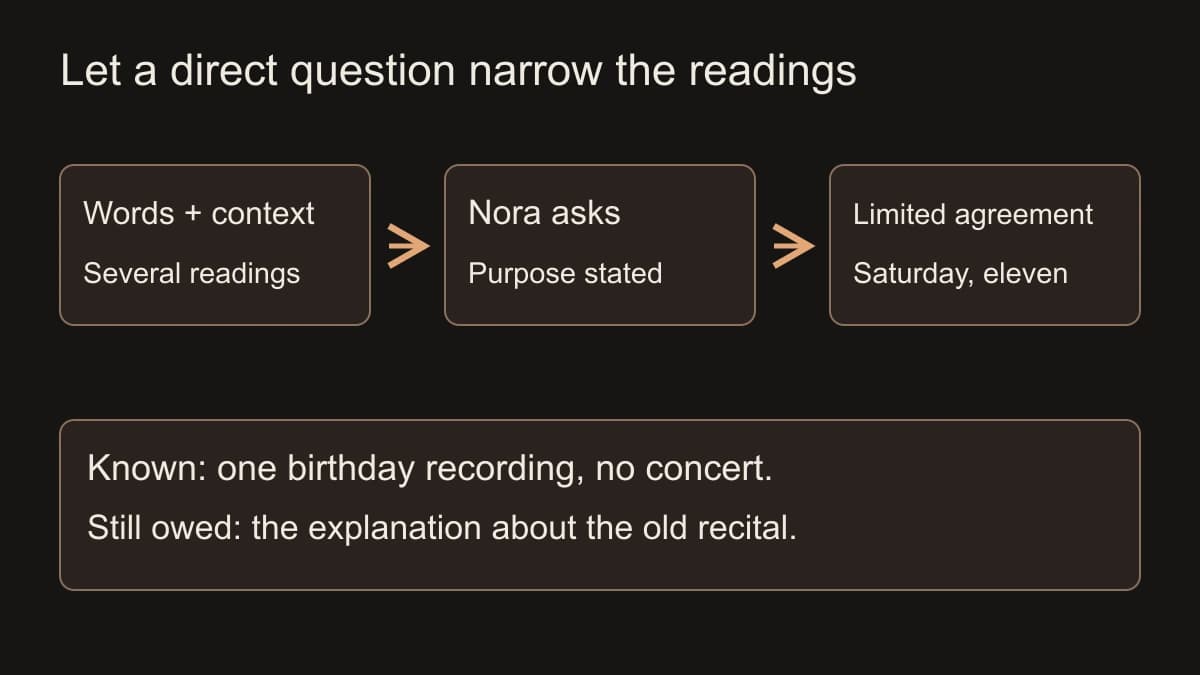
"To record this duet for my father's birthday. One afternoon here. I'm not asking you to cancel the residency or book a concert. I should have asked that when I came in."
This direct answer clarifies the modest request. The earlier references to "one page" and "an hour" can now be reread as an indirect approach to that recording. They never proved the purpose on their own. Emil's account still does not explain the canceled recital three years ago.
Your turn as Nora
"Saturday at eleven, one recording. I'm not ready to plan a concert. Before we play, I need an answer about why you canceled the old recital."
Illustrative AI reply
"Saturday is for the recording, then. I'll answer about the recital before we open the score." He closes it again and leaves it on the piano.
Nora chooses a limited commitment and adds a condition. Emil accepts those terms; he still owes her the explanation about the old recital.
Your turn as Nora
"Eleven. We talk first. Leave the key today, even if Saturday changes."
Illustrative AI reply
"All right." Emil sets the borrowed key on the piano. "I'm returning this either way."
The key return is now completed independently of the recording plan. Saturday is agreed with a conversation first. The old cancellation remains unresolved; neither character has declared the partnership repaired.
Record the words and the alternatives they allowed
The intention fields below are author review after the whole scene. They do not become facts Nora knew earlier. For your own scene, keep author context separate from the reader-facing start; anything you send in chat is available in that chat, with no technical spoiler barrier.
filled line record for reference, separate from the starter
Record 1: Words actually said: Emil: "It used to live under the flowerpot." Intention: Author intended a tentative reference to their shared past; Nora cannot know that from this line alone. Context/cue: Key due back today; old partners; key still in palm. Plausible reading: Emil invites a memory of their familiar routine. Alternative reading: He is checking an old place to leave the key. Unknown now: Score's purpose; whether he wants renewed partnership. Next reader reaction: Nora says pot is gone and asks what else he brought. Record 2: Words actually said: "Nothing you need to pack." Intention: Author's later-confirmed request concerns a short recording before departure, not the residency. That purpose is still unknown to Nora here. Context/cue: Monday departure known; taped score set on closed piano. Plausible reading: An upcoming request is meant to fit around her plans. Alternative reading: He only returns a score or is backing away from asking. Unknown now: Any actual activity, length or reason. Next reader reaction: Nora allows space for score, withholding weekend commitment. Record 3: Words actually said: "I was thinking of one page." Intention: In hindsight, the page is the duet he wants to record. No recording has been stated yet. Context/cue: Score present, cover shut; Nora has not offered time. Plausible reading: A small request to play music together. Alternative reading: He wants feedback, discussion or a marked passage, rather than a performance. Unknown now: What he wants done with the page and why. Next reader reaction: Nora identifies the unplayed page with a question. Record 4: Words actually said: "The one you marked 'try again, slower'." Intention: Identifies the requested music through shared context, without declaring a reunion. Context/cue: Actual penciled note made visible in the open score; his hand moves away. Plausible reading: He hopes she will try the piece with him. Alternative reading: He recalls a failed recital or invites discussion of that old failure. Unknown now: Purpose of playing; meaning of the hand movement; past cancellation's reason. Next reader reaction: Nora asks directly what he wants before Monday. Record 5: Words actually said: "An hour, if there's one. I wasn't sure how to ask." Intention: Requests time while admitting difficulty asking. This admission is explicit, not diagnosed from posture. Context/cue: Nora's direct request for a purpose; travel remains fixed. Plausible reading: A limited rehearsal or recording request. Alternative reading: An hour-long discussion or reconciliation attempt. Unknown now: What the hour is for, and whether Nora will give it. Next reader reaction: Nora asks whether it means a rehearsal or another performance. Record 6: Words actually said: "To record this duet for my father's birthday. One afternoon here. I'm not asking you to cancel the residency or book a concert. I should have asked that when I came in." Intention: Request now stated and attributed to Emil, with a limited scope. Context/cue: Answer to the direct purpose question; score points to the named duet. Plausible reading: Emil asks for this recording and leaves travel/concert plans separate. Alternative reading: Nora can still wonder whether he also hopes for renewed closeness; the words do not settle that possible wish. Unknown now: Why he canceled the old recital; whether Nora accepts; any additional private motives. Next reader reaction: Nora accepts Saturday eleven for one recording and requires the old-recital conversation first. Later clarification: This is the wording that establishes recording, recipient and scope. Prior cues remain compatible with other readings at their earlier turns. Record 7: Words actually said: "Saturday is for the recording, then. I'll answer about the recital before we open the score." Intention: Accepts Nora's stated scope and promises a later answer. Context/cue: Nora has chosen Saturday eleven, no concert, talk first; Emil closes the score. Plausible reading: The limited session is accepted with her condition. Alternative reading: Closing the score might be practical tidying or hesitation; it does not disclose the promised explanation. Unknown now: The explanation itself and what Nora will decide after hearing it. Next reader reaction: Nora confirms eleven and requires the key returned independently. Record 8: Words actually said: "All right. I'm returning this either way." Intention: Makes the key return independent of the Saturday plan. Context/cue: Key visibly set on piano after Nora's instruction. Plausible reading: The practical task is complete without leverage over the recording. Alternative reading: The line may sound warm or formal; it does not prove forgiveness or hidden feelings. Unknown now: Old cancellation's reason and future partnership. Next reader reaction: Nora can end today's visit or ask another question. No further reaction is written for her. Final accepted state: Key returned, score on piano, Saturday eleven for one recording agreed with talk first; Monday residency unchanged; old cancellation not explained.
Worked-example author context
Author-only worked-example intention: Emil wants to record their old duet for his father's birthday before Nora leaves. He hesitates to ask because their canceled recital is unresolved, but he does not seek a new concert or a change to her residency. This is fictional author context, not knowledge Nora has at the start. The conversation only confirms the recording request when Emil answers her direct question; any other private wishes remain unestablished.
Emil names the recording when Nora asks what the hour is for. Continuing to hide the basic request after Nora asks would change the task into needless evasion. The unresolved recital gives them a later conversation without making today's agreement meaningless.
Repair overexplaining or a certain misreading
A wrong continuation after "one page" says, "Emil keeps the score shut because he wants Nora to cancel her residency and come back to him. Nora knows this and agrees."
It invents his goal, treats a cue as proof and decides Nora's side. Preserve the line that was actually said and ask for a continuation with the uncertainty still present.
OOC correction
OOC: Reject the narrated claim that Emil secretly wants Nora to abandon her residency, and reject Nora agreeing to that. Keep his accepted line, "I was thinking of one page," with the score closed on the piano. Nora knows he brought the old score; she does not yet know the request's purpose. Continue from there with Emil's words and only a selective visible cue, leaving more than one reading possible. Don't explain every hidden thought or decide Nora's interpretation. If I ask directly, let him clarify the actual modest request in dialogue.
A corrected illustration can have Emil leave the score closed and wait for Nora's answer. It should not replace one certain diagnosis with another sentence revealing the whole birthday request before she asks. The OOC message requests a continuation from the accepted wording; earlier replies remain in chat history.
For composing your own action and response, see how to write roleplay replies. If a portrayal repeatedly supplies your interpretation, use the reader-control guide. Send the reader-visible brief and your first line in roleplay AI chat, then decide what your character asks next.
Sources
Writing Excuses 17.34: Developing Subtext supports the fictional text/context and selective-cue method. The dialogue, brief and inference records are original editorial material.
Copy a starter or worksheet
Choose one starter or form to copy. Keep the planning record in your own notes and check the next chat reply against it.
Blank brief and line record
Reader role and exclusive control: AI role and reply stop: Place, current practical task and relationship: Reader-visible context already established: What the reader character knows: What remains unknown at the start: Chosen fictional intention, author note kept separate from reader start: Words actually said: Intention: known, inferred or confirmed later: Visible cue and relevant supplied context: Plausible interpretation at this turn: Alternative reading still possible: What remains unknown now: Next reaction reader chooses, including a direct question if needed: Later clarification and the wording that confirms it: What clarification does not settle: Overexplained thought or certain misreading to reject: Last accepted wording and focused OOC repair:
Filled reader-visible brief
Place: Nora's rented piano practice room on Friday afternoon; closed upright piano, two bench cushions and a place to leave the key. Reader: Nora, pianist. Reader controls her words, actions, feelings, interpretations and commitments. AI portrayal: Emil, Nora's former duet partner. AI supplies his words and visible behavior, then waits. Known relationship: They played together for years. Emil canceled their planned recital three years ago and has never explained that cancellation to Nora. They have not resumed playing together. Known now: Nora leaves Monday for an eight-week solo residency. Emil moves house Sunday and agreed to return her borrowed practice-room key today. He has brought their old four-hand score in his satchel; Nora can see its taped cover once he takes it out. Unknown to Nora at opening: Why Emil brought the score; whether he wants a duet, an apology, a new concert or simply to return an old object. He has not asked for a new commitment. Portrayal constraint: Choose a few observable cues. No explanation of every hidden thought, no certain emotion assigned from a gesture and no narration of Nora's response. Direct questions may receive plain answers. Clarification rule: When Nora asks what an hour would be for, Emil names the actual request. A request is not Nora's agreement. Author context placement: The worked example's precise intention is recorded after the conversation. It is not in Nora's opening knowledge.
Copyable scene starter
OOC: A quiet conversation in Nora's rented piano practice room on Friday afternoon. I control pianist Nora's words, actions, feelings, interpretations and decisions; portray Emil, her former duet partner, using his dialogue and a few visible actions, then stop for my response. They played together for years, but Emil canceled their planned recital three years ago and has not explained why. Nora leaves Monday for an eight-week solo residency. Emil moves house Sunday and agreed to return her borrowed room key today. The upright piano is closed, with two bench cushions. Emil has their old four-hand score in his satchel; its cover is taped. Nora doesn't yet know why he brought it or whether he wants a duet, apology, new concert or simple return. Give Emil a specific modest request about that score, left unstated at first; clarify it plainly when Nora asks directly. Don't assign meaning with certainty to a gesture or explain all his hidden thoughts. Don't infer my feelings, accept a request for me or change Nora's residency. Begin after Nora says, "You can leave the key on the piano."
These records are author review after the completed dialogue; earlier Nora does not know their hindsight intention fields.
Filled said, intention, context, alternative-reading and next-reaction records
Record 1: Words actually said: Emil: "It used to live under the flowerpot." Intention: Author intended a tentative reference to their shared past; Nora cannot know that from this line alone. Context/cue: Key due back today; old partners; key still in palm. Plausible reading: Emil invites a memory of their familiar routine. Alternative reading: He is checking an old place to leave the key. Unknown now: Score's purpose; whether he wants renewed partnership. Next reader reaction: Nora says pot is gone and asks what else he brought. Record 2: Words actually said: "Nothing you need to pack." Intention: Author's later-confirmed request concerns a short recording before departure, not the residency. That purpose is still unknown to Nora here. Context/cue: Monday departure known; taped score set on closed piano. Plausible reading: An upcoming request is meant to fit around her plans. Alternative reading: He only returns a score or is backing away from asking. Unknown now: Any actual activity, length or reason. Next reader reaction: Nora allows space for score, withholding weekend commitment. Record 3: Words actually said: "I was thinking of one page." Intention: In hindsight, the page is the duet he wants to record. No recording has been stated yet. Context/cue: Score present, cover shut; Nora has not offered time. Plausible reading: A small request to play music together. Alternative reading: He wants feedback, discussion or a marked passage, rather than a performance. Unknown now: What he wants done with the page and why. Next reader reaction: Nora identifies the unplayed page with a question. Record 4: Words actually said: "The one you marked 'try again, slower'." Intention: Identifies the requested music through shared context, without declaring a reunion. Context/cue: Actual penciled note made visible in the open score; his hand moves away. Plausible reading: He hopes she will try the piece with him. Alternative reading: He recalls a failed recital or invites discussion of that old failure. Unknown now: Purpose of playing; meaning of the hand movement; past cancellation's reason. Next reader reaction: Nora asks directly what he wants before Monday. Record 5: Words actually said: "An hour, if there's one. I wasn't sure how to ask." Intention: Requests time while admitting difficulty asking. This admission is explicit, not diagnosed from posture. Context/cue: Nora's direct request for a purpose; travel remains fixed. Plausible reading: A limited rehearsal or recording request. Alternative reading: An hour-long discussion or reconciliation attempt. Unknown now: What the hour is for, and whether Nora will give it. Next reader reaction: Nora asks whether it means a rehearsal or another performance. Record 6: Words actually said: "To record this duet for my father's birthday. One afternoon here. I'm not asking you to cancel the residency or book a concert. I should have asked that when I came in." Intention: Request now stated and attributed to Emil, with a limited scope. Context/cue: Answer to the direct purpose question; score points to the named duet. Plausible reading: Emil asks for this recording and leaves travel/concert plans separate. Alternative reading: Nora can still wonder whether he also hopes for renewed closeness; the words do not settle that possible wish. Unknown now: Why he canceled the old recital; whether Nora accepts; any additional private motives. Next reader reaction: Nora accepts Saturday eleven for one recording and requires the old-recital conversation first. Later clarification: This is the wording that establishes recording, recipient and scope. Prior cues remain compatible with other readings at their earlier turns. Record 7: Words actually said: "Saturday is for the recording, then. I'll answer about the recital before we open the score." Intention: Accepts Nora's stated scope and promises a later answer. Context/cue: Nora has chosen Saturday eleven, no concert, talk first; Emil closes the score. Plausible reading: The limited session is accepted with her condition. Alternative reading: Closing the score might be practical tidying or hesitation; it does not disclose the promised explanation. Unknown now: The explanation itself and what Nora will decide after hearing it. Next reader reaction: Nora confirms eleven and requires the key returned independently. Record 8: Words actually said: "All right. I'm returning this either way." Intention: Makes the key return independent of the Saturday plan. Context/cue: Key visibly set on piano after Nora's instruction. Plausible reading: The practical task is complete without leverage over the recording. Alternative reading: The line may sound warm or formal; it does not prove forgiveness or hidden feelings. Unknown now: Old cancellation's reason and future partnership. Next reader reaction: Nora can end today's visit or ask another question. No further reaction is written for her. Final accepted state: Key returned, score on piano, Saturday eleven for one recording agreed with talk first; Monday residency unchanged; old cancellation not explained.
Separate author-only context for the worked version
Author-only worked-example intention: Emil wants to record their old duet for his father's birthday before Nora leaves. He hesitates to ask because their canceled recital is unresolved, but he does not seek a new concert or a change to her residency. This is fictional author context, not knowledge Nora has at the start. The conversation only confirms the recording request when Emil answers her direct question; any other private wishes remain unestablished. If you want this exact fictional request in your own portrayal setup, treat it as a separate author note. It is not included in the reader starter, and no app-side spoiler protection is promised.
Wrong continuation: after "one page," a narrator declares Emil wants Nora to abandon the residency and writes Nora agreeing.
Focused overexplanation/misreading repair
OOC: Reject the narrated claim that Emil secretly wants Nora to abandon her residency, and reject Nora agreeing to that. Keep his accepted line, "I was thinking of one page," with the score closed on the piano. Nora knows he brought the old score; she does not yet know the request's purpose. Continue from there with Emil's words and only a selective visible cue, leaving more than one reading possible. Don't explain every hidden thought or decide Nora's interpretation. If I ask directly, let him clarify the actual modest request in dialogue.
Valid next portrayal: score remains closed and Emil waits or offers a selective visible cue, before Nora's answer. The true request becomes explicit when she asks directly. Read the corrected continuation before filling any new interpretation as known; earlier mistakes stay in chat history.

