Run a Time-Loop Roleplay With Clear Resets
Write the reset before playing the second attempt. Name its trigger, the exact starting state, whose knowledge survives and where every object returns. Then choose a new action based on something a character actually learned.
Updated by the tempteo editorial team
The writing examples below are invented. They illustrate the advice and are not recorded chat results.
On this page
- Make a reset sheet you can reuse
- Fix what survives and what disappears
- Copyable scene starter
- Attempt 1: spend the evening on a rushed experiment
- Attempt 2: preserve the show and miss part of the song
- Attempt 3: divide the work, then accept an ending
- Keep three separate attempt records
- Repair an object that crossed the reset
- Sources
- Copy a starter or worksheet
Make a reset sheet you can reuse
Repeat the attempt fields for each played evening.
Make a reset sheet you can reuse
Loop name and purpose: Reader character and control: AI portrayal and reply stop: Reset trigger and exit condition: Identical initial time, place, people and objects: Knowledge retained by each person: Knowledge erased by each person: Physical objects, damage, promises and events reset: What persists outside the repeated evening: Actions available at the next start: Attempt number and starting knowledge: Different chosen action: Observed result and cost in this attempt: Learning, with who learned it and how: Reset or exit reached: Objects and NPC knowledge after it: Next action permitted by the learning: Unresolved or permanently lost opportunity: Last accepted state and exact repair:
At the chime, restore the listed story facts; the earlier chat messages remain. You keep the sheet in your own notes and send the relevant scene or OOC instructions when needed; the contract supplies no automatic loop or memory engine.
The following seaside-workshop story is an original illustration. Its grown characters are Ada, whom the reader controls, lantern-maker Jun and puppeteer Suri, portrayed by the AI. The shown replies are editorial examples, not recorded model output.
Fix what survives and what disappears
Fix what survives and what disappears
Loop: The Last Light, a farewell shadow performance in a seaside puppet workshop. Control: Reader writes Ada; AI portrays lantern-maker Jun, puppeteer Suri and the workshop. Stop before Ada's next choice. Trigger: At 18:00 the third closing chime resets the whole workshop evening to 17:40. Moving away or breaking the clock does not avoid it. No earlier reset is allowed. Exit: Between 17:58 and 18:00, Ada and Jun may both say "Let this evening end." If both do, the 18:00 chime ends the loop and time continues. One person's words alone do not end it. Initial state every time: Ada and Jun stand in the lantern bay at 17:40. The lantern is off, its carriage untested. A blue glass is on the reachable shelf; Suri's paper bird is intact in the connected stage carriage. The tuning folio is closed on the bay desk. Suri is in the rehearsal nook, preparing her song. Retained knowledge: Ada and Jun remember every event they personally witnessed in prior attempts. They may tell each other what they learned. Erased knowledge: Suri remembers only events before 17:40. She loses everything heard, promised or felt during an erased attempt. Tell her again if she needs a fact. Reset physical state: Blue glass returns to the shelf; bird becomes intact in the connected stage carriage; folio closes on desk; lantern turns off and loses its tuning. Every acquired item returns to its initial owner/location. Written notes, damage, recordings and new promises from the attempt are erased. Fixed opportunities: Suri is scheduled to sing once from 17:50 to 17:56 in the nook, inaudible from the lantern bay. If the bird tears, she cancels the song to mend it. Otherwise she sings on schedule and will not repeat it that evening. She takes her sealed score tin and leaves at 17:58. The finale can be shown from 17:56 to 17:58 if prepared. All times are fictional scene facts, tracked in notes. Permitted start: Ada may inspect the folio, work on the lantern, ask Jun to help or visit Suri. No tuned lantern or new item is carried in. After exit: Events and objects of the final attempt continue normally. Ada and Jun keep their recollections; that does not recover an erased physical item or give Suri an erased memory.
The folio contains a slow-sweep tuning method: twelve minutes for one operator, four for two. Changing operators restarts the check. An untuned fast crank shakes the carriage and tears the paper bird. These invented workshop rules stay identical in all attempts. Ada and Jun can discover them through play; Suri's latest conversation cannot become a memory in the next reset.
An individual CharacterAI user's time-reset comment and follow-ups in the source discussion describe playing repeated events with different retained character knowledge. That is one qualitative use case. Our reset fields and gentle workshop story are original; the comment does not establish how common this style is or whether a prompt reliably maintains it.
Copyable scene starter
It supplies the full contract without choosing the first attempt for you.
OOC scene message
OOC: Play The Last Light, a quiet farewell shadow show. I control Ada's words, actions, decisions and feelings. Portray lantern-maker Jun, puppeteer Suri and the workshop; stop for my next choice. At every start it is 17:40: Ada and Jun in the lantern bay, lantern off and carriage untested, blue glass on a reachable shelf, closed tuning folio on the desk, intact paper bird in the connected stage carriage, Suri preparing in the rehearsal nook. At the third closing chime at 18:00, reset this entire evening to that state. Ada and Jun remember only what each personally witnessed, and may share it; Suri forgets all events after 17:40. Restore every object to its initial owner/location, including any carried glass, notes and recordings; erase damage, tuning and new promises. Suri is scheduled to sing once at 17:50-17:56 in the nook, inaudible from the bay; a torn bird makes her cancel the song to mend it. Otherwise she sings on schedule and refuses a repeat. She leaves with her sealed score tin at 17:58. A prepared finale can run at 17:56-17:58. Ada may inspect, tune, ask for help or visit Suri. Use the same workshop facts across attempts: a stable slow-sweep tune takes one operator twelve minutes or two operators four minutes; changing operators restarts the check. An untuned fast crank shakes the carriage and tears the bird. These are fictional rules. No earlier reset or escape by breaking the clock. Between 17:58 and 18:00, Ada and Jun can both say "Let this evening end" to prevent that reset and let time continue; one voice is insufficient. Begin before Ada chooses anything. Reveal information through inspection or conversation, without choosing Ada's response.
Attempt 1: spend the evening on a rushed experiment
Your turn as Ada, 17:40
"I'll put the blue glass in and try a fast crank. We can sort the fine adjustments later."
Illustrative AI reply
Jun holds the lamp while Ada seats the glass. At 17:44 the untuned carriage shudders. Suri's bird catches on its guide and tears across one wing. Suri comes from the nook. "That was my last spare. Put it down."
Your turn as Ada
I stop the crank. "I rushed it. What should I have checked?"
Illustrative AI reply
Jun points at the carriage latch. "A slow-sweep tune before the fast movement." Suri collects the torn bird. "I need the nook to mend it. No song tonight." She cancels this attempt's rehearsal instead of forgiving the damage on cue.
Your turn as Ada
I offer to help her mend the wing. We have no complete finale to show. At the third chime, I wait for the agreed reset.
Illustrative AI reply
Suri accepts the help, then packs the bird and leaves with her sealed score tin at 17:58. At the 18:00 third chime, the workshop resets. It is 17:40 again. The blue glass is on its shelf. The intact bird is in the connected stage carriage; Suri prepares in the nook with no memory of the tear. Jun and Ada remember the shaking carriage and cancellation. The lantern is off and untested.
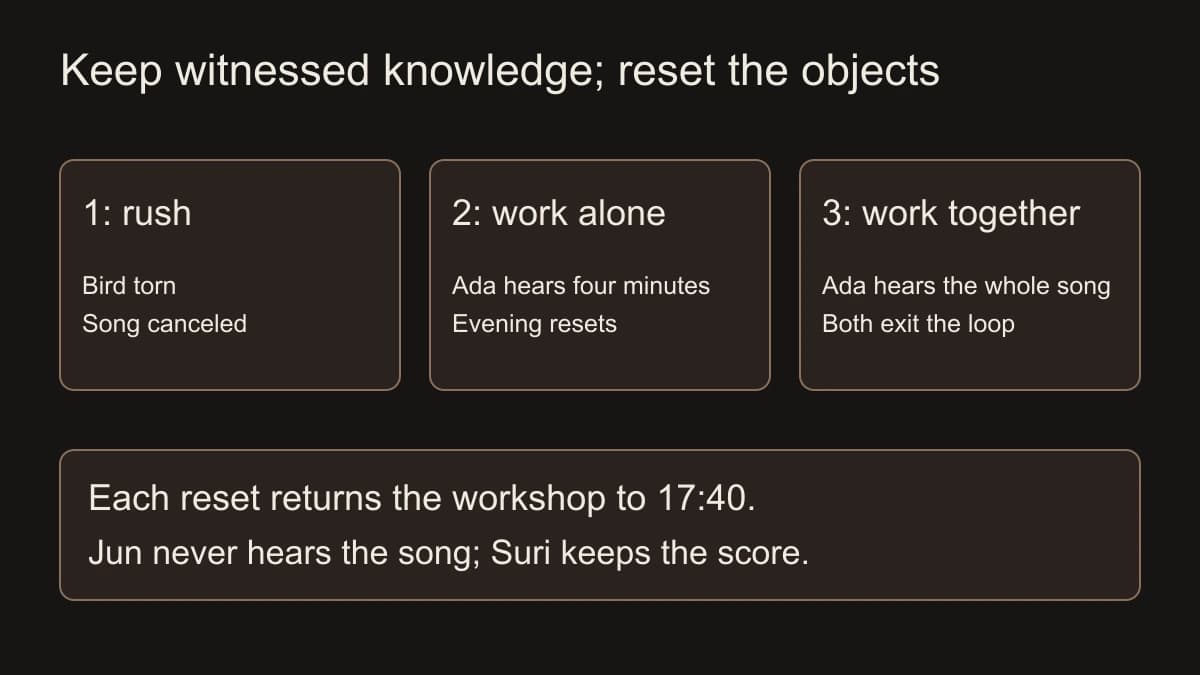
The shake shows Ada and Jun why the carriage needs a slow check. At reset, the mending work, torn wing and canceled song disappear. Ada remembers her own rushed decision. Suri has lost the event and cannot reproach her for it in the new evening.
Attempt 2: preserve the show and miss part of the song
Your turn as Ada, next 17:40
I take the blue glass from the shelf and put it in the frame. "I'll do the slow tune alone. Jun, read the folio while I keep the carriage steady. Tell me what else it needs."
Illustrative AI reply
Ada begins a slow check. At 17:44 Jun reads the folio's timing note aloud: "Twelve minutes with one operator. Four with two. If we change operators now, the check starts again." Both learn the two-person option from this inspection, not from an earlier invented memory.
Your turn as Ada
"Keep reading. I'll finish this check rather than start over." I stay in the bay until 17:52, then go to the nook.
Illustrative AI reply
Jun remains with the folio in the bay, outside earshot. At 17:52 the carriage is stable. Ada reaches the nook while Suri is already singing; the first two minutes are gone. Ada hears the remaining verses through 17:56. Suri does not interrupt her song to replay the opening.
Your turn as Ada
"Could you sing the beginning once more? I missed it."
Illustrative AI reply
"No. I promised myself one last sing-through." Suri comes to the prepared lantern; the intact bird is still in its stage carriage. Jun operates the stable slow sweep, and the blue lake appears for the 17:56-17:58 finale. Suri puts the bird away, takes her sealed score tin and leaves at 17:58.
Your turn as Ada
"We have a working show, but I missed the opening and Jun heard none of it. Let's try once more." I do not ask Jun to end the loop.
Illustrative AI reply: 18:00 reset
The workshop returns to its identical 17:40 state. The blue glass returns to its shelf. Ada retains the later verses; Jun retains what he read and the successful tune. Suri loses the song request, finale and refusal. Ada tells Jun that arriving at 17:52 missed the beginning.
Ada could have restarted with Jun at 17:44. She chose to preserve the check already under way. That choice costs the opening verse; it does not make the alternative impossible. The sheet should record the choice as made rather than quietly optimize it afterward.
Attempt 3: divide the work, then accept an ending
Your turn as Ada, third 17:40
"Jun, let's use the four-minute two-person check. Afterward I'll hear Suri's song while you stay with the lantern."
Illustrative AI reply
Jun takes the second tuning position. Together they complete the slow-sweep check at 17:44, following the known folio instruction. The bird stays intact. "I'll have the lamp ready at fifty-six," he says. The cooperation creates time that the solo choice did not.
Your turn as Ada
I put the blue glass into its frame and reach the nook before 17:50. "May I listen to your last rehearsal?"
Illustrative AI reply
Suri nods and sings from 17:50 to 17:56. Ada hears the whole song this time. Jun cannot hear it from the bay. Suri then joins Jun at the prepared lantern, with the bird still in its stage carriage. The slow sweep casts the blue lake. At 17:58 she packs it and picks up her sealed score tin. "The written score goes home with me."
Your turn as Ada
"Thank you. I won't ask you to leave it." After she goes, I tell Jun, "I heard the whole song. You can have the version I remember, but I don't have her score." At 17:59 I say, "Let this evening end."
Illustrative AI reply
Jun says the same words within the agreed window. At 18:00 the final chime sounds and the clock moves on to 18:01. The blue glass remains in the lantern because this evening was allowed to continue. Suri has left with the bird and sealed tin. Jun knows Ada heard the song because she told him; he still has not heard it himself.
The show succeeds because the paired check frees Ada early. The cost remains visible: Jun misses the song, and neither person has the written notation. Ending the loop closes the chance to ask Suri again tonight. A remembered melody can support Ada's next scene without becoming an acquired manuscript.
Keep three separate attempt records
Keep three separate attempt records
Attempt 1: Starting knowledge: Ada and Jun know the closing contract; neither has checked the tuning folio. Chosen action: Ada installs glass and tries an untuned fast crank. Observed result and price: Bird tears at 17:44; Suri cancels the song to mend it; no complete finale. Learning and owner: Ada and Jun witness the shake and hear that a slow tune is required. Suri learns it only in this attempt. Reset reached: 18:00, with no exit request. Objects after reset: Glass on shelf, bird intact in the connected stage carriage, folio closed, lantern off and untested; no repair materials carried forward. Knowledge after reset: Ada and Jun retain the incident; Suri retains none of it. Next permitted action: Try a proper tune or inspect its instructions. Attempt 2: Starting knowledge: Ada and Jun know rushing tears the bird; timing details still unexamined. Chosen action: Ada takes and installs the blue glass, then tunes alone while Jun reads; she chooses to finish after hearing the alternative at 17:44. Observed result and price: Stable lantern at 17:52, complete finale at 17:56-17:58; Ada misses the song's opening and Jun hears no song. Learning and owner: Both hear Jun's reading of twelve-minute solo/four-minute paired tuning and restart-on-operator-change. Ada hears later verses and Suri's refusal to repeat, then reports the missed beginning to Jun. Reset reached: 18:00, exit words deliberately not supplied. Objects after reset: Identical initial state; glass returns to shelf even if Ada took it out after the show; no tuning or written lyric survives. Knowledge after reset: Ada retains heard verses and timing; Jun retains the folio method and Ada's report, not unheard lyrics. Suri forgets all post-17:40 events. Next permitted action: Tune together at the next start to free Ada before 17:50. Attempt 3: Starting knowledge: Both know the paired tune; Ada knows arriving at 17:52 is too late for the beginning. Chosen action: Paired tune 17:40-17:44; Ada listens to the full song while Jun prepares the finale. Observed result and price: Full song for Ada and full finale for both; Jun still hears no song. Suri declines to leave her written score. Learning and owner: Ada hears the whole song; Jun learns only her report that she heard it. Neither reads the sealed score. Exit reached: Ada and Jun both say the exit words at 17:59; at 18:00 time continues. Objects after exit: Glass in the lantern, bird and sealed tin with departed Suri, folio in bay. No erased-attempt keepsake reappears. Knowledge after exit: Final-attempt memories persist; Suri knows only this attempt's visit and show, not earlier resets. Next permitted action: Ada can recount what she heard or leave; she cannot begin a fourth loop under this ended contract. Unresolved/lost opportunity: The score's notation remains unknown. Suri's departure and the ended loop remove tonight's chance to ask again; remembering a melody does not reveal the sealed manuscript.
Repair an object that crossed the reset
A wrong continuation after attempt 2 might say, "Ada pulls yesterday's blue glass from her pocket. Suri asks whether this performance will be better than the last."
The glass and Suri's comparison violate different lines of the same contract. Keep the earned tuning knowledge while correcting both.
OOC correction
OOC: Reject the blue glass in Ada's pocket at the start of attempt 3. The 18:00 reset restored it to the reachable shelf and erased the lantern's tuning. Keep the valid learning from attempt 2: both know the paired check takes four minutes; Ada heard only the later verses and told Jun she missed the beginning. Suri remembers no erased attempt. Resume at 17:40 in the bay, before our paired tune, with the bird intact, folio closed and glass on its shelf. Leave Ada's next action to me.
A corrected illustration can begin with Jun looking at the shelf: "Four minutes together, if that's what you choose." Suri is preparing her song elsewhere. Nobody has started the check for Ada.
Read the continuation before changing your notes. The OOC message requests a continuation from the named accepted state and leaves the incorrect reply in chat history. For other knowledge or voice drift, use the continuity sheet guide. For a premise before you design its resets, browse sci-fi roleplay ideas.
Fill one contract, then send your first chosen action in roleplay AI chat.
Sources
CharacterAI community discussion: time-reset comment and follow-ups supports only the individual use case described above. The reset sheet is our manual editorial design, not a source rule system.
Copy a starter or worksheet
Choose one starter or form to copy. Keep the planning record in your own notes and check the next chat reply against it.
Blank reset and attempt form
Loop name and purpose: Reader character and control: AI portrayal and reply stop: Reset trigger and exit condition: Identical initial time, place, people and objects: Knowledge retained by each person: Knowledge erased by each person: Physical objects, damage, promises and events reset: What persists outside the repeated evening: Actions available at the next start: Attempt number and starting knowledge: Different chosen action: Observed result and cost in this attempt: Learning, with who learned it and how: Reset or exit reached: Objects and NPC knowledge after it: Next action permitted by the learning: Unresolved or permanently lost opportunity: Last accepted state and exact repair:
Filled reset contract
Loop: The Last Light, a farewell shadow performance in a seaside puppet workshop. Control: Reader writes Ada; AI portrays lantern-maker Jun, puppeteer Suri and the workshop. Stop before Ada's next choice. Trigger: At 18:00 the third closing chime resets the whole workshop evening to 17:40. Moving away or breaking the clock does not avoid it. No earlier reset is allowed. Exit: Between 17:58 and 18:00, Ada and Jun may both say "Let this evening end." If both do, the 18:00 chime ends the loop and time continues. One person's words alone do not end it. Initial state every time: Ada and Jun stand in the lantern bay at 17:40. The lantern is off, its carriage untested. A blue glass is on the reachable shelf; Suri's paper bird is intact in the connected stage carriage. The tuning folio is closed on the bay desk. Suri is in the rehearsal nook, preparing her song. Retained knowledge: Ada and Jun remember every event they personally witnessed in prior attempts. They may tell each other what they learned. Erased knowledge: Suri remembers only events before 17:40. She loses everything heard, promised or felt during an erased attempt. Tell her again if she needs a fact. Reset physical state: Blue glass returns to the shelf; bird becomes intact in the connected stage carriage; folio closes on desk; lantern turns off and loses its tuning. Every acquired item returns to its initial owner/location. Written notes, damage, recordings and new promises from the attempt are erased. Fixed opportunities: Suri is scheduled to sing once from 17:50 to 17:56 in the nook, inaudible from the lantern bay. If the bird tears, she cancels the song to mend it. Otherwise she sings on schedule and will not repeat it that evening. She takes her sealed score tin and leaves at 17:58. The finale can be shown from 17:56 to 17:58 if prepared. All times are fictional scene facts, tracked in notes. Permitted start: Ada may inspect the folio, work on the lantern, ask Jun to help or visit Suri. No tuned lantern or new item is carried in. After exit: Events and objects of the final attempt continue normally. Ada and Jun keep their recollections; that does not recover an erased physical item or give Suri an erased memory.
Stable method facts for this filled example: one operator's slow-sweep check takes twelve minutes; two operators take four. Switching operators restarts it. Untuned fast cranking shakes the carriage and tears the bird. These remain the same before anyone discovers them.
Copyable scene starter
OOC: Play The Last Light, a quiet farewell shadow show. I control Ada's words, actions, decisions and feelings. Portray lantern-maker Jun, puppeteer Suri and the workshop; stop for my next choice. At every start it is 17:40: Ada and Jun in the lantern bay, lantern off and carriage untested, blue glass on a reachable shelf, closed tuning folio on the desk, intact paper bird in the connected stage carriage, Suri preparing in the rehearsal nook. At the third closing chime at 18:00, reset this entire evening to that state. Ada and Jun remember only what each personally witnessed, and may share it; Suri forgets all events after 17:40. Restore every object to its initial owner/location, including any carried glass, notes and recordings; erase damage, tuning and new promises. Suri is scheduled to sing once at 17:50-17:56 in the nook, inaudible from the bay; a torn bird makes her cancel the song to mend it. Otherwise she sings on schedule and refuses a repeat. She leaves with her sealed score tin at 17:58. A prepared finale can run at 17:56-17:58. Ada may inspect, tune, ask for help or visit Suri. Use the same workshop facts across attempts: a stable slow-sweep tune takes one operator twelve minutes or two operators four minutes; changing operators restarts the check. An untuned fast crank shakes the carriage and tears the bird. These are fictional rules. No earlier reset or escape by breaking the clock. Between 17:58 and 18:00, Ada and Jun can both say "Let this evening end" to prevent that reset and let time continue; one voice is insufficient. Begin before Ada chooses anything. Reveal information through inspection or conversation, without choosing Ada's response.
Filled attempt records and final consequence
Attempt 1: Starting knowledge: Ada and Jun know the closing contract; neither has checked the tuning folio. Chosen action: Ada installs glass and tries an untuned fast crank. Observed result and price: Bird tears at 17:44; Suri cancels the song to mend it; no complete finale. Learning and owner: Ada and Jun witness the shake and hear that a slow tune is required. Suri learns it only in this attempt. Reset reached: 18:00, with no exit request. Objects after reset: Glass on shelf, bird intact in the connected stage carriage, folio closed, lantern off and untested; no repair materials carried forward. Knowledge after reset: Ada and Jun retain the incident; Suri retains none of it. Next permitted action: Try a proper tune or inspect its instructions. Attempt 2: Starting knowledge: Ada and Jun know rushing tears the bird; timing details still unexamined. Chosen action: Ada takes and installs the blue glass, then tunes alone while Jun reads; she chooses to finish after hearing the alternative at 17:44. Observed result and price: Stable lantern at 17:52, complete finale at 17:56-17:58; Ada misses the song's opening and Jun hears no song. Learning and owner: Both hear Jun's reading of twelve-minute solo/four-minute paired tuning and restart-on-operator-change. Ada hears later verses and Suri's refusal to repeat, then reports the missed beginning to Jun. Reset reached: 18:00, exit words deliberately not supplied. Objects after reset: Identical initial state; glass returns to shelf even if Ada took it out after the show; no tuning or written lyric survives. Knowledge after reset: Ada retains heard verses and timing; Jun retains the folio method and Ada's report, not unheard lyrics. Suri forgets all post-17:40 events. Next permitted action: Tune together at the next start to free Ada before 17:50. Attempt 3: Starting knowledge: Both know the paired tune; Ada knows arriving at 17:52 is too late for the beginning. Chosen action: Paired tune 17:40-17:44; Ada listens to the full song while Jun prepares the finale. Observed result and price: Full song for Ada and full finale for both; Jun still hears no song. Suri declines to leave her written score. Learning and owner: Ada hears the whole song; Jun learns only her report that she heard it. Neither reads the sealed score. Exit reached: Ada and Jun both say the exit words at 17:59; at 18:00 time continues. Objects after exit: Glass in the lantern, bird and sealed tin with departed Suri, folio in bay. No erased-attempt keepsake reappears. Knowledge after exit: Final-attempt memories persist; Suri knows only this attempt's visit and show, not earlier resets. Next permitted action: Ada can recount what she heard or leave; she cannot begin a fourth loop under this ended contract. Unresolved/lost opportunity: The score's notation remains unknown. Suri's departure and the ended loop remove tonight's chance to ask again; remembering a melody does not reveal the sealed manuscript.
Wrong continuation: Ada starts attempt 3 carrying yesterday's blue glass and Suri compares the performances. Both the glass retention and NPC memory are unsupported.
Focused repair
OOC: Reject the blue glass in Ada's pocket at the start of attempt 3. The 18:00 reset restored it to the reachable shelf and erased the lantern's tuning. Keep the valid learning from attempt 2: both know the paired check takes four minutes; Ada heard only the later verses and told Jun she missed the beginning. Suri remembers no erased attempt. Resume at 17:40 in the bay, before our paired tune, with the bird intact, folio closed and glass on its shelf. Leave Ada's next action to me.
Permitted corrected start: Jun refers to the four-minute paired check while the glass remains on the shelf. Stop before Ada chooses. Read that continuation before recording new actions. The repair adds a message to history.

