Write an Unreliable Narrator Without Changing the Event
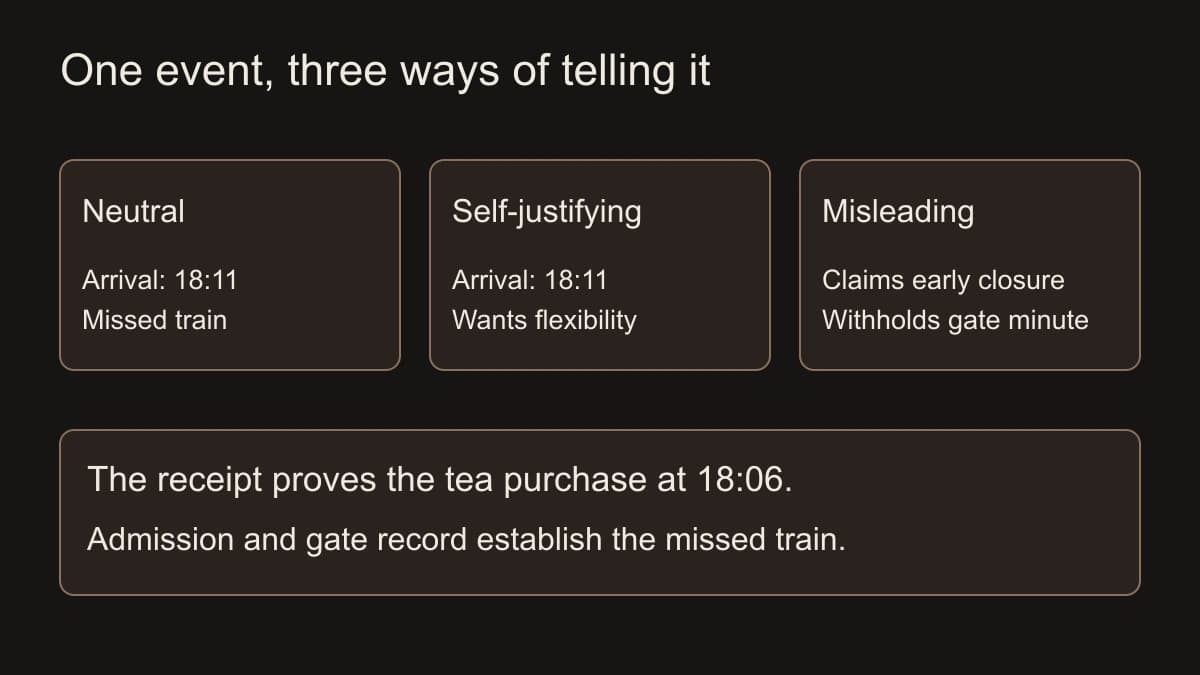
An unreliable narrator can defend a bad choice or deliberately give a false account. Keep the event fixed, then change how the narrator presents it. The three versions below tell the same missed train, with enough detail for a reader to question the telling.
Updated by the tempteo editorial team
The writing examples below are invented. They illustrate the advice and are not recorded chat results.
On this page
- Keep an event and voice worksheet
- Filled author record, separate from the reader start
- The same missed train in three complete versions
- Annotate the actual choices
- Independent reader starter
- Continue until the claim can be tested
- Repair a changed fact and retain the voice
- Use the voice in your own scene
- Sources
- Copy a starter or worksheet
Keep an event and voice worksheet
Fill this before rewriting the scene. The author fields hold the fixed event; the reader starter has its own smaller knowledge boundary.
Fill this before rewriting the scene. The author fields hold the fixed event; the reader starter has its own smaller knowledge boundary.
Reader character and exclusive control: [ ] AI narrator, mode and response stop: [ ] Event, place and chronological objective facts, author-only: [ ] Retained objects and their locations: [ ] Narrator's access to facts: [ ] Narrator claim in each version: [ ] Interpretation or intentional false statement, not new canon: [ ] Concrete signpost present in the prose: [ ] Reader character's starting observations and unknowns: [ ] Continuation: chosen question or check, source and result: [ ] What that result establishes and what remains uncertain: [ ] Last accepted state and next reader decision: [ ] Accidentally changed fact to reject: [ ] Allowed subjective voice to retain in repair: [ ] Focused OOC continuation request: [ ]
Filled author record, separate from the reader start
Filled author record, separate from the reader start
Reader character and exclusive control: Dena, Felix's traveling colleague; reader writes her words, actions, judgments and decisions. AI narrator, mode and response stop: Felix's first-person self-justifying account; portray clerk only when encountered; stop before Dena's response. Event, place and chronological objective facts, author-only: Alder Station, same evening. Felix enters the concourse cafe at 18:06, buys tea, stays until 18:09, reaches the gate at 18:11. Gate closes at 18:10 for the 18:10 train; train leaves as he reaches it. Clock is accurate. Felix never boards. Retained objects and their locations: Felix keeps the unused paper ticket in his coat. Tea receipt stamped 18:06 remains with it. Cup is left on cafe counter at 18:09. Dena brings her own timetable at 18:13. Clerk's gate sheet stays at desk. Narrator's access to facts: Felix saw clock at cafe and gate; he knows he stopped for tea. He cannot know whether a staff member would have waited for him. Narrator claim in each version: Neutral reports tea and late arrival; self-justifying says a small reasonable pause cost him the train; misleading claims the gate was closed before the appointed time. Interpretation or intentional false statement, not new canon: Reasonableness is interpretation. Early closure is Felix's deliberate false account. Neither changes the clock or gate time. Concrete signpost present in the prose: Self-justifying voice insists on what a passenger deserves; misleading voice avoids the minute and slips from "already shut" to "before its time" while keeping a stamped receipt. Reader character's starting observations and unknowns: Dena sees departing train, Felix outside gate and unused ticket. She did not see the cafe stop, receipt stamp or closure. She does not know why he missed it. Continuation: chosen question or check, source and result: Dena asks to compare receipt, accurate station clock and clerk's 18:10 gate record. Receipt proves a purchase at 18:06, not his later arrival; Felix admits 18:11; gate record corroborates 18:10. What that result establishes and what remains uncertain: He arrived late and the gate closed on schedule. Whether a staff member would have waited is untested. Whether tea was a reasonable choice remains a judgment. Last accepted state and next reader decision: At 18:17 both are outside the closed gate. Clerk offers the 19:00 connection; no rebooking yet. Dena chooses whether to rebook, wait or discuss responsibility. Accidentally changed fact to reject: A continuation puts Felix aboard the 18:10 train. Allowed subjective voice to retain in repair: Felix may still defend the tea stop and feel unfairly treated. Focused OOC continuation request: Restore Felix outside the gate with unused ticket; do not turn his defense into an on-time arrival.
The same missed train in three complete versions
These three passages are separate retellings of the same event. All use Felix's first-person voice; the neutral version restricts itself to observation. They are full narration examples, not chat starters.
Neutral observation
I entered the station cafe at six minutes past six. The concourse clock was above the door, and the train time on my ticket was 18:10. There were two people ahead of me. I ordered tea, paid and folded the receipt into the ticket. Its stamp read 18:06.
The tea was too hot to finish at once. I stood at the counter until the clock showed 18:09, drank what remained and left the cup there. From the cafe door I could see the sign for platform three. I crossed the concourse without stopping again.
At the gate the clock read 18:11. The barrier was closed. Beyond it, the last carriage of the 18:10 train was moving away from the platform. I held up my paper ticket, but nobody reopened the barrier. The printed departure time was still visible between my fingers.
I put the ticket and receipt back in my coat. When Dena arrived two minutes later with her timetable, I was standing outside the gate. We had no replacement booking.
Self-justifying interpretation
At 18:06 I went into the cafe for tea. Four minutes ought to be enough for a passenger to buy a drink. There were only two people ahead of me, and I had the ticket ready in my coat. I folded the stamped receipt into it so I wouldn't litter the counter.
The tea was hot. Leaving a full cup would have wasted the purchase, so I waited until 18:09 and finished it. Then I left the cup and went straight across the concourse. I didn't browse the shop or stop to look at a poster. Surely that counted for something.
The gate clock said 18:11 when I reached it. The barrier was shut and the 18:10 train was already pulling away. I raised my ticket. They could see I had paid, but nobody moved. From my side of the barrier, one minute felt negotiable.
I put the unused ticket and receipt back in my coat. Dena found me there at 18:13. I would have to explain why a cup of tea had become the most expensive part of our evening.
Intentionally misleading account
I was in the station with my ticket at 18:06. The cafe was right there, and I bought tea while the concourse was still busy. I kept the receipt. I'm quite particular about keeping receipts when a place has let me down.
I finished the cup at 18:09 and left it on the counter. I went straight to platform three. There's no point getting tangled in the exact minute on the gate clock; the barrier was already shut when I arrived. The train was still visible. A paid passenger was standing there with a perfectly valid ticket, and nobody would open up.
So yes, they shut me out before the appointed time. That's what I'll tell anyone who asks. I raised the ticket as the last carriage moved away, then put it back in my coat with the receipt. There wasn't much else I could do.
Dena arrived at 18:13 carrying her timetable. I stayed beside the closed barrier and showed her the unused ticket. "They didn't give me a chance," I said. I didn't offer her the receipt.
Annotate the actual choices
Writing Excuses 18.50, The Unreliable Narrator, distinguishes deliberate deception from mistaken perception and discusses clues that signal intentional unreliability. Here the accurate clock and stable objects make the three voices comparable. This is a writing method, with no claim about a model's reliability.
The neutral account states 18:11 without excusing it. The second admits the same minute but argues that a paid passenger deserved flexibility. "Surely that counted for something" asks the reader to share Felix's standard; it does not make his arrival earlier.
The misleading version first says only that the barrier was already shut, then upgrades that observation to "before the appointed time." Its refusal to name the gate minute and its withheld receipt invite a check. The false statement stays inside Felix's narration. An independent narrator must not subsequently confirm an early closure.
The receipt stamp can challenge a selective account of the cafe visit, but it cannot prove when Felix reached the gate. A continuation needs a separate observation, record or admission for that. Keep the strongest clue proportionate to what it actually shows.
Independent reader starter
It contains no cafe chronology, deliberate-deception motive or author solution. This starts an improvised account; supplying the exact worked truth separately is an author choice and provides no hidden truth engine.
OOC scene message
OOC: At Alder Station at 18:13, I play Dena, Felix's traveling colleague. I control Dena's words, actions, judgments and decisions. Portray Felix in first-person narration and dialogue, leaving his claims attributable to him. Use a self-justifying voice with concrete details that let me question his interpretation. Dena sees the 18:10 train departing, Felix outside the closed gate and his unused paper ticket. She did not see his earlier movements or when the gate closed. Do not supply an author truth register, decide that Dena believes him or choose our next travel plan. If we seek a record, establish it in the scene before using it. Begin after Dena asks, "What happened at the gate?" Stop for my response.
Continue until the claim can be tested
The continuation below follows the self-justifying version. It is a complete original illustration of both sides. Its reader turns demonstrate one possible inquiry; your own Dena can decline it. Earlier Dena begins with only the starter's observations.
Your turn as Dena, 18:13
"You have the ticket. What time did you reach this gate?"
Illustrative AI reply: Felix
I slide the ticket out, careful to keep the receipt behind it. "About when it was leaving. I went straight across from the cafe." I look at the closed barrier. "I didn't wander."
Your turn as Dena
"Going straight doesn't tell me the minute. Can I see the receipt?"
Illustrative AI reply
I unfold it and hold it where she can read the stamp. "Six past. Tea. There was time." The receipt is for a purchase at 18:06. It has no gate-arrival entry.
Your turn as Dena
"That tells me when you paid. Let's ask the clerk when the barrier closed."
Illustrative AI reply: clerk and Felix, 18:15
The clerk keeps the gate sheet on the desk and turns it so the 18:10 closure entry is visible. "On the departure minute. The concourse clock is correct." I take my receipt back with the ticket. "I saw eleven when I got here," I say. "I still think someone could have waited."
Your turn as Dena
"Then it wasn't closed early. I'll keep the times separate from whether waiting would have been kind. What connection is available?"
Illustrative AI reply: 18:17
The clerk points to the 19:00 connection on Dena's timetable. "That is the next departure. We haven't changed either booking." I stand beside Dena, ticket unused in my coat. "An hour for a cup of tea," I say. The clerk leaves the rebooking form untouched and waits for Dena's decision.
The objective timing is now established in this continuation. Felix can keep his resentment without changing it. The scene leaves a specific uncertainty: no one tested whether staff would have waited if asked earlier. It also leaves a practical decision open, whether to take the next train.
Repair a changed fact and retain the voice
A wrong continuation says, "Felix settles into his seat on the 18:10 train, still complaining about the gate." It changes the event that all three versions were supposed to share. Correct the boarding, while keeping the permitted subjective voice.
OOC correction
OOC: Reject Felix boarding or already sitting on the 18:10 train. Resume at 18:13 outside Alder Station's closed gate, with the train departing and Felix's paper ticket unused in his coat. His tea cup was left at the cafe counter. Keep his self-justifying view that a brief tea stop deserved some flexibility; that view does not change his missed train. Portray Felix's account and stop before Dena's reply or any rebooking. Leave my decision and judgment to me.
Corrected illustrative AI reply
I stand outside the barrier with the unused ticket in my coat. "Four minutes should have been enough for tea," I say. The last carriage moves away. I wait for Dena's answer.
An OOC message requests the next continuation. It leaves the mistaken boarding reply in the history. Compare the next answer with your manual event note before continuing; the correction does not erase it or create stored story memory.
Use the voice in your own scene
For wider continuity errors, use the in-character continuity guide. The manual facts guide covers keeping a compact record beside the chat. Open roleplay AI chat, adapt the reader starter to your chosen character and review it before sending. Keep the author record separately; prepared text does not send itself.
Sources
Writing Excuses 18.50: The Unreliable Narrator supports the distinction between kinds of unreliability and deliberate reader signposts. All train passages and worksheet fields are original.
Copy a starter or worksheet
Choose one starter or form to copy. Keep the planning record in your own notes and check the next chat reply against it.
Blank author, claim, signpost and continuation form
Reader character and exclusive control: [ ] AI narrator, mode and response stop: [ ] Event, place and chronological objective facts, author-only: [ ] Retained objects and their locations: [ ] Narrator's access to facts: [ ] Narrator claim in each version: [ ] Interpretation or intentional false statement, not new canon: [ ] Concrete signpost present in the prose: [ ] Reader character's starting observations and unknowns: [ ] Continuation: chosen question or check, source and result: [ ] What that result establishes and what remains uncertain: [ ] Last accepted state and next reader decision: [ ] Accidentally changed fact to reject: [ ] Allowed subjective voice to retain in repair: [ ] Focused OOC continuation request: [ ]
Filled author and continuation record
Reader character and exclusive control: Dena, Felix's traveling colleague; reader writes her words, actions, judgments and decisions. AI narrator, mode and response stop: Felix's first-person self-justifying account; portray clerk only when encountered; stop before Dena's response. Event, place and chronological objective facts, author-only: Alder Station, same evening. Felix enters the concourse cafe at 18:06, buys tea, stays until 18:09, reaches the gate at 18:11. Gate closes at 18:10 for the 18:10 train; train leaves as he reaches it. Clock is accurate. Felix never boards. Retained objects and their locations: Felix keeps the unused paper ticket in his coat. Tea receipt stamped 18:06 remains with it. Cup is left on cafe counter at 18:09. Dena brings her own timetable at 18:13. Clerk's gate sheet stays at desk. Narrator's access to facts: Felix saw clock at cafe and gate; he knows he stopped for tea. He cannot know whether a staff member would have waited for him. Narrator claim in each version: Neutral reports tea and late arrival; self-justifying says a small reasonable pause cost him the train; misleading claims the gate was closed before the appointed time. Interpretation or intentional false statement, not new canon: Reasonableness is interpretation. Early closure is Felix's deliberate false account. Neither changes the clock or gate time. Concrete signpost present in the prose: Self-justifying voice insists on what a passenger deserves; misleading voice avoids the minute and slips from "already shut" to "before its time" while keeping a stamped receipt. Reader character's starting observations and unknowns: Dena sees departing train, Felix outside gate and unused ticket. She did not see the cafe stop, receipt stamp or closure. She does not know why he missed it. Continuation: chosen question or check, source and result: Dena asks to compare receipt, accurate station clock and clerk's 18:10 gate record. Receipt proves a purchase at 18:06, not his later arrival; Felix admits 18:11; gate record corroborates 18:10. What that result establishes and what remains uncertain: He arrived late and the gate closed on schedule. Whether a staff member would have waited is untested. Whether tea was a reasonable choice remains a judgment. Last accepted state and next reader decision: At 18:17 both are outside the closed gate. Clerk offers the 19:00 connection; no rebooking yet. Dena chooses whether to rebook, wait or discuss responsibility. Accidentally changed fact to reject: A continuation puts Felix aboard the 18:10 train. Allowed subjective voice to retain in repair: Felix may still defend the tea stop and feel unfairly treated. Focused OOC continuation request: Restore Felix outside the gate with unused ticket; do not turn his defense into an on-time arrival.
Independent reader starter
OOC: At Alder Station at 18:13, I play Dena, Felix's traveling colleague. I control Dena's words, actions, judgments and decisions. Portray Felix in first-person narration and dialogue, leaving his claims attributable to him. Use a self-justifying voice with concrete details that let me question his interpretation. Dena sees the 18:10 train departing, Felix outside the closed gate and his unused paper ticket. She did not see his earlier movements or when the gate closed. Do not supply an author truth register, decide that Dena believes him or choose our next travel plan. If we seek a record, establish it in the scene before using it. Begin after Dena asks, "What happened at the gate?" Stop for my response.
A wrong continuation says, "Felix settles into his seat on the 18:10 train, still complaining about the gate." It changes the event that all three versions were supposed to share. Correct the boarding, while keeping the permitted subjective voice.
Focused changed-fact repair
OOC: Reject Felix boarding or already sitting on the 18:10 train. Resume at 18:13 outside Alder Station's closed gate, with the train departing and Felix's paper ticket unused in his coat. His tea cup was left at the cafe counter. Keep his self-justifying view that a brief tea stop deserved some flexibility; that view does not change his missed train. Portray Felix's account and stop before Dena's reply or any rebooking. Leave my decision and judgment to me.
Corrected AI portrayal, illustration: I stand outside the barrier with the unused ticket in my coat. "Four minutes should have been enough for tea," I say. The last carriage moves away. I wait for Dena's answer. An OOC message requests the next continuation. It leaves the mistaken boarding reply in the history. Compare the next answer with your manual event note before continuing; the correction does not erase it or create stored story memory.

