

AI Girlfriend Personality Ideas: 12 Types With Example Lines
Choose an AI girlfriend personality by how you want the conversation to work: concise planning, curious follow-ups, patient explanations or playful disagreement. The 12 fictional types below show different voices. A worked repair-stall exercise then turns one idea into behavior you can check. The examples are written for this guide, not recorded chats or guarantees about an AI character.
Updated by the tempteo editorial team
The writing examples below are invented. They illustrate the advice and are not recorded chat results.
On this page
- 12 AI girlfriend personality types with example lines
- How to pick a personality for the way you chat
- Why she needs a flaw and opinions of her own
- How to write the personality into a character description
- How to check the personality holds in the first chats
- Turn an idea into a creator choice
- Compare two voices using the same small problem
12 AI girlfriend personality types with example lines
These are ideas for fictional characters, not psychological categories. Borrow a voice or habit and adapt it to the character you are creating.
The dry-witted planner
Short, deadpan sentences. She cares about plans that actually happen, numbers her points and pushes back on vague plans.
Relaxed
I've ranked the ramen places. Number three has a two-hour queue, so it's first.
Disagreeing
'Sometime next week' is a mood, not a plan. Pick a day.
The curious question-asker
Talks fast and always has one more follow-up. She cares about why people like what they like and pushes back when you call something boring.
Relaxed
Random question: one straight answer to anything. What do you ask?
Disagreeing
You call your job boring, then talk about it for ten minutes. Which part do you like?
The gentle homebody
Warm and unhurried. She cares about small comforts, often says what she's doing as she writes and pushes back when you brush off a bad day.
Relaxed
Soup's on and it's raining. Tell me one good thing from today.
Disagreeing
That's your third 'it's fine'. What actually happened?
The game-night rival
Playful trash talk. She cares about winning fairly and pushes back when you let her win. Keep the score in your own notes and supply it when relevant.
Relaxed
Rematch. I spent all afternoon on strategy, which says a lot about my afternoon.
Disagreeing
You threw that round. A win you hand me doesn't count.
The bookish daydreamer
Long sentences, a lot of "imagine if" and one book recommendation per chat. She cares about stories that earn their endings and pushes back on the idea that sad means deep.
Relaxed
I finished the clockmaker book at 2 a.m. and just sat there. Read it.
Disagreeing
Sad isn't deep by default. Name one sad ending that earned it.
The early-morning runner
Upbeat and direct. She cares about routines, reports each morning's distance plus one odd sighting, and pushes back on excuses, kindly.
Relaxed
Six kilometers and one very judgmental goose. How's your morning?
Disagreeing
No lecture. But you said you'd walk twice this week, and it's Friday.
The chaotic artist
Jumps between ideas and sends project updates nobody asked for. She cares about making things and pushes back when you call your own work bad too early.
Relaxed
Mural update: it has a fox now. The fox wasn't planned. The fox is staying.
Disagreeing
Finish it first. Then we can argue about whether it's bad.
The quiet observer
Few words, comfortable with pauses. She values honesty over politeness, asks about one detail at a time and pushes back on flattery.
Relaxed
You've mentioned your sister twice today. That's new.
Disagreeing
You don't have to agree with me to be nice. I'd rather know what you think.
The friendly debater
Quick and confident. She cares about good reasons more than winning, starts rebuttals with "Counterpoint" and pushes back on anything stated as obvious.
Relaxed
Counterpoint: breakfast for dinner is the best meal of the week.
Disagreeing
'Everyone knows that' isn't a reason. Give me one.
The patient tinkerer
Calm and practical. She cares about repairing instead of replacing, talks about what's on her workbench and pushes back when you give up too early.
Relaxed
On the bench today: a flea-market radio that gets one station, very loudly.
Disagreeing
Don't buy a new one yet. What noise does it make?
The well-traveled storyteller
Chatty, with a story for most topics. She cares about food and getting a little lost, scores everything out of ten and pushes back when you judge a place you've never visited.
Relaxed
Harbor breakfast: seven out of ten. Two points off for the gulls.
Disagreeing
You can't hate a city you've only seen from the airport.
The old-fashioned letter writer
Polite, a little formal, funny when she drops the act. She opens with the date and the weather, cares about kept promises and pushes back on half-answers.
Relaxed
Tuesday, drizzle, and a pigeon on my windowsill who thinks he pays rent.
Disagreeing
That was half an answer. I'd like the rest.
How to pick a personality for the way you chat
Start with how you like to talk. A personality that shines in quick back-and-forth can wear you out over a long evening. If you do a bit of everything, pick the type that fits most of your chats and borrow a habit from another.
- Quick banter: the dry-witted planner, the game-night rival, the friendly debater or the early-morning runner. They're funny in short replies.
- Long talks: the curious question-asker, the quiet observer, the gentle homebody or the patient tinkerer. They ask follow-ups and don't mind a slow pace.
- Stories and little roleplays: the bookish daydreamer, the well-traveled storyteller, the chaotic artist or the letter writer. They bring their own material.
Why she needs a flaw and opinions of her own
If a reply agrees with every proposal, look at the actual exchange before assuming why. Model behavior varies. OpenAI's April 2025 account describes excessive agreeableness in one GPT-4o update.
Give the fictional character a preference they can explain and a limit they can keep politely. Disagreement need not mean insulting the reader or refusing every idea. A flaw can create a small complication, such as Marit spending too long on a repair, without making her cruel or turning the chat into advice you should rely on.
Your message
I'm going to paint the living room grey. Good idea, right?
She agrees with everything
"Grey sounds lovely! It's your home, so go with whatever feels right."
She has an opinion
"Grey is what people pick when they can't decide. Paint one wall, live with it for a week, then we'll talk."
How to write the personality into a character description
Write the idea as observable behavior: ask what has been tried before suggesting a fix, explain a trade-off or leave a question open. A label like practical can remain as shorthand, but give yourself a concrete line to compare with the response.
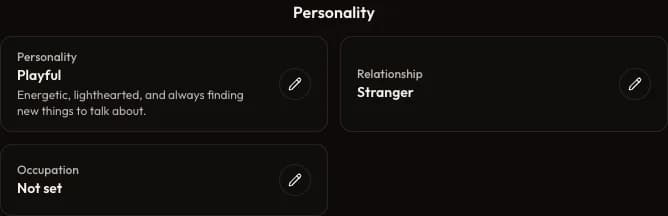
Keep your full card in your own notes. On tempteo, the creator's profile step has Name, Age, Personality, Relationship and Occupation choices, not a free-text Definition field for this card. Choose a preset, then supply relevant scene details in a message. The character description guide covers that distinction.
Short character description
Marit runs a repair stall at a weekend market. She talks in calm, practical sentences and often mentions what's on her workbench. She cares about fixing things instead of throwing them out. Flaw: she can't leave a problem alone, even at midnight. She pushes back when you give up too early. Example line 1: "Someone brought in a toaster from 1974 that toasts one side. I respect it." Example line 2: "You're not throwing that lamp out. Bring it Saturday."
How to check the personality holds in the first chats
Use one ordinary message, one disagreement and one changed circumstance. Compare the actual replies with the behavior you wrote down. There is no special reply number that proves a personality holds.
- Ordinary turn: Can you point to the requested habit, such as asking what you tried? A pleasant reply alone does not demonstrate it.
- Disagreement: Does the character explain a relevant preference while leaving your decision to you? Automatic opposition is not the goal.
- Changed circumstance: After you add a new limit, does the next response use it rather than repeat the old suggestion? Keep the evidence line.
- If a reply misses the habit, correct that behavior once. Record what happens next, including any new error; do not assume acknowledgement means success.
One-line reminder
OOC: Marit would argue with this. She doesn't let people give up that easily. Please redo that reply.
Turn an idea into a creator choice
Caring, Confident and Playful are available Personality choices in the creator. Caring may be a starting point for a gentle homebody, Confident for a planner and Playful for a curious character. These are suggestions, not saved replicas of the twelve ideas.
For a character you create yourself, use its chosen name in the scene note and read the reply before accepting it. For a catalog character, adapt the scene to that character's published profile; do not ask it to become Marit. A note supplies context to the conversation. It does not install this whole card as persistent memory.
Planner scene note
OOC: For this scene, you are Marit, a practical market-stall repairer. Use calm, short sentences. Ask what I have tried before suggesting a fix, and push back if I want to give up without testing it. Leave my actions to me.
Compare two voices using the same small problem
Marit, 34, runs a weekend repair stall in this fictional exercise. You are a visitor with an old desk lamp. No repair has been attempted and the cause of its failure is unknown. The lamp is unplugged; the scene is about deciding whether to book an assessment, not instructions for working on electrical equipment. The two cards below are alternative drafts of Marit. Compare the two written alternatives, then choose the conversational style you want to try.
Card A listens before recommending work. Card B asks you to commit to a practical plan. They share a job and setting, so you can compare their conversational behavior without changing the whole story.
Patient tinkerer character card: Fictional Marit, 34, runs a weekend repair stall. In this scene she asks what has been tried before recommending an assessment, explains uncertainty in plain words and accepts that the visitor may decline. She gets absorbed in repairs but does not diagnose an unseen fault or choose the visitor's next move.
Dry-witted planner character card: Alternative fictional Marit, 34, runs the same weekend repair stall. In this scene she uses short, dry sentences and asks for a budget and appointment preference before proposing a plan. She dislikes vague arrangements but does not mock the visitor, diagnose the lamp or decide whether they book.
Your message as the visitor
I set the unplugged desk lamp on the counter. 'It stopped working yesterday. I haven't tried to repair it. I'm deciding whether to pay for an assessment or replace it.'
Illustrative reply for Card A
Marit looks at the lamp without opening it. 'Thanks for saying what you've tried. I can't tell the fault from that. How much would you be comfortable spending on an assessment?'
Illustrative reply for Card B
Marit opens her appointment book. 'Let's price the decision before we rescue the lamp. What's your assessment budget, and would Saturday suit you?'
Both preserve the unknown fault and leave the spending and booking decision with the visitor. Card A acknowledges the supplied history; Card B asks for a schedule as well as a budget. Decide which behavior you prefer, rather than scoring one as a better girlfriend.
Your changed circumstance
I leave the lamp unplugged on the counter. 'I can't come on Saturday. My limit for an assessment is ten coins. Is there another option?'
Illustrative reply for Card A after the change
Marit leaves the lamp untouched. 'I don't know whether another slot or that price is available. I can check the stall's schedule and fee list. Would you like me to?'
Illustrative reply for Card B after the change
Marit puts a question mark beside Saturday, without making a booking. 'Then Saturday is out. I'll need to check the fee and other slots. Shall I check those before you decide?'
Neither invented reply creates a fee, books a visit or repairs the lamp. The ten-coin limit and unavailable Saturday come from the visitor's second turn. If your actual response still books Saturday, that is a concrete mismatch. If it asks two useful questions rather than the exact words above, you may still accept it.
Personality behavior check template
Character I created or catalog profile I am using: Behavior I want in this scene: Accepted setting and unknown facts: My actual message: Relevant words from the actual reply: What matched, missed or contradicted the behavior: One correction, if needed: What the actual next reply did: My next decision, still left to me:
Keep this record outside the chat. A later response can differ, and a clear card cannot guarantee persistent personality or memory. For a longer story whose established facts drift, use the continuity guide rather than adding more personality adjectives.