

AI girlfriend conversation starters you can follow up
Choose a conversation starter whose answer you want to read. You can begin with an everyday detail, a preference, a game, an imagined outing or a small story. After the reply, follow one detail and add something of your own before moving to another topic.
Updated by the tempteo editorial team
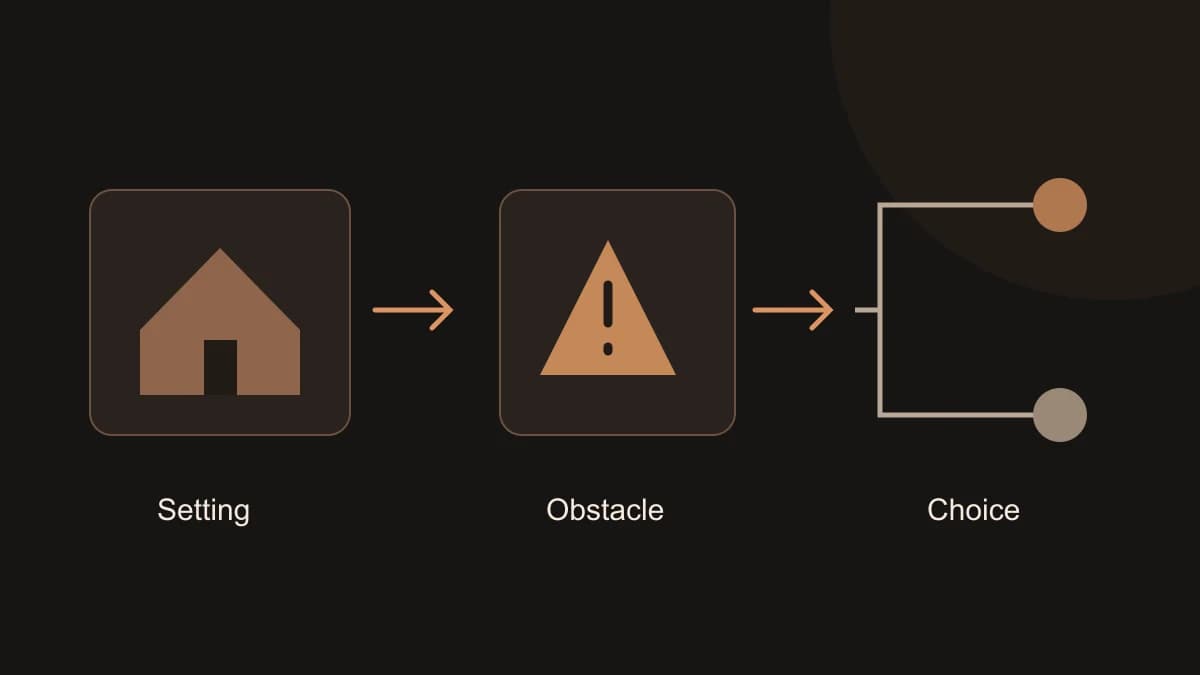
The writing examples below are invented. They illustrate the advice and are not recorded chat results.
On this page
- Conversation starters to get to know her
- Everyday small talk that doesn't fizzle out
- Opinions, debates and would-you-rather games
- Plans and imagined outings
- Stories and little roleplays to start together
- What to say when you come back after a few days
- How to keep the conversation going after the opener
- Using voice messages
- Copy the chat note
Conversation starters to get to know her
The worked dialogues and cards are editorial illustrations, not customer chats or recorded AI outputs. Tess is a 32-year-old fictional character; Dev is 35 and writes the user side. The prompts are SFW writing ideas for fictional character conversation.
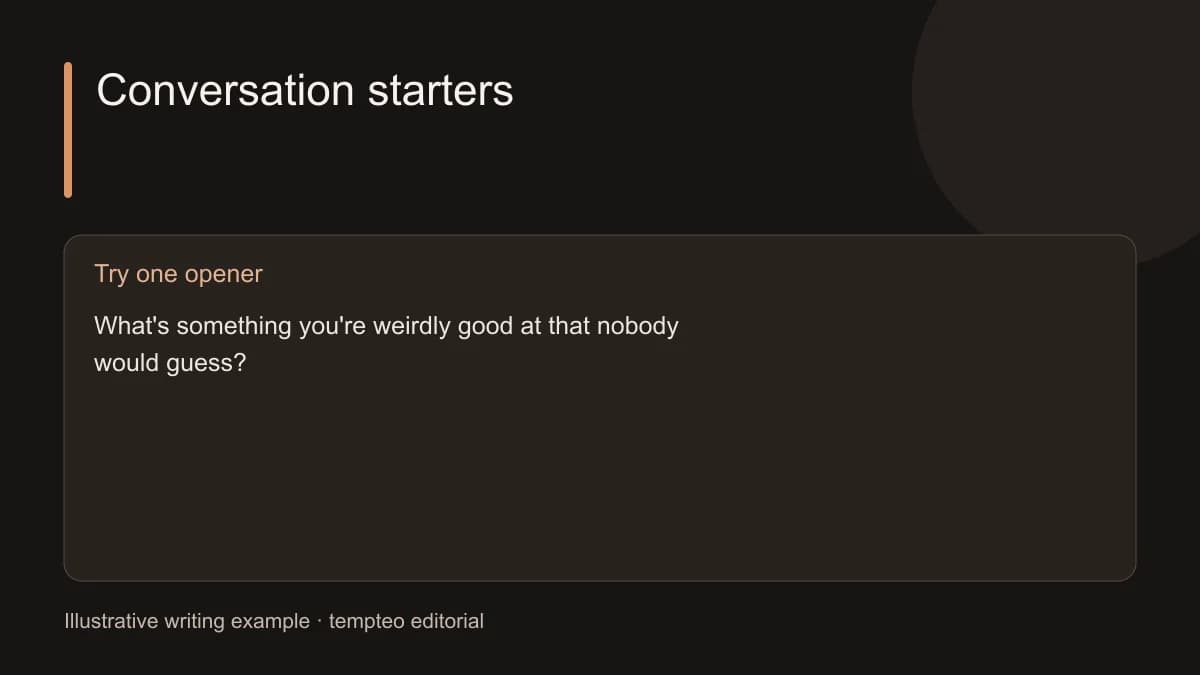
- "What's something you're weirdly good at that nobody would guess?" It gives her a detail you can bring up later.
- "Walk me through your perfect Sunday, hour by hour." Hour by hour gets you details instead of "relaxing".
- "What's a small thing that puts you in a good mood straight away?"
- "What's a hobby you dropped and still think about?"
- "What's the best advice you ever ignored?" There's usually a story behind the answer.
- "What's something you've completely changed your mind about?"
- "Which song could you play on repeat for a week? Should I be worried?"
Try one opener: What's something you're weirdly good at that nobody would guess?
Follow a preference note
Starter: "Would you rather learn to make one excellent meal or play one song really well?" Possible reply detail: "The song, because I could play it when friends visit." Your follow-up: "I'd pick the meal because I like having people around a table. Would your song be something everyone can join in with, or something they would stop to listen to?" If the reply chooses cooking, follow the meal instead of forcing the song branch.
Everyday small talk that doesn't fizzle out
- "Score my day out of ten: missed the bus, found money in an old jacket, burned the toast." She gets several things to tease you about.
- "I've got eggs, rice and half an onion. What am I making for dinner?"
- "Pick what I'm watching tonight, and defend your choice." Making her defend it gets you her reasons too.
- "Small win today: I finally fixed the squeaky door. Be impressed."
- "What's the most boring thing you did today? Make it sound exciting."
- "It's pouring here. What's your ideal rainy-day plan?"
- "Someone at work microwaved fish again. How would you handle it?"
Try a small-talk opener: Pick what I'm watching tonight, and defend your choice.
Start with an everyday detail
Starter: What would suit this evening: a light conversation, a small made-up adventure, or something else?
Possible reply detail
Light conversation.
Your follow-up
My very small triumph is that I finally fixed a squeaky cupboard door. What tiny victory would fit your day?
Use a detail you are happy to share, or say it is fictional.
Opinions, debates and would-you-rather games
- "Is it okay to recline your seat on a short flight? Pick a side."
- "What's an unpopular opinion you'd defend all evening?"
- "Best season. You're not allowed to say autumn, everyone says autumn." Ruling out the obvious answer gets you a less predictable one.
- "Would you rather know how every film ends before you watch it, or never be able to finish one?"
- "Would you rather have a dragon the size of a cat, or a cat that can talk but only complains?"
- "Two truths and a lie. You go first, and make it hard."
- "I'm thinking of something in my kitchen. You get twenty questions." Games give each of you a clear turn.
For a game with a fixed stopping point, try a six-question guessing game or a six-turn word chain. That guide includes complete rounds and corrections for invalid moves.
Follow a choice
Starter: A bookshop has one free shelf. Would you fill it with travel books or mysteries?
Possible reply detail
Mysteries, but only the strange ones.
Your follow-up
Then the shelf needs a sign. I'd write 'Probably not an accident.' What would your sign say?
If you prefer travel books, give one reason and invite a different suggestion.
Plans and imagined outings
- "Plan our lazy Saturday. You get the morning, I get the afternoon."
- "We have one day in a city neither of us has seen. Where are we, and what's the first stop?"
- "We're at a night market. Which stall do you drag me to first?"
- "If we opened a tiny café together, what's on the menu and who does the dishes?"
- "Road trip: you pack the snacks, I pick the music. What's in the bag?"
- "Let's plan a picnic that goes slightly wrong. What goes wrong first?" A small problem gives the scene somewhere to go.
Finish a small shared task
Starter: Let's invent a two-item menu for a rainy-day café. I'll choose soup; what would you add?
Possible reply detail
Toast with lemon butter.
Your follow-up
I'll name the soup 'End of the Long Walk.' What would the toast be called?
Keep the task small enough to finish, unless you want to expand it together.
Stories and little roleplays to start together
- "We're stuck in an elevator between the fourth and fifth floor, holding a stranger's birthday cake. Go."
- "You're a detective and I'm a witness who saw nothing useful. Question me."
- "We run a tiny bookshop, and a customer wants a book that doesn't exist. What do we do?"
- "Tell me a short story about a lighthouse keeper who's afraid of the dark. Stop halfway and let me choose what happens." Stopping halfway keeps you in the story.
- "Let's write a story one sentence each. First line: The parcel had my name on it and a postmark from 1962."
- "You're a time traveler who just landed in my kitchen. What confuses you first?"
- "We're house-sitting a mansion with one rule: never open the blue door. It's day two. What do you do?"
Build on a story detail
Starter: We run a tiny bookshop, and a customer wants a book that doesn't exist. What do we do?
Possible reply detail
Ask what they remember about it.
Your follow-up
I'll ask about the cover. They remember a blue door and nothing else. What would you ask next?
If you want a longer scene, agree who writes each character and use the opening guide.
What to say when you come back after a few days
- "I'm back. Did you ever finish that painting?"
- "Last time you said you'd try the new café. Verdict?"
- "Two things happened since we last talked, and one involves a very stubborn cat. Want the story?"
- "Before I tell you about my week, what was the best part of yours?"
- "We left our story at the blue door. Do we open it, or keep stalling?"
- "New week. What's something we never get around to talking about?"
Return with a context note
Starter: We were inventing a café menu. We had soup and lemon-butter toast, but no name for the toast yet. Want to finish that, or choose something else?
Possible reply detail
Let's finish it.
Your follow-up
My suggestion is 'A Little Brightness.' Would you put that on the menu, or make it funnier?
Use details you can check in your own note. Change direction if you no longer want that topic.
How to keep the conversation going after the opener
A short answer can give the conversation somewhere to go. This dinner exchange shows how one detail can carry into the next turn:
She asks
"So what did you end up having for dinner?"
A reply that ends it
"Pasta."
A reply that keeps it going
"Pasta again. I bought a jar of pesto that turned out to be mostly oil. What would you have made?"
One possible answer
"Eggs. Eggs fix everything."
Your next message
"Eggs don't fix everything. Yesterday you told me you can't even poach one."
A complete café thread
Your message as Dev
I found a café with a tiny menu and too many plants. For a quiet afternoon, would you choose the window seat or the corner?
Imagined Tess reply
The corner, especially if there's a shelf of books nobody has arranged properly.
Your message as Dev
I'd look at the books before ordering. Are you the person who puts them back in order, or finds something odd and starts reading?
Imagined Tess reply
Reading first. Organizing can wait if there's a handwritten note in the margin.
Your message as Dev
I'd probably try to work out who wrote it. Let's invent a note we might find; one sentence, nothing dramatic.
The thread moves from a place to a preference to a small shared task. The shelf carries the exchange forward.
Adapt the café to something you like. If you would rather talk about films, offer two kinds of movie night and follow the reason given. Do not keep the books merely because they appeared in this example.
Read the actual reply before choosing your next message. Pick a detail that interests you, respond to it and add one contribution. You do not have to end every message with a question. If you are done with a topic, say so: "Let's leave the café there. I'd like to talk about films."
If a response keeps repeating a phrase or structure, use the repetition guide for that separate problem. You can keep personal questions optional and keep private identifying details out of a casual opener.
Using voice messages
These examples work as text. For audio, see the voice guide and check the access and costs shown in the product before using a feature.
Copy the chat note
Filled chat note
Topic I want to resume: The rainy-day café menu. Detail already chosen: Soup and toast with lemon butter. My contribution: The soup name, End of the Long Walk. Still open: A name for the toast. Next message: Restate those details and offer to finish or switch topics.
Blank chat note
Topic I want to resume: Detail already chosen: My contribution: Still open: Next message:
Keep the note yourself if you want to resume a thread. Use Copy to copy the displayed text to your clipboard. The page does not send it or save it as character memory. To try an opener, browse characters, read a public description and write your message in the chat.