Play a Comedy AI Roleplay With Room for Your Next Line
Give a comic scene a small job and one awkward rule, then leave time for the other character to answer. In the library scene below, returning a trolley requires treating it as a borrower. The exchange develops that same problem instead of adding a new disaster at every turn. Whether it makes you laugh is a matter of taste.
Updated by the tempteo editorial team
The writing examples below are invented. They illustrate the advice and are not recorded chat results.
On this page
Choose a problem the characters take seriously
"Be funny" leaves the next reply to invent a style, target and situation at once. A more useful starting point supplies a task, a relationship and the particular inconvenience both characters must work around. Decide whose decisions you write and where a reply should stop.
Our original scene has Ellis, the reader's character, returning an empty library trolley. Bex, the AI-portrayed clerk, sincerely follows an absurd policy: wheeled equipment needs a borrower record before it can be checked back in. The trolley stays an ordinary inanimate object. The humor can come from the paperwork; neither person needs to insult the other.
Comic-scene form
Ordinary task: Reader's character and decisions: AI character and practical goal: One awkward rule or mismatch: Facts that remain ordinary: Tone and excluded material: Length and stopping point: Earlier detail available for a later callback:
A complete short library scene
These are written examples, not a transcript of a tested AI performance. Ellis's lines illustrate one possible reader choice. In your chat, the clerk should wait for the choice you actually make.
Independent starter
OOC: A gentle comic scene at a library returns desk. I play Ellis and control Ellis's dialogue, actions and decisions. You play Bex, a sincere clerk trying to finish an equipment return. Ellis brings one empty borrowed trolley. It is ordinary and inanimate. The library's one absurd rule is that wheeled equipment needs its own borrower record before return. Ellis wants the return recorded; Bex wants usable paperwork. Use one short action and one or two spoken lines per turn, then wait for Ellis. Keep it friendly, with no insults or danger. Do not add unrelated disasters or explain the joke. Begin before any form is signed.
Illustrative AI reply, Bex
Bex slides a card across the desk. "The trolley needs a borrower record. Does it have proof of address?"
Your turn as Ellis
"The cupboard. It has lived there longer than I have."
Illustrative AI reply, Bex
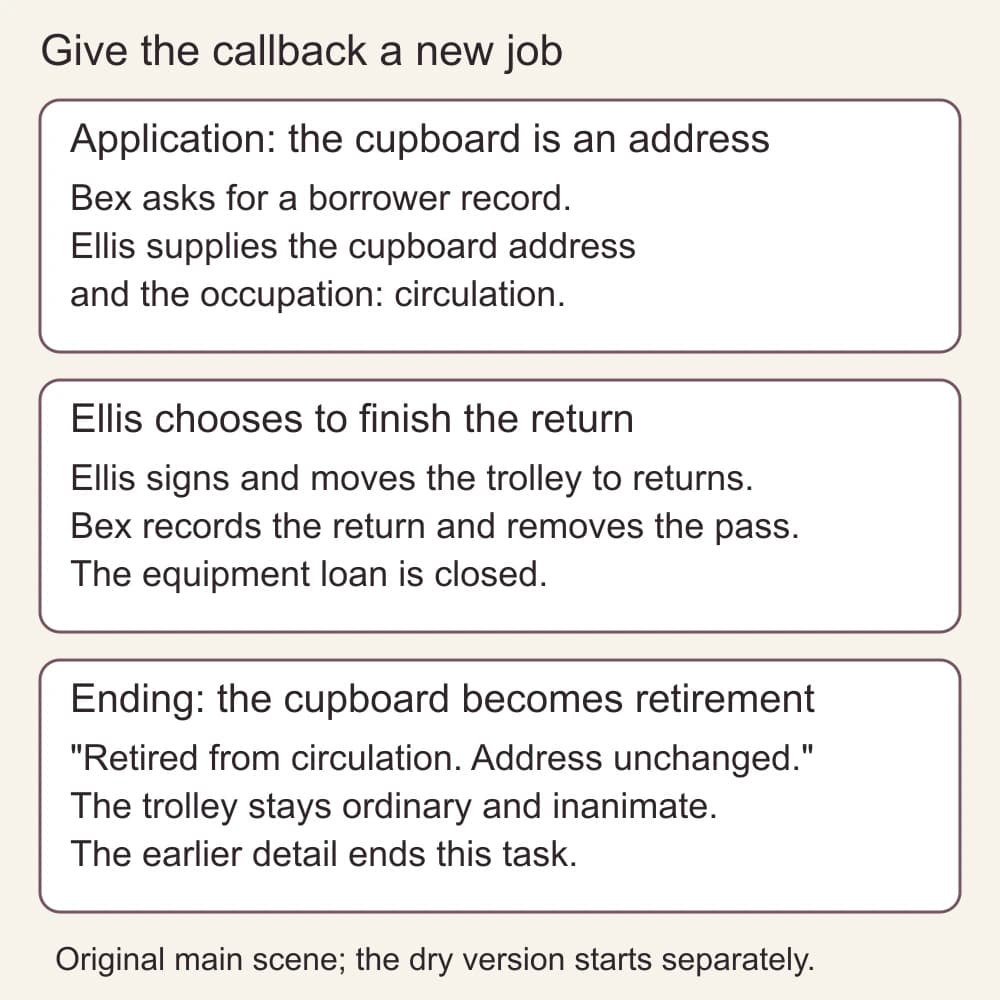
Bex writes "Cupboard" in the address box. "And its occupation?"
Your turn as Ellis
"Circulation. Mostly round the carpet."
Illustrative AI reply, Bex
Bex checks a box. "Excellent. An experienced library worker. I can issue a temporary reader pass, but someone must sign for it."
Your turn as Ellis
"I'll sign as its responsible adult. Does the pass let me return it?"
Illustrative AI reply, Bex
Bex points to the signature line. "Yes. After that I can close the equipment loan. The pass stays on the handle until I remove it."
Your turn as Ellis
I sign the form and push the trolley to the marked returns space. "Then please close the loan. It has had a long working day."
Illustrative AI reply, Bex
Bex records the return and removes the temporary pass. She places it beside the cupboard key. "Retired from circulation. Address unchanged."
The practical task is complete: the equipment loan is closed and the trolley is in the returns space, ready to be put away. "Address unchanged" brings back the cupboard in a new role, as the end of the trolley's working day. The example stops there instead of opening a second plot.
Let a callback do something new
Repeating "Does it have proof of address?" after every message would keep returning to the first obstacle. In the worked scene, each contribution gives Bex something usable: an address, an occupation, a person to sign. Bex's formal process adapts to Ellis's answers and eventually allows the return. The clerk remains earnest throughout.
Try keeping a short note: "Earlier detail: cupboard address. Already used: application. Available later use: where the trolley retires." That is your writing note, not a promise that a character will remember it in another chat. Drop a callback if it no longer fits the accepted events.
Compare a drier version of the opening
This is an alternative beginning from the unsigned form. The pass, signature and completed return above have not happened in this version.
Illustrative AI reply, Bex
"The trolley has no borrower record."
Your turn as Ellis
"It has been coming here for years."
Illustrative AI reply, Bex
Bex looks at the worn wheels. "Then we should have noticed sooner."
Your turn as Ellis
"Can I sign for it?"
Illustrative AI reply, Bex
"On this line. I'll close the loan once you sign and place it in returns."
Your turn as Ellis
I sign and wheel it into the marked space.
Illustrative AI reply, Bex
Bex records the return. "A regular at last."
The dry version ends the same task with fewer exchanges. Neither version needs a narrator to announce a pause, tell you Ellis laughs or explain why the paperwork is absurd. Ask for the shorter style if the long application stops being enjoyable; you need not preserve every planned joke.
Redirect a joke that is taking over
Suppose a continuation makes the trolley talk, insults Ellis and repeats the address question after Bex has already recorded it. That changes the agreed premise and restarts completed work. You can keep the useful part of the scene without accepting those additions.
Correction at the application stage
OOC: Keep the ordinary inanimate trolley and Bex's sincere paperwork. Bex has recorded the cupboard address and circulation occupation; the form is still unsigned. Reject the speaking trolley, insults and repeated address question. Continue with Bex explaining the next practical step in one short turn, then wait for Ellis. Keep the humor in the procedure, and do not explain the joke or write Ellis's reaction.
Use the state that actually applies in your exchange. After the return has been recorded, a repair should keep that return complete rather than going back to an unsigned form. An OOC instruction can be missed; check the next reply and stop if the tone still feels wrong. Agreement inside a fictional scene does not require accepting unwanted content.
Start a scene you would like to answer
Pick another small task if the library premise does not suit you: two volunteers labeling identical plant pots, or a ceremonial announcer introducing a very ordinary lunch. Give it one mismatch, then write your own first move. Leave the ending open until the characters have done something that earns it.
For more premises, see AI roleplay ideas. If every turn repeats a line, use AI keeps repeating itself. Open roleplay AI chat, adapt the starter to the chosen character and send it yourself. A catalog character may interpret the scene differently; this is a writing exercise, not a guaranteed comedic persona or a measured learning outcome.

