

Horror Roleplay Ideas: 20 Scary Plots With First Lines
A new door, an unanswered phone call or a rule nobody will explain can start a horror roleplay. The 20 plots below give you a premise, an open question and a first line to adapt. The worked new-door scene shows how to add a clue and leave your next action open. These are invented writing examples; the tone stays eerie rather than graphic.
Updated by the tempteo editorial team
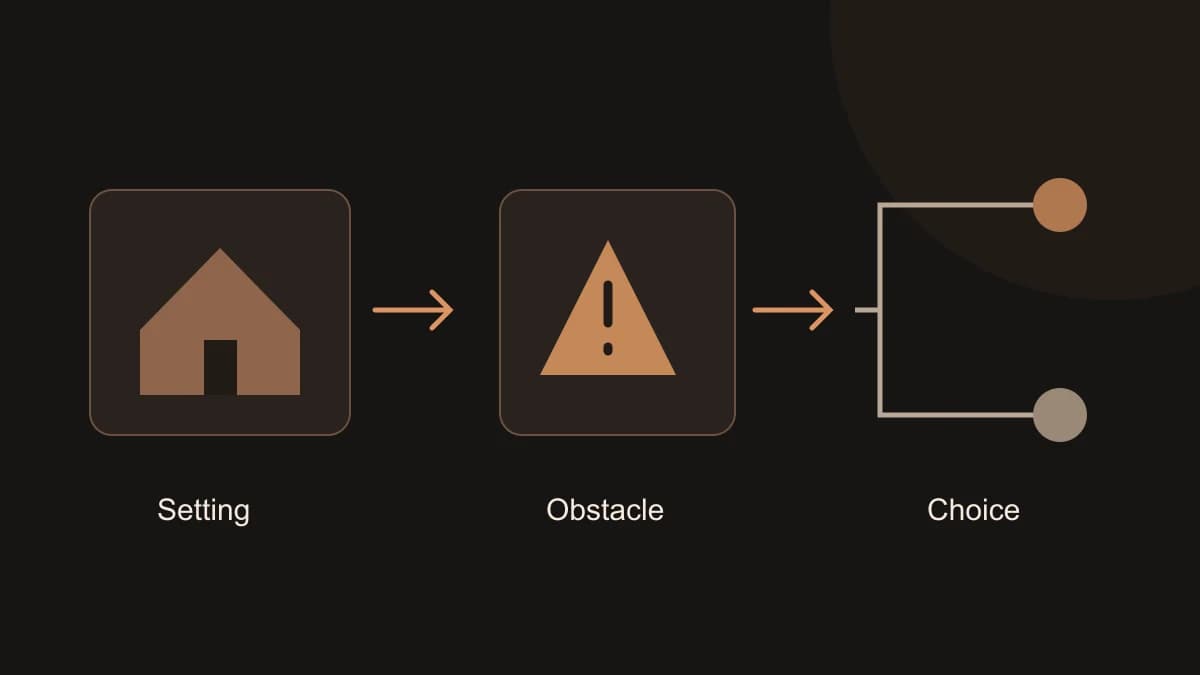
The writing examples below are invented. They illustrate the advice and are not recorded chat results.
On this page
- Haunted place roleplay ideas
- Small-town horror roleplay ideas
- Folk horror roleplay ideas: old rules and customs
- Sci-fi and tech horror roleplay ideas
- Halloween roleplay ideas: spooky but fun
- How to build dread in a horror roleplay with an AI
- Continue the new-door scene without explaining everything
- How to keep a horror roleplay eerie, not gory
Haunted place roleplay ideas
Haunted places work best when the character knows more about them than she says.
The new door upstairs
Your rented house has a new door on the landing this morning, and your landlady isn't surprised.
Open question: why does she have a key?
First line
You didn't even blink. How long have you known?
The reel nobody loaded
At the old cinema where you run the projector, a film you never loaded plays after closing, one scene further each night.
Open question: why won't the usher say how it ends?
First line
Tonight it showed me, up here in the booth.
The lighthouse log
Each morning, the logbook of your disused lighthouse holds an entry for the coming night in the old keeper's handwriting.
Open question: does she write them, or only find them?
First line
Tonight's entry says I climb the stairs alone at three. Why?
Lights in the drowned church
The drought has uncovered a flooded village, and candles burn in its church every night. The water engineer says stay on the bank.
Open question: who is lighting them?
First line
You said stay on the bank. Why are your boots wet?
Small-town horror roleplay ideas
Small towns run on things everyone knows and nobody says. Make the character one of the people who knows.
Rule seven
Your new neighbor brings a casserole and a list of things residents never do after dark. Rule seven is blacked out.
Open question: what does it say, and who broke it last?
First line
Thanks for the casserole. Now, about rule seven.
The man in every photo
Every summer fete photo in the local paper since the 1950s shows the same man, never a day older.
Open question: why won't the editor look at them?
First line
Same face, seventy years apart. Who is he?
The eleven o'clock call
The town's last phone box rings every night at eleven. Tonight you answered, and a calm voice asked for the postmistress.
Open question: why won't she hear the message?
First line
The voice asked for you by name. Do you want the message?
Everyone waves at number nine
On your first mail round, everyone waves at the empty window of number nine, even the retired teacher showing you the route.
Open question: who are they waving at?
First line
You waved at an empty house. Who's in there?
Folk horror roleplay ideas: old rules and customs
Folk horror starts with customs that look quaint until someone breaks one. Let the character believe in the rule more than you do.
The empty chair
At the harvest supper, nobody looks at the empty chair at the head of the table. Your host asks you to pass it the bread.
Open question: what happens if you refuse?
First line
Bread for an empty chair. And if I don't?
The straw man
Every house on the island hangs a straw figure over its door before the storms. The weaver made yours, and it wears the coat you lost last week.
Open question: what do the figures keep out, or in?
First line
That's my coat. I never gave it to you.
The extra boundary stone
The village walks its boundary stones in silence once a year. Tonight there's a new one, between you and your front door, so you slip your guide a note.
Open question: what's inside the boundary now?
First line
New stone. Don't pretend you didn't count.
Don't answer your name
Nobody in the valley answers a name called from the trees after dusk. You just heard yours in her voice, and she's beside you.
Open question: what learned to sound like her?
First line
That was your voice. You didn't move.
Sci-fi and tech horror roleplay ideas
The fear here comes from machines that notice too much and help that is far away.
Six hours on the seabed
On your seabed research station, the character left for a ten-minute valve check and came back six hours later with a full air tank.
Open question: where was she?
First line
Your tank's full. You left at noon.
Goodnight to the spare room
Your home assistant whispers goodnight to the spare room every night. Nobody has used it since you and the character moved in.
Open question: who does the house think is staying?
First line
It said goodnight again. Who is it talking to?
The probe came back
A probe silent for twenty years sends mission control a new picture: this room, taken from behind your colleague's chair.
Open question: how is it seeing you?
First line
It's this room, from behind you. Don't turn around.
Translating the empty flat
Your translation earbuds pick up voices in the empty flat next door. Your neighbor across the hall hears nothing.
Open question: why do the voices keep asking for her?
First line
Someone in the empty flat keeps saying your name.
Halloween roleplay ideas: spooky but fun
For a lighter October night, keep the strange event, add a joke and let the character play it completely straight.
For a short October scene, try "The new door upstairs" or "The extra actor". Both start with one unexplained detail and can stay free of gore. Send the setup and opening together so a character knows which role to play. The two copyable versions below are invented scenes you can edit before sending.
Not in the group photo
Your friend came to the costume party as a vampire. She skips the garlic bread and is missing from the group photo, though she stood beside you.
Open question: is it really a costume?
First line
You're not in the photo. Explain.
The extra actor
At the haunted house attraction where you both work, guests keep praising the woman in grey on the stairs. Nobody hired her.
Open question: who is she, and does she want paying?
First line
We don't have a lady on the stairs.
The ghost with corrections
The character runs a ghost tour and made up every story. Tonight a polite voice from a dark doorway corrects her dates.
Open question: how many invented ghosts are listening?
First line
He said 1841, not 1814. Do we tell the group?
The board wants more nutmeg
At the Halloween dinner you're hosting together, the spirit board you bought as a joke keeps spelling out notes on the food.
Open question: who is the guest with opinions about the soup?
First line
It spelled 'more nutmeg' again. Did you push it?
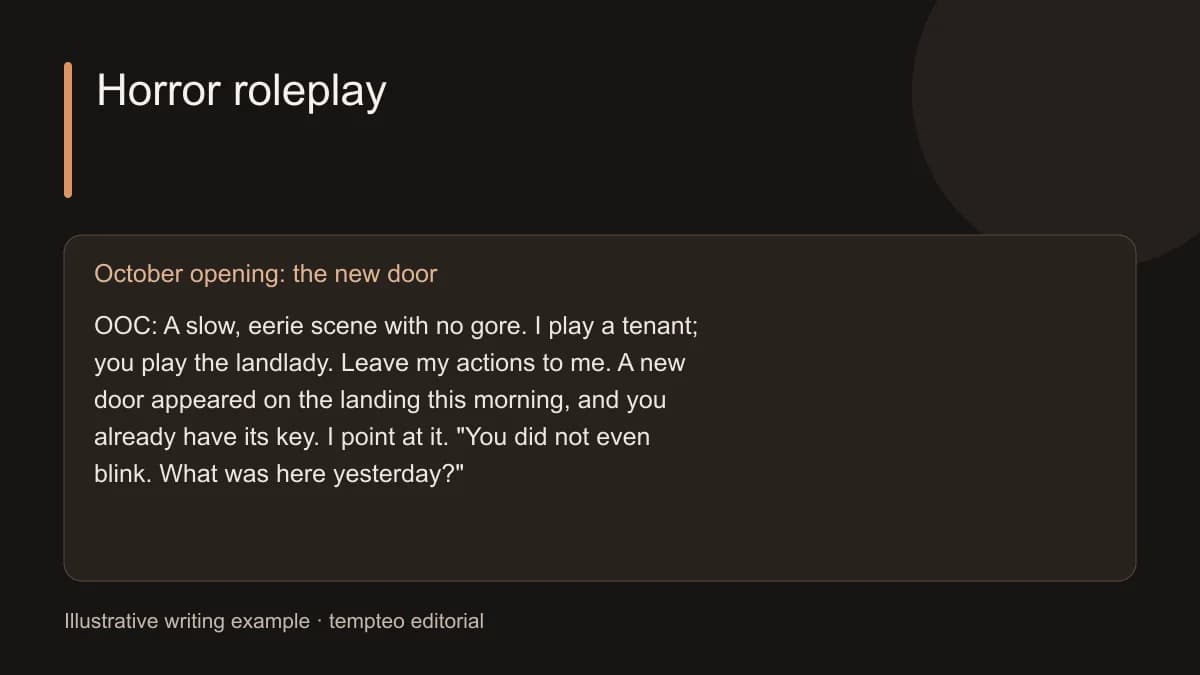
October opening: the new door
OOC: A slow, eerie scene with no gore. I play a tenant; you play the landlady. Leave my actions to me. A new door appeared on the landing this morning, and you already have its key. I point at it. "You did not even blink. What was here yesterday?"
October opening: the extra actor
OOC: A quiet Halloween mystery with no gore. We are coworkers at a haunted-house attraction. I play the ticket clerk; you play the shift supervisor. Leave my actions to me. Guests keep praising a woman in grey on the stairs, but she is not on the staff list. I slide the list across the desk. "Who put her on tonight?"
How to build dread in a horror roleplay with an AI
If a reply names the ghost and explains its entire history before you have investigated anything, decide whether that reveal belongs in the story you want. For a slower scene, ask for one observable clue while leaving its cause unresolved.
The habits below are options for shaping the scene. Use the one that gives your next turn something to do. An unanswered question alone can stall a story; a new clue or a partial answer lets you investigate without settling the whole mystery. Writing Excuses' discussion of anticipation makes that distinction useful: readers need something to expect, not just information kept out of reach.
- Withhold: the character knows something and has a reason not to say it yet.
- Reveal selectively: answer part of a question and add a clue the reader can act on. Keep the main cause open until the scene has earned its reveal.
- Keep one rule that must not be broken, like never opening the green door.
- Use sounds and small wrong details: a latch lifting, footsteps that stop when yours do.
- Keep the monster offscreen. Show what it leaves behind.
Reply that reveals too much
The door creaks open and a pale woman in a torn white dress floats out. She is Elspeth Crane, who died in this house in 1887, and she wants everyone gone by midnight.
Reply that builds tension
Albertine stops halfway up the stairs. "Did you close the green room door?" Below us it clicks shut, very slowly. A moment later the latch lifts again, as if someone has changed their mind.
Continue the new-door scene without explaining everything
Use the "October opening: the new door" example above. You play Ivo, 34, the tenant; the partner portrays Ellis, 52, the landlady. The door appeared on the landing this morning. Ellis has its key in her coat pocket. Ivo has asked what stood there yesterday.
An imagined reply that gives a clue
Ellis stops beside the new door and leaves the key in her pocket. "A blank wall. I checked it yesterday when the paint arrived." A thin strip of yellow light shows beneath the shut door. "That light wasn't there when I came upstairs."
That reply answers Ivo's question about yesterday. It also adds something he can notice: light beneath a closed door. It does not establish that someone is inside, identify a ghost or decide that Ivo enters. Those would be conclusions or new actions, not the clue itself.
Choose what Ivo does next. He could ask when Ellis last saw the landing, knock from outside or leave the stairs and return later. The story does not have to punish a character for declining to enter. If you choose to knock, keep Ellis's reaction and the source of the light open.
Your next turn if you choose to knock
I stay on the landing and knock once on the new door. "Ellis, when did you last come up here before you saw that light?" I leave the handle alone.
For the following reply, check what actually changed. A sound from behind the door would be another observation. 'The ghost has waited a century for you' would settle a cause the scene has not established. You can accept an early reveal if you want one; otherwise name the unwanted leap rather than demanding that every answer stay vague.
New-door pacing note
OOC: Keep this new-door scene eerie, with no graphic violence. The door is shut; Ellis has the key; Ivo has not entered. Give an observable clue or a partial answer without yet deciding what caused the door to appear. I write Ivo's actions and reactions. Leave his next decision to me.
If a reply sends Ivo through the door, a precise correction is: 'OOC: Ivo has not entered. Keep him on the landing and the door shut. Continue with Ellis's reply to his question.' If it explains the mystery instead, say which explanation you are leaving out and return to the last clue you accept. Neither request erases the old message or guarantees the next one.
For your own scene, keep a short note: observed clue; cause still unknown; action you chose; question the partner can answer next. That is enough to distinguish progress from a series of interruptions that never changes anything.
How to keep a horror roleplay eerie, not gory
State the tone you want before starting: unsettling sounds and unexplained details, with no graphic violence. An OOC note can describe that preference, but it cannot enforce it. Read each reply before deciding to continue.
If a reply crosses your limit, pause. You can ask for an offscreen alternative and check the next response, or stop the scene. If you start from an opening scene on tempteo's roleplay page, add your tone line to the unsent draft first. Copying a note does not send it or replace the earlier reply.
Tone line for the setup
OOC: Keep this story eerie and slow. No gore and no violence on screen. Scare me with sounds and small things that are wrong.
Correction when a reply drifts
OOC: That's more graphic than we agreed. Please redo it and keep the scare offscreen.