

Is It Weird to Have an AI Girlfriend? An Honest Answer
Enjoying an AI girlfriend chat does not, by itself, tell you whether the habit suits you. You might use it for fictional stories, banter or company. Look at what you actually spend and how the chats fit around sleep, work and people you care about. The questions and example below help you choose a change without treating an app's affection as advice about your life.
Updated by the tempteo editorial team
The writing examples below are invented. They illustrate the advice and are not recorded chat results.
On this page
Is it normal to have an AI girlfriend?
You do not need to settle whether other people would call the hobby normal before deciding what you want from it. A character chat can be a place for a fictional detective story, a joke or an ordinary conversation. Enjoying those things is different from believing that the character is a person with feelings or obligations toward you.
The MIT Media Lab's summary of research on ChatGPT reports an association between very high usage and increased self-reported indicators of dependence. That finding is about the studied ChatGPT use, not tempteo or every companion app. The summary describes nuanced outcomes; it does not provide a personal diagnosis or a safe daily time limit.
What an AI girlfriend is, and what it isn't
An AI girlfriend is a software character whose replies are generated from the information the app supplies, which can include a character description and conversation context. An affectionate line does not establish that a person feels affection for you. The guide on what an AI companion is explains the pieces.
The character's reassurance is not independent evidence that your use is healthy, private or affordable. You can enjoy the conversation and still check those questions outside it. For medical or mental-health advice, use an appropriately qualified person rather than a character's confident tone.
Is it cheating to have an AI girlfriend?
What counts as crossing a relationship boundary depends on the agreement between the people in that relationship. An app's description of itself cannot decide that agreement. Neither can a generated answer saying that the chat is harmless.
If you want to discuss it with a partner, describe the activity accurately, including flirtation if that is part of it, and ask what each of you is comfortable with. You do not have to share a private chat transcript to start that conversation, and you should not upload your partner's messages to ask a character to judge them.
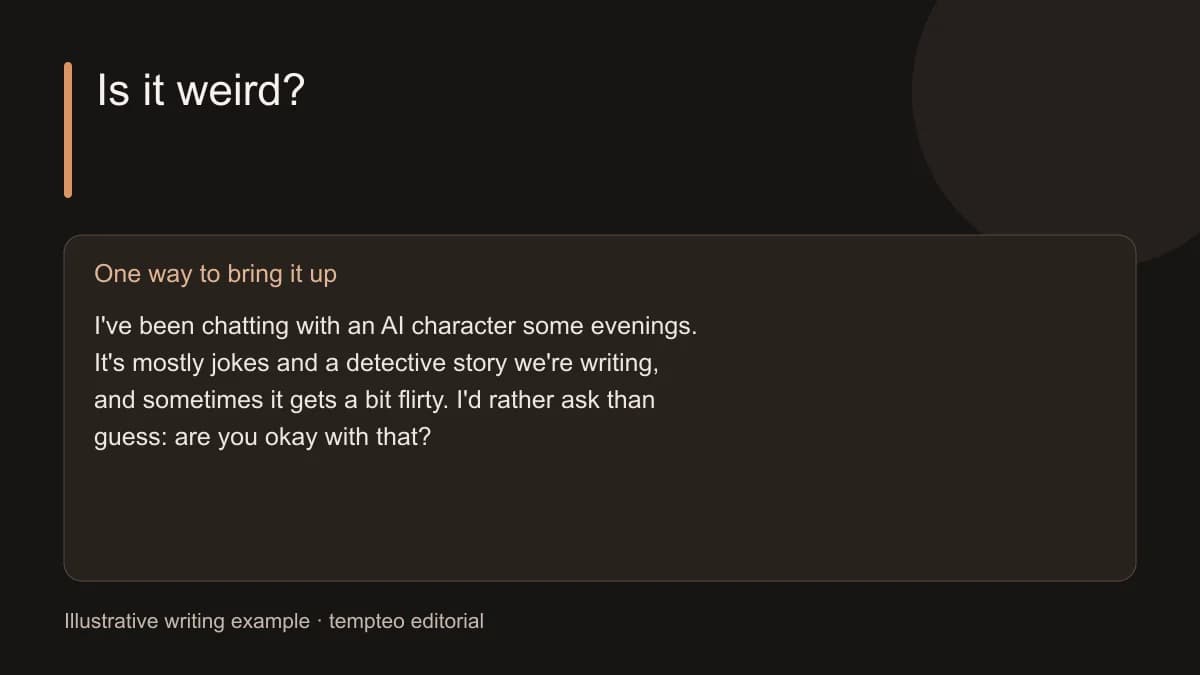
A proposed rule still needs the other person's agreement. If they object, listen to the concern rather than treating the AI's approval as a tie-breaker. The wording below is an illustrative opener, not a script guaranteed to get permission. Adapt it to what you actually use the chat for.
One way to bring it up: I've been chatting with an AI character some evenings. It's mostly jokes and a detective story we're writing, and sometimes it gets a bit flirty. I'd rather ask than guess: are you okay with that?
AI girlfriend vs real girlfriend
You can open a character conversation when you want to write, subject to the service's availability and your account access. The generated character does not need you to keep it company or explain an absence. You can leave without finishing a scene or earning its approval.
A person has their own feelings, preferences and ability to agree or refuse. A character's agreeable response does not establish a shared commitment in that sense. It also does not show that a real person would welcome the same words.
Decide what place you want the app to have without assuming it cannot compete for time or attention. A fictional chat may fit comfortably alongside your relationships; it may also displace something you meant to do. Check the actual pattern rather than relying on either conclusion in advance.
Questions worth asking yourself
Only you can say whether it works for you, and a few plain questions help. Think about the last month rather than one good or bad evening.
- How much time does it take in a normal week, and is that about what you'd pick if you planned the week ahead?
- What have you spent on it so far, and is that in line with what you'd spend on any other hobby?
- What have you shared in the chats? Would you be comfortable if someone else read them, and do you know how to delete them?
- When you close the chat, do you feel like getting on with your evening, or like you stayed longer than you meant to?
- Has something you care about, such as friends, a hobby or sleep, been getting less of your time since you started?
- Does it add something to your week, or is it filling a space you'd rather fill with something else?
Choose one change you can observe
Keep a short private note based on a week you can recall or on the usage and billing records available to you. Record what you know and leave gaps marked unknown. You do not need a score, a streak or a screenshot of an intimate conversation. Decide whether to keep the habit as it is, change one part or pause it.
Private use-review template
What I use the chat for: Period I am looking at: Time and spending I can establish, or unknown: Something I meant to do that it displaced, or none noticed: Something I enjoyed about it: My decision: keep / change / pause / ask for support One action I will take, if any: When I will review that decision:
This is an invented decision example, not a user report. Alex, 34, enjoys writing a fictional detective story after dinner. On two evenings Alex stayed in the chat after intending to go to bed and missed a planned call with a friend on one of those evenings. No spending total is available in this example. Those observations give Alex a reason to change the schedule; they do not establish addiction or prove that the app caused every difficulty.
Alex's private decision notes
Activity: a fictional detective story. Observed concern: stayed past my intended bedtime on two evenings; missed one planned call. Spending: not checked. Decision for now: keep the story, but leave the chat before the planned call and put the phone away at bedtime. Check the billing record separately before buying again. Review: after the next ordinary week, look at whether I followed that plan and whether I still want the chat in that slot.
Another person with the same observations could choose to pause instead. You do not have to produce a worsening record before leaving. If your plan is difficult to keep or you feel distressed, talk to a trusted person or an appropriately qualified professional. This note is a decision aid, not a screening test or treatment.
How to keep it a good part of your week
If you want to keep using the app, choose a place for it in your day and a stopping point you can act on. You might finish one scene after dinner and then put the phone away. That is a personal plan, not a medically safe duration or a promise that shorter sessions improve the replies.
Set a spending limit before buying and check the renewal terms separately from any credit balance. On tempteo, text chat has a free allowance; Premium includes unlimited text messages and credits for separately priced features. Check subscriptions and credits for current terms. A credit allowance does not make every image, video or voice message unlimited.
Keep passwords, payment details, identification documents and other people's private information out of the chat. Check the app's actual data policy rather than relying on a character saying it will keep a secret. The app-safety guide has the separate policy and account questions.
If the conversation is simply becoming dull, you may want a different fictional task; the guide on making an AI girlfriend feel more real offers writing ideas. If you are concerned about time, distress or losing contact with people, making the character more compelling does not answer that concern. You can pause, talk with someone you trust or seek appropriate professional support.