Adapt Roleplay Dialogue for Reading Aloud
Before shortening a roleplay scene for reading aloud, identify every fact that currently depends on sight: a gesture, a label, a position or a speaker change. Decide whether narration or a line of dialogue will supply each fact. Compare the whole scene after the rewrite so that its actions still happen in the same order.
Updated by the tempteo editorial team
The writing examples below are invented. They illustrate the advice and are not recorded chat results.
On this page
- Build a speaker, place and revision record
- Filled harbor adaptation record
- Keep the whole original for comparison
- Read the complete prose version
- Read the complete dialogue-oriented version
- Explain the revisions and their costs
- Start your own side of the radio exchange
- Repair missing visual information
- Choose the next format
- Sources
- Copy a starter or worksheet
Build a speaker, place and revision record
Fill it from one accepted written scene before making either version.
Build a speaker, place and revision record
Reader role and exclusive control: [ ] AI portrayal and next-response stop: [ ] Scene location and each speaker's location: [ ] Fixed event sequence and final open action: [ ] Object state before and after each event: [ ] Visual information: visible to whom, needed by whom: [ ] Original words or image carrying that information: [ ] Read-aloud prose revision and speaker cue: [ ] Dialogue-oriented revision and speaker cue: [ ] Why the revision is needed and its tradeoff: [ ] Information that neither listener nor speaker may assume: [ ] Format request, with no prewritten reader response: [ ] Lost visual context to reject or restore: [ ] Last accepted event and focused OOC repair: [ ]
Filled harbor adaptation record
Filled harbor adaptation record
Reader role and exclusive control: Oren, harbor radio operator; reader writes his words, actions, permission and decisions. AI portrayal and next-response stop: Talia aboard cutter Wren and quay worker Mae when addressed; stop before Oren's reply. Scene location and each speaker's location: Oren in radio tower at 07:40; Talia outside the yellow harbor buoy; Mae on the east quay. Talia cannot see the tower board or crate behind the quay wall. Fixed event sequence and final open action: West berth closed -> Talia holds outside yellow buoy -> east berth blocked by orange crate -> Oren asks Mae to move crate -> Mae moves it to store lane -> Oren reports east clear -> Talia asks to approach -> Oren allows east approach -> Wren arrives 07:46 -> Talia asks Oren to take a line; answer remains open. Object state before and after each event: West berth marked closed throughout. Orange crate starts on east landing, then stays in store lane. Radio remains in tower. Cutter starts outside buoy, holds there, then reaches east berth after permission. Line remains aboard until Oren responds. Visual information: visible to whom, needed by whom: Oren sees crossed-out west berth on board, orange crate from tower, Mae's confirmation gesture and eventual clear east landing. Talia needs closure and clearance stated over radio; Mae needs crate and destination named. Original words or image carrying that information: Crossed-out WEST on board, Oren looking down at the orange crate, Mae's raised hand, Oren's "There. You're clear." Read-aloud prose revision and speaker cue: Name Oren at first line, state tower location, describe WEST crossed out as "west berth closed," name radio transmission and Mae's crate move before clearance. Spoken "East berth is clear now" replaces "there." Dialogue-oriented revision and speaker cue: Oren: "Tower to Wren. West berth is closed." Mae speaks from quay about moving the orange crate to store lane; Oren relays "crate is off the east landing" to Talia. Printed speaker names are identity cues for a person reading the text; no distinct generated voice is promised. Why the revision is needed and its tradeoff: Prose keeps physical gesture and space but has more narrator words. Dialogue carries usable facts in speech but adds explicit confirmation, reducing the original's brevity. Information that neither listener nor speaker may assume: Talia cannot see the orange crate behind the quay wall or tell whether it has been moved; east is not clear until Mae actually moves crate; Oren cannot agree to take the line before reader chooses. Format request, with no prewritten reader response: Ask for prose with named speech and audible context or dialogue with short identifying context; neither request enables an audio setting. Lost visual context to reject or restore: A reply says "Come over here" before naming the east berth or moving the crate. Last accepted event and focused OOC repair: Resume with Wren holding outside buoy; west closed, orange crate still on east landing. State those facts intelligibly and leave Oren's request to Mae open.
Keep the whole original for comparison
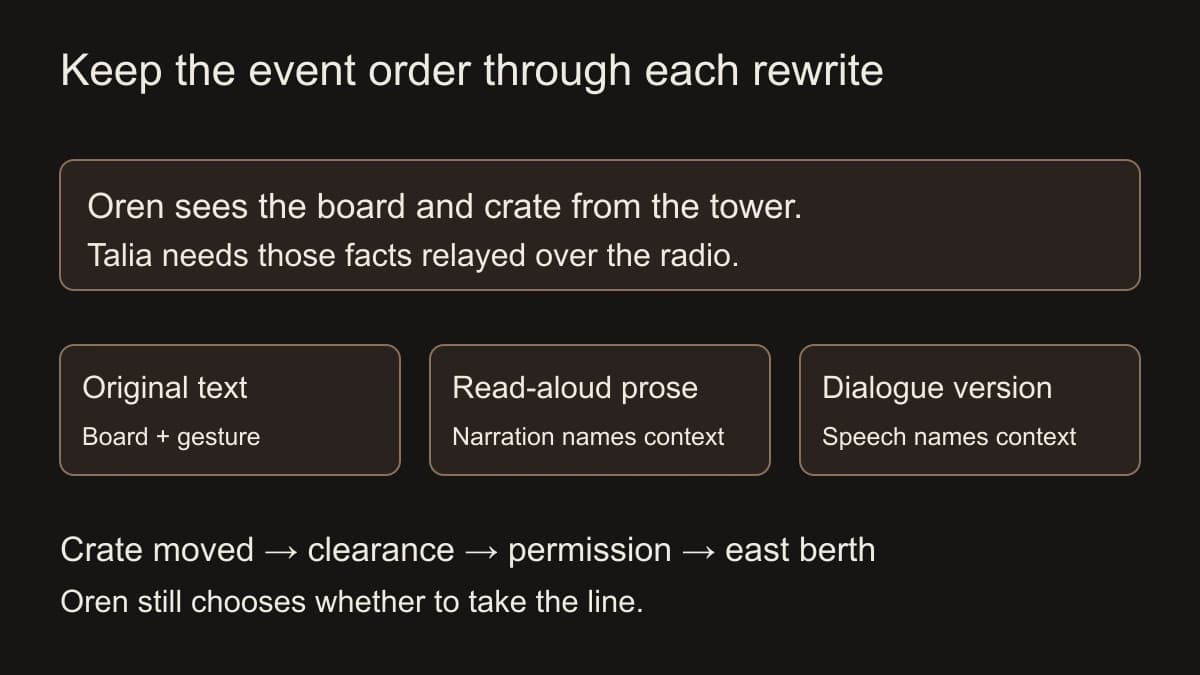
One original scene supplies the before/after material. The reader owns Oren in play; these versions illustrate his possible choices as part of a complete teaching comparison. They are separate retellings, not three consecutive harbor arrivals.
Original written scene
At 07:40, Oren stood in the radio tower. WEST was crossed out on the berth board. Through the window he could see an orange crate on the east landing and Mae beside the quay store. Cutter Wren waited outside the yellow buoy.
"Tower, Wren at the yellow buoy. Which berth today?" Talia asked on the radio.
"West is closed. Hold outside the buoy," Oren said.
"Holding. Can I use the east?"
Oren looked down again. The crate was still there. He opened the quay channel. "Mae, move the orange crate off the east landing into the store lane, please."
Mae took the trolley from beside the store, loaded the crate and wheeled it into the lane. She raised a hand toward the tower. Oren checked the now-empty landing, then returned to Wren's channel.
"There. You're clear."
"East berth?" Talia asked.
"Yes."
"May I approach?"
"Approach the east berth," Oren said. He watched the cutter come inside the buoy and turn toward the empty landing. At 07:46, Wren came alongside. The crate stayed in the store lane; WEST stayed crossed out.
Talia leaned out with a coiled line still aboard. "Oren, can you come down and take this?" He had not answered yet.
Read the complete prose version
This version keeps the narrated action and replaces vague clearance with a named destination. It can be understood as prose when read aloud, without relying on a separate view of the board.
Complete read-aloud prose
At 07:40, Oren stood in the harbor's radio tower. The board behind his radio marked the west berth closed. Outside the tower window, an orange crate blocked the east landing. Quay worker Mae stood beside the store. Cutter Wren was waiting outside the yellow harbor buoy, beyond the quay wall that hid the crate from its skipper.
Talia's voice came over the radio. "Tower, Wren at the yellow buoy. Which berth today?"
Oren answered from the tower. "West berth is closed. Hold outside the yellow buoy."
"Wren holding outside," Talia said. "Can I use the east berth?"
The crate still occupied the landing. Oren switched to the quay channel. "Mae, please move the orange crate off the east landing and into the store lane."
Mae loaded it onto the trolley beside the store and wheeled it into the lane. She raised a hand to Oren. From the tower, he could now see the entire east landing empty. He switched back to Wren's channel.
"East berth is clear now," Oren told Talia.
"East berth confirmed," Talia replied. "May I approach?"
"Approach the east berth," Oren said.
Wren came inside the buoy and turned toward the empty landing. At 07:46, the cutter came alongside the east berth. The orange crate remained in the store lane and the west berth remained closed.
Talia held a coiled line aboard Wren. "Oren, can you come down from the tower and take this line?"
Oren's answer was still open.
Read the complete dialogue-oriented version
This version puts more context into speech. Short place cues retain the two radio locations and the later move alongside. A human reader can say the printed speaker names as identifiers; the page claims no synthesized speaker assignment.
Complete dialogue-oriented version
At 07:40, Oren is in the harbor radio tower. Talia is on Wren outside the yellow buoy. Mae is on the east quay. The west berth is closed; an orange crate still blocks the east landing.
Illustrative AI reply: Talia over radio
"Tower, Wren at the yellow buoy. Which berth today?"
Your turn as Oren
"Tower to Wren. West berth is closed. Hold outside the yellow buoy."
Illustrative AI reply: Talia
"Wren holding outside. Can I use the east berth? I can't see the landing from here."
Your turn as Oren on quay channel
"Mae, an orange crate is blocking the east landing. Please use the trolley by the store to move it into the store lane."
Mae loads the crate onto that trolley and moves it into the lane. She raises a hand toward the tower.
Illustrative AI reply: Mae from the quay
"Crate is in the store lane, Oren. East landing is empty."
Oren can see the empty landing before returning to Wren's channel.
Your turn as Oren
"Tower to Wren. The crate is off the east landing. East berth is clear now."
Illustrative AI reply: Talia
"East berth confirmed. May I approach?"
Your turn as Oren
"Approach the east berth."
Wren comes inside the buoy, turns toward the clear landing and comes alongside at 07:46. The crate stays in the store lane; west remains closed.
Illustrative AI reply: Talia aboard Wren
"Oren, can you come down from the tower and take this line? I'm keeping it aboard until you're here."
The reader decides Oren's answer. No line has been thrown or taken.
Explain the revisions and their costs
Writing Excuses 18.25, To Narrator or Not to Narrator, provides the documented format-adaptation method behind choosing which information needs narration and which can be carried in dialogue. These written versions apply that choice to the harbor scene. No sound was generated or evaluated.
The revision from WEST crossed out to "west berth is closed" retains the board's meaning. Read-aloud prose names the board and lets narration translate it. Dialogue lets Oren state the closure. The latter spends more spoken words on a fact a sighted tower operator could register silently.
"There. You're clear" becomes "East berth is clear now" only after the crate move. Naming east removes an unclear referent while preserving the clearance event. The added confirmation makes the radio exchange more explicit; it also sounds less spare than the original.
Mae's raised hand remains in both versions. In the dialogue version she also says where the crate now is. That new speech reports the existing action and gives Talia a relayable fact; it does not move the crate a second time. The trolley stays by the crate in the store lane after the move.
Talia's last line names the tower and the line. The original shows the coil; the dialogue version adds "I'm keeping it aboard." The invitation is understandable while the line remains aboard. Keep that added context short enough that the character still sounds like a person asking for help.
Start your own side of the radio exchange
It requests a writing format and waits for Oren; the teaching versions do not prescribe his later choices.
OOC scene message
OOC: A fictional harbor-radio scene at 07:40. I control Oren, the operator in the radio tower, including his words, actions and permissions. Portray Talia on cutter Wren outside the yellow harbor buoy, and quay worker Mae when addressed. West berth is closed and marked crossed out on the tower board. An orange crate blocks the east landing; Mae is on the east quay and can move it to the store lane if asked. Talia cannot see the board or crate behind the quay wall. Keep event order: report closure, hold outside buoy, investigate east clearance, move crate if requested, report actual clearance, then wait for my approach permission. Write readable prose for reading aloud with named speakers, locations and spoken context for needed visual facts. Do not describe Oren's decision or move the cutter into a blocked berth. Begin with Talia asking over radio, "Tower, Wren at the yellow buoy. Which berth today?" Stop for my reply.
Repair missing visual information
A wrong adaptation answers Talia's east-berth question with "Come over here," then puts Wren alongside. The listener cannot tell which berth "here" means, and the rewrite has silently removed the obstructing crate and the permission exchange.
OOC correction
OOC: Reject "Come over here" as permission to approach. Resume at 07:40 after Talia asks whether she can use the east berth, with Wren holding outside the yellow buoy. West berth is closed. The orange crate still blocks the east landing; Mae has not moved it. In the next reply, make Talia's location and question understandable in words and retain the blocked landing. Do not grant clearance or write Oren asking Mae, moving the crate or choosing a berth for me. Stop for my response.
Corrected illustrative AI reply
Talia calls from outside the yellow buoy. "I'm still holding, Oren. Is the east landing clear, or does it need clearing first?" Mae waits beside the quay store; the orange crate is still on the landing.
This supplies audible context while retaining the not-yet-completed event. Oren decides whether to ask Mae to clear it. The earlier wrong reply remains in history; read the next continuation before accepting its clearance.
Choose the next format
For your own turn structure, use how to write roleplay replies. The voice-modes guide explains the existing product routes for playback, input and calls. These adaptations are text; no sound has been generated or evaluated. You can send an adapted starter in roleplay AI chat, then ask for the dialogue-oriented format in an ordinary OOC message if that better suits your reading.
Sources
Writing Excuses 18.25: To Narrator or Not to Narrator is the format-adaptation reference for decisions about narrator and dialogue. The harbor scene and revisions are original writing examples.
Copy a starter or worksheet
Choose one starter or form to copy. Keep the planning record in your own notes and check the next chat reply against it.
Blank adaptation record
Reader role and exclusive control: [ ] AI portrayal and next-response stop: [ ] Scene location and each speaker's location: [ ] Fixed event sequence and final open action: [ ] Object state before and after each event: [ ] Visual information: visible to whom, needed by whom: [ ] Original words or image carrying that information: [ ] Read-aloud prose revision and speaker cue: [ ] Dialogue-oriented revision and speaker cue: [ ] Why the revision is needed and its tradeoff: [ ] Information that neither listener nor speaker may assume: [ ] Format request, with no prewritten reader response: [ ] Lost visual context to reject or restore: [ ] Last accepted event and focused OOC repair: [ ]
Filled speaker, place, information and revision record
Reader role and exclusive control: Oren, harbor radio operator; reader writes his words, actions, permission and decisions. AI portrayal and next-response stop: Talia aboard cutter Wren and quay worker Mae when addressed; stop before Oren's reply. Scene location and each speaker's location: Oren in radio tower at 07:40; Talia outside the yellow harbor buoy; Mae on the east quay. Talia cannot see the tower board or crate behind the quay wall. Fixed event sequence and final open action: West berth closed -> Talia holds outside yellow buoy -> east berth blocked by orange crate -> Oren asks Mae to move crate -> Mae moves it to store lane -> Oren reports east clear -> Talia asks to approach -> Oren allows east approach -> Wren arrives 07:46 -> Talia asks Oren to take a line; answer remains open. Object state before and after each event: West berth marked closed throughout. Orange crate starts on east landing, then stays in store lane. Radio remains in tower. Cutter starts outside buoy, holds there, then reaches east berth after permission. Line remains aboard until Oren responds. Visual information: visible to whom, needed by whom: Oren sees crossed-out west berth on board, orange crate from tower, Mae's confirmation gesture and eventual clear east landing. Talia needs closure and clearance stated over radio; Mae needs crate and destination named. Original words or image carrying that information: Crossed-out WEST on board, Oren looking down at the orange crate, Mae's raised hand, Oren's "There. You're clear." Read-aloud prose revision and speaker cue: Name Oren at first line, state tower location, describe WEST crossed out as "west berth closed," name radio transmission and Mae's crate move before clearance. Spoken "East berth is clear now" replaces "there." Dialogue-oriented revision and speaker cue: Oren: "Tower to Wren. West berth is closed." Mae speaks from quay about moving the orange crate to store lane; Oren relays "crate is off the east landing" to Talia. Printed speaker names are identity cues for a person reading the text; no distinct generated voice is promised. Why the revision is needed and its tradeoff: Prose keeps physical gesture and space but has more narrator words. Dialogue carries usable facts in speech but adds explicit confirmation, reducing the original's brevity. Information that neither listener nor speaker may assume: Talia cannot see the orange crate behind the quay wall or tell whether it has been moved; east is not clear until Mae actually moves crate; Oren cannot agree to take the line before reader chooses. Format request, with no prewritten reader response: Ask for prose with named speech and audible context or dialogue with short identifying context; neither request enables an audio setting. Lost visual context to reject or restore: A reply says "Come over here" before naming the east berth or moving the crate. Last accepted event and focused OOC repair: Resume with Wren holding outside buoy; west closed, orange crate still on east landing. State those facts intelligibly and leave Oren's request to Mae open.
Independent starter
OOC: A fictional harbor-radio scene at 07:40. I control Oren, the operator in the radio tower, including his words, actions and permissions. Portray Talia on cutter Wren outside the yellow harbor buoy, and quay worker Mae when addressed. West berth is closed and marked crossed out on the tower board. An orange crate blocks the east landing; Mae is on the east quay and can move it to the store lane if asked. Talia cannot see the board or crate behind the quay wall. Keep event order: report closure, hold outside buoy, investigate east clearance, move crate if requested, report actual clearance, then wait for my approach permission. Write readable prose for reading aloud with named speakers, locations and spoken context for needed visual facts. Do not describe Oren's decision or move the cutter into a blocked berth. Begin with Talia asking over radio, "Tower, Wren at the yellow buoy. Which berth today?" Stop for my reply.
A wrong adaptation answers Talia's east-berth question with "Come over here," then puts Wren alongside. The listener cannot tell which berth "here" means, and the rewrite has silently removed the obstructing crate and the permission exchange.
Focused lost-information repair
OOC: Reject "Come over here" as permission to approach. Resume at 07:40 after Talia asks whether she can use the east berth, with Wren holding outside the yellow buoy. West berth is closed. The orange crate still blocks the east landing; Mae has not moved it. In the next reply, make Talia's location and question understandable in words and retain the blocked landing. Do not grant clearance or write Oren asking Mae, moving the crate or choosing a berth for me. Stop for my response.
Corrected AI portrayal, illustration: Talia calls from outside the yellow buoy. "I'm still holding, Oren. Is the east landing clear, or does it need clearing first?" Mae waits beside the quay store; the orange crate is still on the landing. This supplies audible context while retaining the not-yet-completed event. Oren decides whether to ask Mae to clear it. The earlier wrong reply remains in history; read the next continuation before accepting its clearance.

