

Slice of Life Roleplay Ideas: 20 Everyday Plots With First Lines
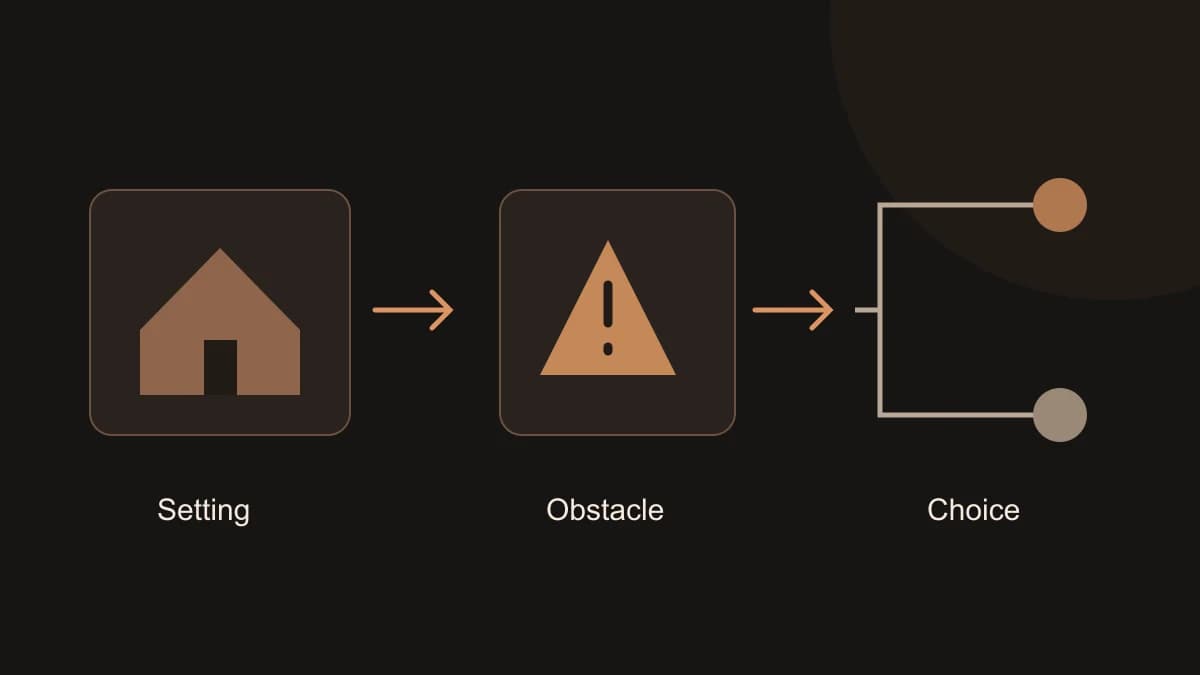
Slice of life roleplay follows ordinary days: a shared kitchen, a small job, a club meeting or a wet weekend away. These 20 ideas each offer a small tension and a first line. The Thursday-box walkthrough shows how an everyday scene can change on a later visit while names, objects and earlier choices stay consistent in your own notes.
Updated by the tempteo editorial team
The writing examples below are invented. They illustrate the advice and are not recorded chat results.
On this page
- Slice of life ideas for shared homes and neighbors
- Everyday roleplay ideas for jobs and small businesses
- Slice of life roleplay ideas for hobbies and clubs
- Weekend and trip roleplay ideas
- Seasonal roleplay ideas and small traditions
- What makes slice of life work with an AI
- How to keep a long everyday story fresh
- Return to the kitchen with one small change
Slice of life ideas for shared homes and neighbors
A building hands you a cast for free. Start with one neighbor who has a habit.
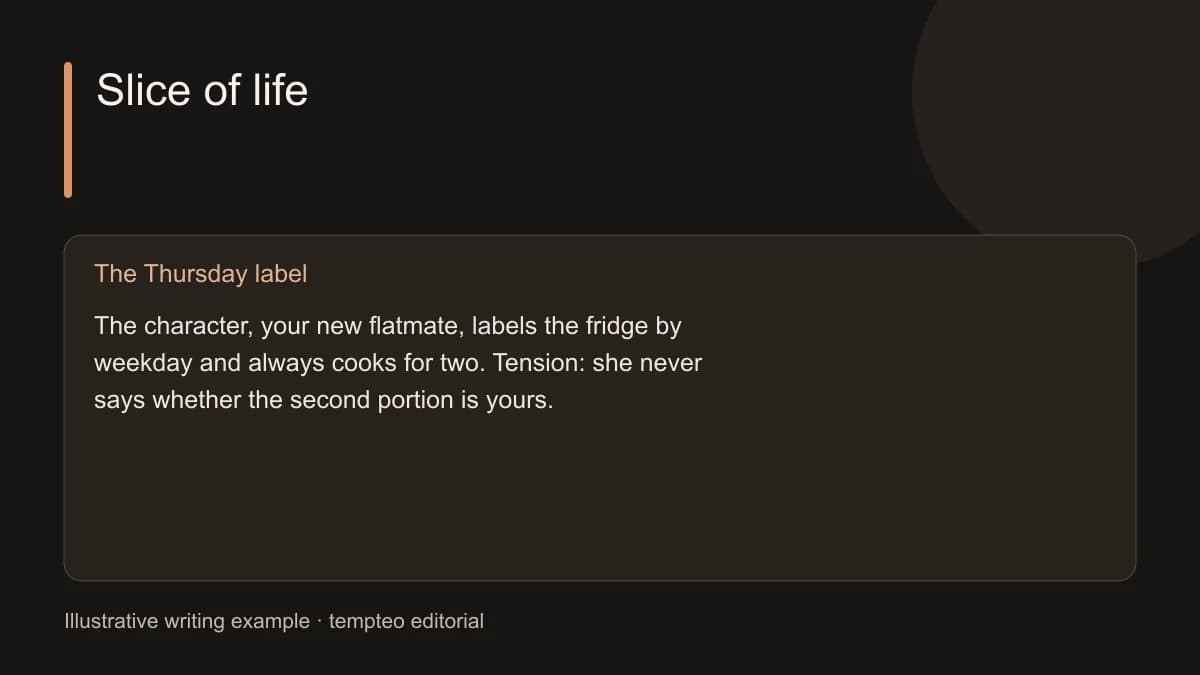
The Thursday label
The character, your new flatmate, labels the fridge by weekday and always cooks for two.
Tension: she never says whether the second portion is yours.
First line
This box says 'Thursday, do not touch.' It's Thursday. Is it mine?
The parcel ledger
The character works from home and takes in the building's parcels, with a ledger and opinions.
Tension: your third parcel this week is a present for her.
First line
Don't shake that one. And no, I'm not saying what's in it.
The Sunday rota
Your landing takes turns hosting Sunday dinner. At your first, the character, host for eleven years, turns up early to help.
Tension: her help looks like an inspection.
First line
You brought your own pan. Should I be nervous?
Final warning
The character runs your building's group chat, and your first post broke three rules.
Tension: she's the only one who can restart the boiler, and it's January.
First line
A final warning? For a photo of a cat?
Everyday roleplay ideas for jobs and small businesses
A job gives every scene a reason to happen, and regulars keep coming back.
Ten to eleven
Every night at ten to eleven, the character buys milk at your corner shop and tells you about her day.
Tension: from next month the shop shuts at ten.
First line
Milk's on the counter. How did it go with the landlord?
Brakes again
You fix bikes under a railway arch. The character, a courier, brings in the same bike every week.
Tension: she can't spare a day off the road for a proper repair.
First line
Brakes again. Did you ride it down the station steps?
The Friday tulips
You deliver for a florist. For a year, someone has sent the character tulips every Friday with an unsigned card.
Tension: she keeps asking you who.
First line
Same tulips, same card. And no, I still can't tell you.
The handover week
You've bought a dog-walking round, and the character who ran it stays a week to hand over.
Tension: one owner hasn't paid in months, and she still walks his dog.
First line
Biscuit's owner owes you eight weeks. Why are we walking Biscuit?
Slice of life roleplay ideas for hobbies and clubs
A club meets on a fixed day, which gives a long chat its rhythm.
The October rule
The character has swum at the outdoor pool every morning for twenty years and says you're not a regular until you've swum in October.
Tension: the pool may close for the winter.
First line
Seven degrees. You said it gets easier. When?
Page forty
The character runs a book club in a pub's back room. This month's novel is secretly hers.
Tension: you're about to say you hated it.
First line
I gave up on page forty. Does it get better?
The wobbly bowls
At your Tuesday pottery class, the character keeps leaving her best glazes by your shelf.
Tension: she's been asked to run the class and hasn't said yes.
First line
Third week, third wobbly bowl. Is it the clay or me?
The heron nobody saw
The character claims a rare heron for your birdwatching group's yearly tally. You were beside her and saw nothing.
Tension: the group wants you to confirm it.
First line
They want me to confirm your heron. I was looking at my sandwich.
Weekend and trip roleplay ideas
A short trip moves the characters somewhere new without changing who they are.
Lock nine
On a narrowboat weekend with friends, the character has steered for two days and won't give up the tiller.
Tension: the others sent you to ask.
First line
Lock nine. You've done eight. Can I have one?
The avoid list
You drive the character to a wedding in the town she left twelve years ago. She has a list of people to avoid.
Tension: number one runs your guesthouse.
First line
Number one on your list just handed me our key.
The wrong poles
It's raining at the campsite, and the poles the character packed belong to another tent.
Tension: she won't admit it and has a plan with rope and the car.
First line
These aren't our poles. Whose tent did you borrow?
The café at the top
The character plans every hike with a laminated map, and today the summit café is shut.
Tension: she has no plan B, and the cake was the point.
First line
What does the laminated plan say about this?
Seasonal roleplay ideas and small traditions
A yearly tradition gives a long story a date to aim for.
First frost soup
On the first frosty morning, the character makes soup for the whole street, and this year she's teaching you.
Tension: her only measurement is a handful.
First line
A handful isn't a measurement. Whose hand?
The lights feud
You've bought the house of the only rival the character ever had in the street's winter lights contest.
Tension: she expects you to carry on the feud.
First line
I bought one string of lights. Why are you staring at my house?
The swap day lamp
At the spring swap day, you trade a kettle for a green lamp the character gave away last year.
Tension: she wants it back and won't say why.
First line
You've walked past my lamp four times. Want it back?
Resolution number five
Every New Year's Day, you and the character read last year's resolutions aloud at the same café.
Tension: she has torn the bottom off her list.
First line
You tore off the end of your list. What was number five?
What makes slice of life work with an AI
Give the character an ordinary want, such as sharing supper or preparing a club meeting. A small disagreement can provide a next turn without a fire, a secret inheritance or a confession.
Bring back a detail only when it still fits the accepted scene. If a mug was chipped, you can mention the chip on a later visit. Keep a short note yourself and supply it when needed; a character may miss or contradict the detail. The app is not promising an automatic callback across chats.
Agree that quiet scenes are welcome. If a proposed reply suddenly changes the genre, decide whether you want that development before treating it as part of the story. These two invented replies answer the Thursday-box premise with a flatmate called Hedda, 32.
Reply that jumps to drama
Hedda drops the plate. "I need to tell you something. I'm leaving the country tonight, and I need you to keep this box safe."
Reply that stays small
Hedda slides the Thursday box across the counter. "I always make two. It's yours if you wash the pan, and you're not allowed to say it's too salty."
How to keep a long everyday story fresh
Repeat a place with one changed condition. The same kitchen can host a new meal or a different schedule. Keep earlier accepted facts separate from the detail you are changing, so the new scene does not quietly undo an old choice.
An unresolved small task can carry a return, but you do not need to stretch every chore into a long plot. Finish one scene when it has answered its question. Before another visit, write down what is done and what is still open.
For a longer story, keep names and relevant object states in a note you control. The memory guide describes limits, and the continuation guide offers a recap format. You can browse characters and provide your own scene as ordinary chat context. A recurring setting is not a saved world or a promise that a character recalls earlier sessions.
Return to the kitchen with one small change
This invented walkthrough uses the Thursday-label idea. Hedda, 32, and Cato, 35, are flatmates. You write Cato; the partner writes Hedda. At 6 p.m. on Thursday, a closed food box labeled "Thursday, do not touch" is in the fridge. It holds two portions of soup Hedda made. The empty cooking pan is in the sink. Cato has not opened the box and does not know whether either portion is for him.
First-visit setup
OOC: Fictional shared kitchen. I write Cato, 35. You write Hedda, his flatmate of 32. It is Thursday at 6 p.m. A closed box labeled "Thursday, do not touch" is in the fridge, with two portions of soup Hedda made. The empty cooking pan is in the sink. Cato has not opened the box and does not know whether a portion is for him. Keep the stakes ordinary. Reply as Hedda to my question and leave Cato's actions to me.
Your first question as Cato
"This box says 'Thursday, do not touch.' It is Thursday. Is either portion for me?"
Illustrative reply from Hedda
"One is, if you wash the pan afterward." Hedda points to the sink. "I wrote that label yesterday. I did not want it disappearing before supper."
Hedda has explained the label and offered a deal. Cato can accept, propose another arrangement or leave both portions alone. Permission for one portion does not establish that every future Thursday meal is his.
Your chosen turn as Cato
Cato takes the box out of the fridge and puts one portion into his bowl. He closes the box with the other portion still inside and returns it to the fridge. "I will wash the pan after I eat. Can it wait until half past six?"
Illustrative reply from Hedda
"Half past is fine." Hedda takes a spoon from the drawer. "I am eating mine at the table. No salt verdict until yours has cooled."
The other portion stays in the fridge until Hedda chooses to take it. Cato's bowl holds his portion; the pan is still dirty. Her agreement settles the timing, not the washing itself. Stop here if you want to decide what Cato does next.
Close this visit before starting another
For the return below, choose this explicit ending for Cato: at 6:30 p.m. he washes the cooking pan and puts it on the rack. That is an authored player choice, not an action Hedda writes for him. The example closes the chore so it cannot be charged to him again next week.
Accepted end-of-visit notes
Thursday visit completed: Cato ate the offered portion and washed the cooking pan at 6:30 p.m. Pan at the end: clean, on the rack. Agreement: that portion in return for washing that pan. Hedda's remaining portion: in the closed box in the fridge at the last observed moment. Not established: what happened to that portion later; any permanent meal or washing arrangement.
Next Thursday, change the schedule and keep the old task finished
Start a separate visit the following Thursday at 6 p.m. Cato has pottery at 7 p.m., a new agreed condition. Hedda has just made two fresh portions of soup in the same pan. The pan is dirty again because of that new cooking, not because Cato failed to wash it last week. The previous food box's later history is outside this scene; do not pretend the same soup waited a week.
Return-visit context
OOC: Start a new visit the following Thursday at 6 p.m. I still write Cato, 35; you write Hedda, 32. Last Thursday Cato ate the portion Hedda offered and washed the pan at 6:30 p.m.; that deal is finished. Earlier dialogue supplied for the callback: Hedda said, "No salt verdict until yours has cooled." Today Hedda has cooked two fresh portions, so the pan is newly dirty. Cato has pottery at 7 p.m. No permanent meal or washing deal was agreed. Do not reuse last week's soup or invent what happened to the old box. Keep this a small kitchen scene and leave Cato's decision open.
Your return question as Cato
"I have pottery at seven. Would you mind if I ate a portion now and washed today's pan before I leave?"
Illustrative return reply from Hedda
"That would work for me." Hedda sets a clean bowl on the counter. "I made less salty soup this time. You are allowed an opinion once it cools."
Hedda agrees to Cato's offer to eat a portion and wash today's pan before pottery. Neither action has happened yet, and the clean bowl is still empty on the counter. Her joke uses the earlier line supplied in the return context. The completed washing from last week stays finished; today's agreement concerns the newly used pan. You decide Cato's next action.
Keep a short return card, not a complete invented history
Everyday return worksheet
Recurring place and people: Last accepted player choice: Finished task that must stay finished: Relevant object state at the end of that visit: What happened later that I do not know: One agreed change for this visit: New task or offer, without assuming acceptance: My next line: Decision still left to me:
The ink developer tutorial shows how written interactive fiction can make later text depend on earlier choices. Here you supply the record manually. tempteo does not run an ink story or enforce this return card. Keep the record in your own notes and review any recap before sending it. Copying the card sends nothing.
For another idea, choose a job, club or seasonal plot above. Replace the kitchen details with that setting, name one completed action and one new condition, then stop before the partner chooses your response. A request for a quieter scene may still be missed; pause or restate the accepted situation if the continuation no longer fits.