Let an Early Detail Matter Later in AI Roleplay
For AI roleplay foreshadowing, keep a visible detail from a scene you have played. Note a possible future use separately, then wait for later accepted events to offer a reason to use it. Leave your character's choice open. If the story goes elsewhere, you can drop the possibility. A door that catches can help someone fetch supplies later without announcing a rescue or committing the story to a planned ending.
Updated by the tempteo editorial team
All theatre scenes, replies and notes below are invented editorial examples. They are not recorded model replies or tests of an AI memory feature.
On this page
- Give the detail a purpose in the current scene
- Play the ordinary scene first
- Keep a possible future use outside the accepted record
- Bring it back through a choice and an attempt
- Let the callback go unused
- When the AI reveals the plot too early
- Keep a short manual setup and payoff note
- Try an ordinary opening with a character
Give the detail a purpose in the current scene
A setup puts something usable into the story: a familiar action, an object, a preference or a limitation. A payoff happens when that earlier detail gains a later use or significance. The first scene still needs to work on its own. If someone handles a sticking door while putting things away, the action belongs there even if the door never matters again.
Drew Yanno's Scriptmag article on setup and payoff describes giving a setup an immediate scene purpose as well as a later significance. Writing Excuses 18.34 discusses reusing material already present and preparing the elements a later development needs. For an ongoing chat, look back at accepted turns for something you can use. Manuscript revision is different: you cannot silently insert an earlier lesson into a scene you have already accepted.
This guide follows a detail forward into a possible new situation. If you want to investigate an explanation already fixed in the past, use the mystery clue sheet. If you want to compare conflicting accounts of that past, the unreliable narrator guide keeps claims separate from events.
Begin with one modest detail. Giving every mug, coat and loose board a promised future role makes ordinary conversation feel like a list of assignments. Choose something your character has a reason to notice, then continue the current task.
Play the ordinary scene first
Tavi, 34, handles props at a riverside community theatre. Mila, 41, looks after the building. You write Tavi; the partner portrays Mila and the surroundings. They are clearing up after an afternoon rehearsal. The labels below are references for your own notes, not commands or product fields.
E1: Your opening as Tavi
OOC: A quiet scene at a riverside community theatre. I play Tavi, 34, who handles props. Portray Mila, 41, who looks after the building, and the surroundings. I write Tavi's words, actions and choices. Keep this opening about putting away mugs; leave later problems undecided. Stop for my reply. I carry the mugs in from the courtyard and set them on the table. "Where do these go, Mila?"
E2: Invented Mila reply
Mila lifts the storeroom handle slightly before pulling. "It catches low," she says. She takes a tea towel from the shelf, closes the door and lays the towel beside the mugs. "They can dry here. The shelf above the sink is clear."
E3: Your reply as Tavi
I spread the towel beneath the mugs. "So, lift it a little before pulling? I thought that door was locked."
E4: Invented Mila reply
"Just a little. No key needed." Mila places her own mug on the towel. "I keep meaning to get the handle adjusted. Have we brought all the cups in?"
For this walkthrough, accept E1 through E4. The door action is visible in E2, and Tavi notices it in E3. Mila returns to the cups in E4. No narrator hints at danger, no one promises that Tavi will save the theatre, and the conversation has something ordinary left to answer.
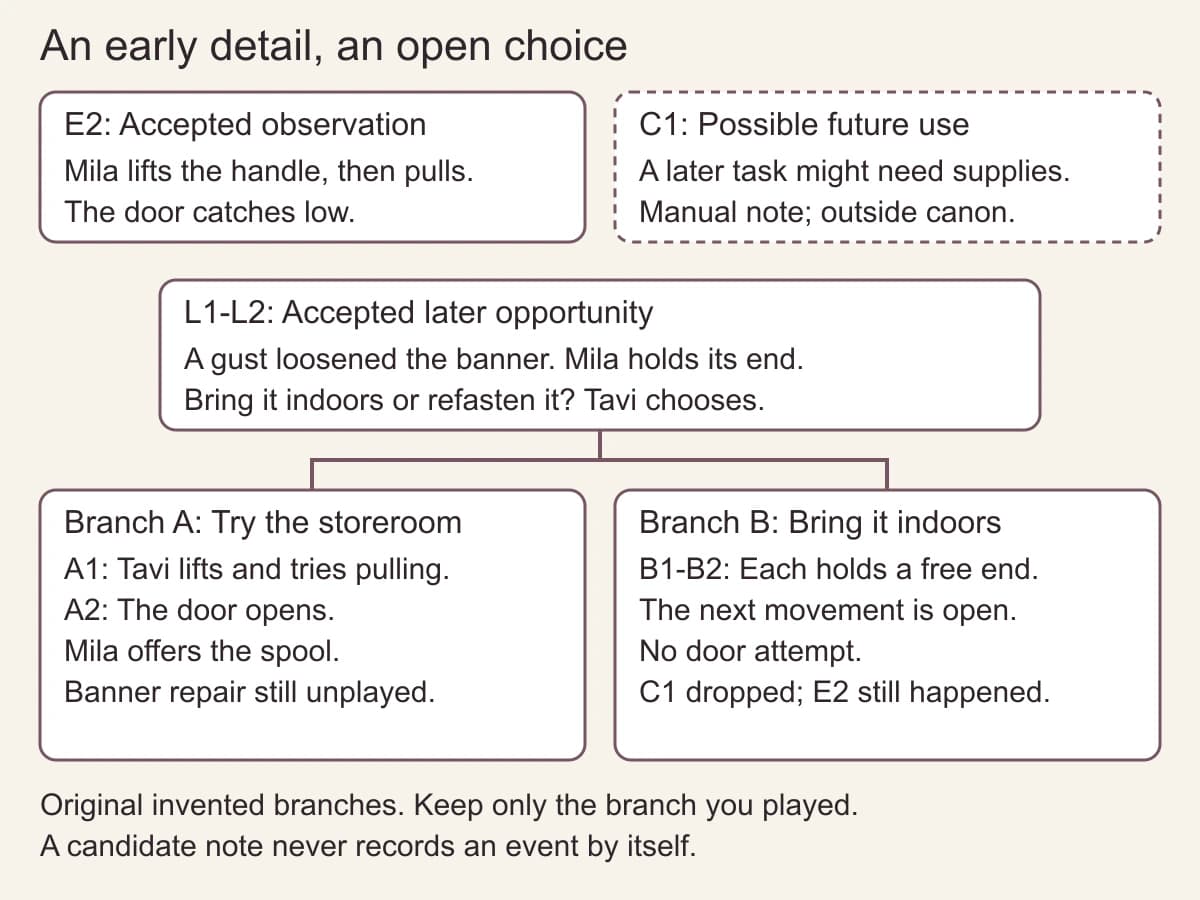
Accepted observation note, source E2
Mila lifts the storeroom handle slightly before pulling. "It catches low," she says.
Keep that wording intact in your note. E4 adds that no key is needed. Neither turn establishes that the handle always works, that anything will go wrong outside, or that Tavi will choose to use the door. Those would be separate claims.
Keep a possible future use outside the accepted record
You might now see a way to reuse the handle action. Write the possibility in your own notes, beside the chat. It is a proposal about writing, outside the story's accepted events. Calling a note "future use" does not turn it into a hidden AI field, a plot planner or guaranteed memory.
Candidate C1: manual planning note after E4
Source: E2 handle action, noticed in E3; no key needed in E4. Possible future use: if a later task makes supplies in the storeroom relevant, Tavi could try the lift-before-pull action. Status: tentative, outside canon. No task, choice or result has happened. Drop it if Tavi chooses another approach or the scene moves elsewhere.
Keep the observation and the candidate on separate lines. You can share the observation when it is needed without sending the proposed future. If you paste C1 into chat, the model can use or reveal it. An instruction to keep it secret gives no protected private layer. Keeping it in your own document also means the model has not received that plan.
You do not need to have C1 in mind when writing E2. You may notice the possibility later by rereading accepted text. What you must not do is claim that Tavi previously learned a trick which never appeared. If the needed detail is absent, introduce it in a new scene and let the reader respond before relying on it.
Bring it back through a choice and an attempt
Later, the cups have been put away in an agreed transition. The following continuation starts with a new, explicitly agreed event. C1 did not cause it. L1 offers a manageable problem in the same place, and L2 gives the storeroom an immediate reason to matter.
L1: Your agreed later scene
OOC: Let the next scene begin in the courtyard after we have put the cups away. A gust has loosened one end of the outdoor cloth banner; it now hangs within reach. Nobody is hurt. This is the new event I accept. Tavi has not chosen what to do about it. Portray Mila and stop before my decision.
L2: Invented Mila reply, later opportunity
Mila gathers the loose end so it stops flapping. "There are dry ties in the storeroom. Would you rather bring the banner inside or refasten it?" She holds the cloth and waits.
Once you accept L2, record the loose banner from L1, Mila holding its end, and her statement about the ties. The question is still unanswered. An available place and a useful observation are enough to offer a choice; you do not need a line telling Tavi that this is the moment the earlier lesson was for.
A1: Your chosen attempt as Tavi
"Let's try refastening it. I'll look for those ties." I go to the storeroom, lift the handle slightly and try pulling the door toward me.
A2: Invented Mila reply, played consequence
The door opens. Still holding the banner end just outside, Mila looks through the doorway. "That's it. There's a spool of dry cotton ties on the near shelf, if you want it."
A1 earns a record of Tavi's choice and attempted action. It does not by itself establish an open door. Accepting A2 earns that update, plus the offered spool's location. Mila can observe the door opening and offer the supplies. She must leave Tavi taking them, tying the banner, checking the repair and reacting to the reader.
Branch A: actual played consequence note
Sources: L1-L2 and A1-A2, accepted after E1-E4. Opportunity: loose banner; Mila holds its end and offers two approaches (L1-L2). Reader-owned attempt: Tavi chooses to try refastening, then lifts and pulls the handle (A1). Played consequence: door opens; Mila offers the spool on the near shelf (A2). C1 status: used for access to the storeroom. Banner repair remains unplayed. Next choice: Tavi may take the spool, ask Mila something or change approach.
The payoff is small and complete at A2: a visible action from the earlier scene has become useful. It does not require a finished repair or the end of the whole story. When you do want to resolve the story's larger promises, use the story-ending guide.
Let the callback go unused
This is an alternative to A1-A2, starting from the same accepted L2 question. Do not append it after Branch A or combine the two in a recap. Tavi can choose the other approach without being sent back toward the planned door scene.
B1: Your alternative reply as Tavi
"I'd rather bring it in. Could you undo the other end while I hold this one?" I take the loose end from Mila and wait.
B2: Invented Mila reply
Mila unfastens the remaining end and takes its weight. She turns toward the courtyard entrance to the lobby. "There's room to lay it on the long table. Ready?"
Accepting B1-B2 records Tavi's decision to bring the banner indoors, the transfer of its loose end, and Mila freeing the other end. It does not record the banner already on the table: Tavi still needs to choose the next movement. Neither character visited the storeroom in this branch.
Branch B: separate outcome note
Sources: L1-L2 and B1-B2, accepted after E1-E4; A1-A2 did not happen. Played consequence: both banner ends are free. Tavi holds one; Mila holds the other. Next choice: move together toward the lobby or respond first. C1 status: unused candidate dropped. No storeroom visit, door attempt or spool offer in this branch. E2 remains an accepted observation about Mila opening the door earlier.
Dropping C1 changes your plan, not the earlier scene. Mila still handled the door in E2. You do not need to turn the cups into a second clue or invent another emergency to justify having described it. If a different use emerges much later, consider it as a new possibility with its own source and open choice.
When the AI reveals the plot too early
For this separate repair example, return to E4, before L1 and either branch. Imagine the next reply proposes the following. Treat the whole reply as unwanted, rather than accepting its opening and objecting only to the last sentence.
P1: Invented premature-spoiler and railroading reply
A gust tears the banner loose. Tavi realizes why Mila showed the handle trick: this was the lesson that would save the day. Tavi rushes to the storeroom, opens the door, fetches the ties and secures the banner perfectly. Mila cheers as Tavi grins with relief.
P1 adds an unagreed gust, assigns a future purpose to Mila's earlier action, writes Tavi's realization and choices, and completes a repair. Asking only for "less obvious foreshadowing" would leave too much of that proposal standing. Name the full rejected span and the exact scene you still accept.
OOC rejection of the entire P1 proposal
OOC: Reject the entire previous reply P1, from the gust through the cheering and Tavi's relief. None of those proposed events, thoughts, actions or outcomes is accepted. Resume immediately after E4: we are inside beside the mugs on the towel; Mila has just asked whether all the cups are in. Keep E2 exactly: Mila lifts the storeroom handle slightly before pulling. "It catches low," she says. Keep E3 noticing the action and E4 saying no key is needed. Drop the assumed future rescue, Tavi's use of the door, fetched ties and completed banner repair. The handle demonstration has no agreed future purpose. Continue only with Mila in the current cup-clearing scene and leave Tavi's response to me.
R1: Invented corrected Mila reply
Mila waits beside the table. "I think there was one more cup on the courtyard bench. Shall I have a look?"
The OOC rejection is an ordinary message about how to continue. It is not a story event and does not delete or edit stored messages. P1 remains visible in the chat, so you cannot make its disclosed idea unknown again. Check the next reply before accepting it; if it repeats P1, keep the accepted record at E4 and restate the boundary or stop there.
If you accept R1, record only Mila's question about checking for a cup. No cup has been found and no check has been performed. In this repair branch, mark C1 dropped and keep the E2 observation. L1 would require a new explicit agreement if you later wanted that event; correcting P1 does not quietly accept its gust.
Keep a short manual setup and payoff note
Keep one note per detail worth following. The filled record in Branch A shows the difference between a proposed use, an attempt and its played result. Use the blank version below for your own scene. Copying it puts text on the clipboard; the note is yours to maintain, and it is not automatically saved as story memory.
Blank manual setup and payoff note
Accepted early observation, exact text and source turn: Immediate purpose in that scene: Candidate future use, outside canon: Later accepted opportunity and source turn, or none: Reader-owned choice and attempt, source turn, or still open: Accepted played consequence and source turn, or none: Candidate status: tentative / used / dropped Last accepted scene and next open choice: Rejected proposal to exclude, if any:
Update the accepted lines when you accept a new event. A thought about what could happen goes only in the candidate line. Keep an attempt distinct from its result: "tries the handle" cannot become "door open" until the continuation establishes that outcome. If a reply adds an unwanted result, reject it before using it as the basis for the next turn.
Check the amount of emphasis by asking a reader what they noticed in the early scene and whether the later use makes sense. Writing Excuses discusses using reader feedback to judge emphasis. There is no fixed number of repetitions to apply here. In a chat, add any useful reminder in a new turn rather than rewriting accepted history without agreement.
If the return feels forced, check why the supplies are needed now and whether another approach remains available. If the detail is too obscure, a character can mention the accepted observation when it becomes relevant. If it is too obvious, continue the ordinary task and leave the future use out of the narration. None of these writing choices guarantees what a model will produce.
Try an ordinary opening with a character
Browse the character profiles and choose a voice that fits a quiet shared task. The roleplay entry also offers existing characters and scene starters. Adapt Tavi and Mila's roles to the profile you choose; the names in this guide are invented for the exercise and are not claims about catalog characters.
Copy E1 from the early-scene section, paste it into the chat composer and review the roles and opening before sending. Copy does not send a message. Keep C1 in your own notes if you do not want to supply the proposed future use. After sending an adapted opening, read the reply and decide which details you accept before writing your next turn.
The two sources below support the writing techniques discussed here. The theatre exchanges and manual note format are original adaptations for turn-by-turn roleplay. They do not demonstrate tempteo model performance, a memory feature or a measured success rate.

