

Medieval roleplay ideas: 20 plots and a fair dispute to play
A late letter, a disputed weight or a harvest that cannot wait can give a medieval scene its problem. These 20 plots use a fictional setting inspired by European towns, courts and abbeys, without magic. The worked fair dispute below shows how a few setting details change what the characters can do. These are editorial illustrations, not historical reconstructions or recorded AI chats.
Updated by the tempteo editorial team
The writing examples below are invented. They illustrate the advice and are not recorded chat results.
On this page
- Choose a medieval scene by the conversation you want
- Begin with one cloth sample
- Castle and court roleplay ideas
- Village and trade roleplay ideas
- Travel, pilgrim and market roleplay ideas
- Monastery, scholar and secret roleplay ideas
- Siege, feud and oath roleplay ideas
- Play a fair dispute with three details that affect the scene
- How to make medieval life feel real in a few details
- What to leave out or soften for a good chat
Choose a medieval scene by the conversation you want
Start with what you want to do in the next few turns. These plots use an invented setting without magic. If you want spells, mythical creatures or a magical solution, choose the fantasy ideas instead. Neither list is a historical reconstruction.
A quiet working conversation: try The masterpiece in village and trade ideas. You present cloth; the partner plays the guild warden. Begin by asking which part needs work. Leave the judgement undecided.
A dispute to investigate: try The fair court in travel and market ideas. You hear a complaint; the partner plays the trader. Ask what she observed before deciding who is right. The worked fair scene takes you through it.
A private question with public consequences: try The guest who keeps the peace in castle and court ideas. You keep the guest company; the partner plays the guest. Ask about the missing payment without deciding she knew it would be late.
Loyalty under pressure: try The broken oath in oath and feud ideas. You and the partner play sworn companions. Ask whether an oath still binds you after the lord changes sides. Keep any fight offscreen.
Begin with one cloth sample
Here is a quiet opening based on The masterpiece. In this fictional guild, the warden may request a revision before judging. You write Neri, the weaver; the partner writes Elin, the guild warden. A blue cloth sample is on the table. Elin has examined its lower edge, but no fault, verdict or acceptance has been established. The guild's usual standards are not yet specified.
Quiet medieval workshop starter
OOC: A fictional medieval workshop, without magic or combat. I write Neri, a weaver presenting a blue cloth sample. You write Elin, the guild warden. The sample is on the table, and Elin has examined its lower edge. No fault or verdict has been established. In this invented guild, Elin may request a revision before judging. Leave Neri's decisions and work to me. Neri lays a spare thread beside the cloth. "You've been looking at that edge. What would you like me to check before you judge it?"
A response that leaves work for Neri: "Tell me how you finished it," Elin says, resting a finger beside the edge. "Then we can decide whether it needs another look."
Neri can explain the work, ask what Elin noticed or request time to inspect it. The reply has not established a defect or guaranteed a pass. Stay with that question for a few turns instead of forcing a hidden curse or a sudden attack into the workshop.
If you want to try the opening in tempteo, browse characters, read a profile and adapt Elin's role to your partner. Copy puts the text on your clipboard; review it in the message box before sending. These are ordinary scene instructions, not a historical mode or a promise that a reply will follow every detail.
Castle and court roleplay ideas
A castle is a crowded workplace, so give the character a job there and let the plot come from what she sees.
The grain tally
You're the new clerk of the castle stores.
Conflict: the winter grain is forty sacks short, and the steward wants her own number written down.
First line
Forty sacks don't walk out of a locked cellar. Where did they go?
The borrowed arms
You're herald at a tournament, and a champion rides in under a dead family's arms.
Conflict: name her and she's sent home, or keep quiet and lie to your lord.
First line
Nobody has carried those arms in forty years. Whose are you wearing?
The cut jesses
The lord's best falcon is gone, and you and the falconer have until Sunday's hunt to find it.
Conflict: its leg straps were cut, and only she handles them.
First line
Birds don't carry knives. Why did you let it go?
The guest who keeps the peace
A rival lord's sister lives at your castle as a pledge of the truce, and you keep her company.
Conflict: her brother's payment is late, and your lord asks if she knew.
First line
Your brother's rider didn't come today. Were you expecting him?
Village and trade roleplay ideas
In a village everyone depends on everyone else, so nobody can just walk away from a quarrel.
The raised sluice
The miller has raised her sluice gate, and the stream through your pasture is down to a trickle.
Conflict: the mill is the lord's, and she says she's following his orders.
First line
My sheep are drinking mud. How high did you raise it?
The masterpiece
The guild warden must judge the cloth that could make you a master weaver.
Conflict: the guild wants fewer masters this year, and she has to turn someone down.
First line
You've stared at that corner for an hour. What's wrong with it?
The bell that split
The village's new bell cracked on its first ring, and you're sent to question the bellfounder.
Conflict: she swears someone swapped the bronze before it reached her.
First line
One ring and it split. Was it the metal or the maker?
The ale taster
You brew for half the village, and the new ale taster keeps marking your barrels as weak.
Conflict: she's right about one batch, and her cousin brews too.
First line
Weak? That barrel would knock over a plough horse. Taste it again.
Travel, pilgrim and market roleplay ideas
Travel is slow, which means days on the road with one companion and a new inn every night.
The second pilgrimage
You guide pilgrims to a hill shrine, and one already wears its badge on her hat.
Conflict: she's walking it again for someone else and won't say who.
First line
You've earned that badge already. Who are you walking for this time?
The dead man's seal
You keep a bridge toll, and a merchant with twelve carts shows you a letter excusing her from paying.
Conflict: the seal is real, but its owner was buried three weeks ago.
First line
Good seal. Shame its owner is in the churchyard.
The fair court
At the summer fair you judge quarrels before traders leave town.
Conflict: a spice seller says the town's own weighmaster cheats, and the fair closes at sunset.
First line
You have until the closing bell. How do you know his weights are false?
Two messengers
You carry a marriage offer to a lord ten days' ride away, and a rival family's rider keeps turning up at your inns.
Conflict: whoever arrives first will probably win.
First line
Same road, same inns, same lord. What's your family offering?
Monastery, scholar and secret roleplay ideas
Abbeys held books and land, which makes them good places for a secret.
The scraped page
You copy books at the abbey, and the librarian scrapes an old page clean for reuse.
Conflict: before it vanished, you saw the founder's name in a land dispute.
First line
You scraped that before I'd finished. What didn't you want me to see?
The wrong Easter
A visiting scholar claims the calendar has drifted and the abbey will keep Easter on the wrong day.
Conflict: the abbot won't listen, and she needs a witness who can do sums.
First line
Wrong by how many days? Show me on the wax tablet.
Forty days
A woman claims sanctuary at the abbey gate while the sheriff's men wait outside, and you're the porter.
Conflict: custom gives her forty days, and the abbot wants her gone sooner.
First line
Three days used, thirty-seven left. What do they say you did?
The empty reliquary
On the feast day, you and the sacristan open the reliquary for the pilgrims and find it empty.
Conflict: the pilgrims are already in the yard, and only you two know.
First line
Nothing in the box, and they've walked for weeks. What do we tell them?
Siege, feud and oath roleplay ideas
These plots run on loyalty and bargaining, so the fighting can stay off the page.
Breakfast under truce
Each morning you ride under truce into a besieged castle to ask for surrender, and its lady serves you breakfast.
Conflict: you need to know if her stores are as full as her table.
First line
Fresh eggs again. For a castle under siege, you eat very well.
The price of peace
Your family has owed hers a debt for three generations, and she has come to name the price of peace.
Conflict: she refuses silver and cattle and asks for something harder to give.
First line
My father offered twelve cows and you laughed. What do you want?
The broken oath
You and your sworn companion pledged yourselves to a lord who has just changed sides.
Conflict: she means to follow him, and your oath says you should too.
First line
We swore to him, not to his new friends. Are you really going?
The unpaid ransom
Captured in a border skirmish, you're kept politely by the knight who took you until your ransom comes.
Conflict: your family can't pay, and she has just found out.
First line
You've been kind for six weeks. The letter came back unopened, didn't it?
Play a fair dispute with three details that affect the scene
The fair-court idea above gives you a complaint and a deadline. To play it, establish who can make a decision, what evidence is available and what will happen if the traders leave. Keep those details close to the characters' immediate problem.
The Gazetteer of Markets and Fairs in England and Wales to 1516 records particular market days and fair dates from charters and other evidence. Those dates give you a historical starting point for a trading deadline. The closing bell, disputed weight and procedure used here are choices for an invented town. They are not a claim about every medieval fair.
1. Choose a small dispute and name the authority
In the fictional town of Alderwick, the fair closes after the evening bell. Mara, 42, is a spice seller. You play Edwin, 39, the clerk appointed to hear trading disputes for this fair. His table stands beside the town scales. Mara says the weighmaster changed weights during a sale. Edwin can ask for a comparison and record what witnesses say; he cannot know from looking at Mara whether her accusation is true.
Your opening as Edwin
The Alderwick fair closes after the evening bell. I'm Edwin, 39, the clerk hearing trading disputes. You're Mara, 42, a spice seller who says the town's weighmaster has used a false weight. My table stands beside the town scales, under a rain-spotted awning. I leave a blank space in the record. "You have until the closing bell. What did you see him do?"
2. Ask for evidence your character can examine
Illustrative reply from Mara
Mara lays a wrapped weight on the table. "This is mine. His matched it this morning, but the weight he used for my sale looked different. Compare them before his cousin packs the scales away."
Mara has given Edwin an object and a claim, not a proven culprit. His next turn can ask where her weight came from, call a witness or request a comparison in public. Two weights that disagree do not show which one is correct. If this story has no agreed reference weight, record the disagreement and leave that question open.
Your next turn: arrange a comparison
I leave Mara's weight wrapped and look toward the weighmaster beside the scales. "Mara, who supplied yours, and who saw today's weighing? Weighmaster, will you bring the weight you used to the table?"
3. Let the deadline change the available choices
Illustrative complication: Mara looks toward the gate. "The seller who saw it is taking her cart out now. Ask the porter to bring her back before the weighmaster packs those weights away."
The porter has not been sent anywhere yet. Edwin can ask him to invite the witness back while he stays beside the scales, or go after the witness himself and ask someone else to watch the table. A pause needs the other characters' cooperation.
Your proposed next turn
I ask the porter to invite the witness back and keep my place beside the scales. "Mara, will you stay here with your weight? I'll ask the weighmaster to delay packing until she returns. If he refuses, that goes in the record too."
A delay gives the witness time to return but may anger traders who need to leave. A refusal means Edwin has to record what he can establish before the fair ends. Neither choice requires a sudden confession or a modern laboratory result. For a longer hearing with different interests, use the fictional negotiation workshop.
Keep the agreed facts in a short case note
For a longer scene, keep a note separating the complaint from the evidence and update it after accepted turns. The filled example and blank version below are for your own writing.
Filled fair case note
Fair case: Alderwick weight dispute Deadline agreed for this story: the evening bell Authority: Edwin can request a comparison and record statements Complaint: Mara says the weighmaster changed weights during a sale Evidence accepted so far: Mara brought her own wrapped weight Still unproved: whether the weights differ; which is correct; whether anyone cheated Proposed next move: stay with the scales and ask the porter to invite the witness back
Blank fair case note
Fair case: Deadline agreed for this story: Who can decide, and what can they request: Complaint: Evidence accepted so far: Still unproved: Proposed next move:
If a later reply says that Mara has proved fraud, check the note. You can request: "OOC: We have a complaint and Mara's weight, not a completed comparison. Keep the outcome open until Edwin hears the witness." Read the next reply before accepting its result.
To try this in tempteo, browse character profiles, choose a partner and adapt Mara's scene role to that profile. Copy the opening into the browser chat composer and read it before sending. Copy only puts the text on your clipboard. The setting and tone notes below can help you adapt the other plots.
How to make medieval life feel real in a few details
Ordinary details do more for the period feel than "thee" and "thou". Use two or three in your setup and let the rest come up in play.
For a farming town, set the first scene during harvest week. Bad weather and an unfinished crop give the characters a deadline.
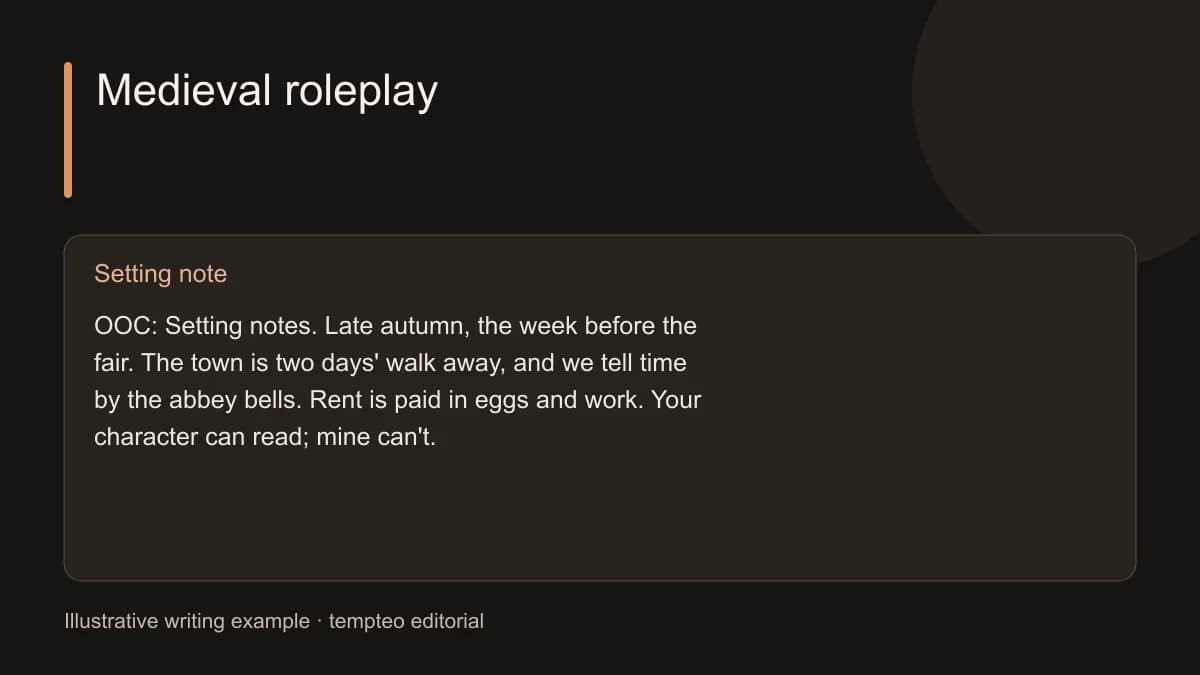
Decide how travel works in your setting. In the note below, the town is two days away on foot; a message sent there will not get an answer that evening.
Choose how your characters tell time. This town uses abbey bells, so "after the evening bell" is a useful meeting time.
Give money a practical role. In this story, rent can be paid in eggs or work and coins are scarce. Other regions and periods used different arrangements.
Decide who can read in this particular scene. If one character needs someone to read a letter aloud, the reader also learns its secret.
A setting note like this one fits well into an opening scene on tempteo's roleplay page, which you can edit before sending.
These plots use a fictional setting inspired by medieval European towns, courts and abbeys. Pick a region and period if historical accuracy matters to your story. The rules below are choices for this fictional town, not claims that all medieval people lived the same way.
Setting note
OOC: Setting notes. Late autumn, the week before the fair. The town is two days' walk away, and we tell time by the abbey bells. Rent is paid in eggs and work. Your character can read; mine can't.
Generic reply
"Meet me tomorrow at noon by the gate, and bring the money."
Same reply with period detail
"Come after the midday bell, to the tanners' gate. Bring what you've got. Six pennies and a cheese will do."
What to leave out or soften for a good chat
Real medieval life could be brutal, and a chat doesn't need all of it. Keep violence off screen: a siege is about hunger and bargaining, and a battle arrives as a messenger's report.
Choose the social rules of your fictional town and use them as obstacles. Perhaps a tenant needs permission to move or a widow has to make a case for keeping a workshop. These are plot choices; check sources for your chosen place and period before presenting them as history.
You can leave some history out on purpose, too, since nobody needs plague in every village. Set the tone in one line at the start, and fix a reply that drifts with a short OOC note.
Tone note for the setup
OOC: Keep fights short and off screen. Rank and custom should make life harder for our characters, but nobody gets punished on screen.