

Superhero roleplay ideas: 20 plots with power limits
A power can solve one problem and leave the hero with another. These 20 superhero roleplay ideas cover new abilities, day jobs, rivals and small-town problems, each with a conflict and a first line. The rescue example below keeps a power's cost in play after it succeeds. The examples are editorial illustrations, not recorded AI chats.
Updated by the tempteo editorial team
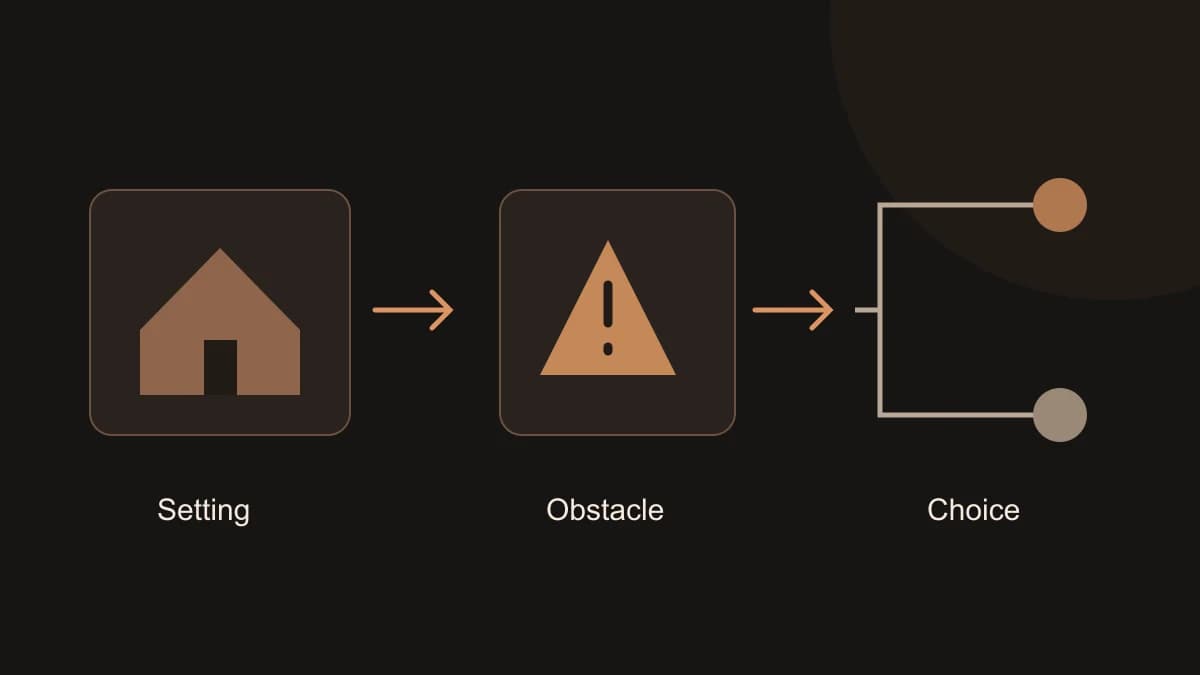
The writing examples below are invented. They illustrate the advice and are not recorded chat results.
On this page
- Superhero roleplay ideas about new powers
- Superhero roleplay ideas for heroes with day jobs
- Play a secret-identity scene without deciding the reveal
- Villain and gray area roleplay ideas
- Hero team and rivalry roleplay ideas
- Small-town and low-key superhero roleplay ideas
- How to design a power with a cost and a limit
- Play a rescue where the power's cost still matters
- How to keep power levels consistent
Superhero roleplay ideas about new powers
The first weeks with a power are awkward, which makes them easy to play.
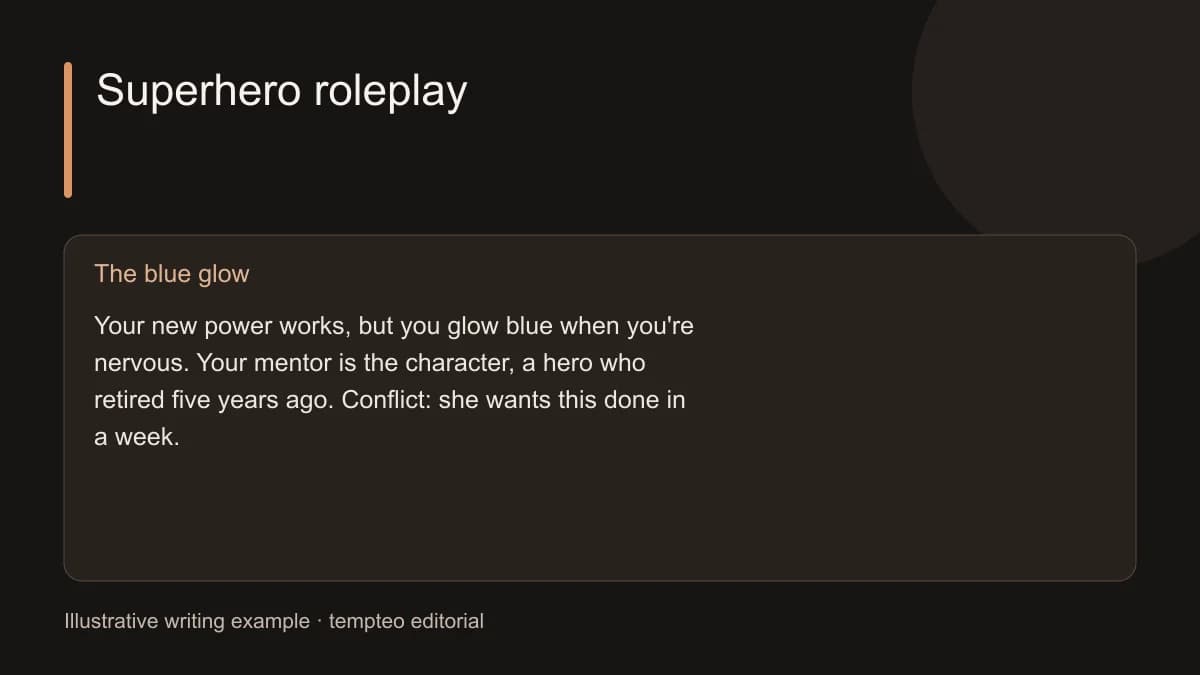
The blue glow
Your new power works, but you glow blue when you're nervous. Your mentor is the character, a hero who retired five years ago.
Conflict: she wants this done in a week.
First line
You're my mentor? You're the one who quit.
The borrowed flight
A handshake gives you the other person's power for an hour, and they lose it. You just shook the character's hand.
Conflict: she can't fly, and she's due at a cliff rescue at two.
First line
I didn't know. How do I give it back?
Five seconds early
The character can stop time for five seconds, once an hour. You're a paramedic, and she beats your crew to every crash.
Conflict: she won't even tell you her name.
First line
You're at every crash before us. I timed it. How?
Hero or decorative
The character makes plants grow in seconds and wants a hero license. You're the clerk.
Conflict: the form has no box for her, and she won't leave.
First line
Two boxes, hero or decorative. Convince me.
Superhero roleplay ideas for heroes with day jobs
A day job gives a hero something to lose and someone to lie to.
The long lunch
You're a hero who works in accounts and vanishes whenever a siren goes past. Your manager, the character, has started timing your lunches.
Conflict: your review is on Friday.
First line
The sandwich queue really was that long.
Two suits, one tailor
The character mends hero costumes, no questions asked. You bring yours in scorched and spot the villain's costume on her rail.
Conflict: she sews for both sides.
First line
You made my suit. Did you make his too?
The fact-checker
You check facts at the city paper. The reporter at the next desk wants you to check her story, which unmasks you.
Conflict: every fix brings her closer.
First line
You've got his street wrong. The hero's, I mean.
The coffee that helps
Every cup the character pours at her café eases a small ache. You're the inspector sent to find out why.
Conflict: each cup tires her a little more.
First line
Three people say your coffee cured them. What's in it?
Play a secret-identity scene without deciding the reveal
The fact-checker idea puts a civilian job and a secret identity in the same conversation. Decide what the reporter has actually found before writing the hero's answer. A suspicious absence gives her a question; it does not prove who was behind a mask.
The following scene is an invented example, separate from Oona's rescue below. You write Kit, a newspaper fact-checker who is also the masked hero Lantern. The partner writes Jo, a reporter. Jo has a photograph of Lantern beside a clock at 12:10 and the office sign-out book showing Kit left at noon. Many people were outside the office then. Neither item identifies the person behind the mask. Jo has not published a story or told anyone her suspicion.
Secret-identity scene starter
OOC: I write Kit, the newspaper's fact-checker and secretly the masked hero Lantern. You write Jo, a reporter. Jo has a photograph of Lantern beside a clock at 12:10 and an office sign-out book showing Kit left at noon. Neither identifies who wore the mask. Jo suspects a connection but has no confirmation. We are alone at her desk; nothing has been published or shared. Ask Kit about the timing, then leave Kit's answer and any decision to reveal the identity to me.
Jo asks about the gap: Jo turns the photograph toward Kit. "You left at twelve. Lantern was at the square ten minutes later. Did you see who was there?"
Choose one of the following turns. They are alternative branches from that question, not consecutive events.
Keep the identity private for now
Kit answers without a reveal: "I can check the square's public noticeboard times," Kit says. "The sign-out book tells you when I left. It doesn't identify anyone in that photograph. What else have you checked?"
Jo can pursue another source, explain her suspicion or ask Kit directly. She still has no confirmation. This branch also leaves Kit's unmentioned movements unknown; do not invent an alibi on Kit's behalf.
Tell one person, not the whole city
Kit chooses a private disclosure: Kit lowers their voice. "I was Lantern. I'm telling you here, not agreeing to an interview. Will you hear why I kept it separate from the paper before deciding what to do?"
Kit has chosen to tell Jo. Jo now knows, but she has not promised secrecy, agreed to the request or published anything. Her response is the next playable turn. A disclosure can put a relationship under pressure without making everyone in the setting know the secret.
The Secret Identity entry in the Marvel Multiverse Role-Playing Game (linked in Sources below) describes tension between a private identity and personal relationships. This scene uses original characters and no rules from that game. If the AI turns suspicion into public knowledge, return to the last accepted branch. Use the correction below only if Kit chose the private disclosure. The supporting-cast guide covers keeping a wider cast's knowledge clear. A written instruction is not a protected secret store.
Correct a public reveal in the disclosure branch
OOC: Kit told Jo privately that Kit is Lantern. Jo has not promised secrecy or published anything, and nobody else learned it in this exchange. Continue with Jo's response to Kit's request; leave Kit's next decision to me.
Villain and gray area roleplay ideas
In a gray area plot, the character's reason should make sense even when you disagree.
The cold snap
You're the parole officer for a former villain who freezes water with a touch and has kept every rule for a year.
Conflict: the harbor froze overnight.
First line
The harbor froze at three. Where were you? Make it boring.
The broken window
A hero saved your street last night and knocked a bus through your shop window. This morning she turns up with a broom.
Conflict: her agency won't pay for the glass.
First line
Are you here to sweep or to sign something?
The pension thief
You're a detective, and the masked thief returning stolen pensions is the character, your quiet neighbor.
Conflict: the company she robs once cheated your father.
First line
I know it's you. I know whose money it was. So what now?
The mind reader's interview
The character reads minds for the police. You're a witness who asked her not to read yours.
Conflict: she heard something private anyway, and it shows.
First line
You flinched when I sat down. What did you hear?
Hero team and rivalry roleplay ideas
A team or a rival gives the character someone to measure herself against.
Timesheets
The character runs your new hero team like a small firm.
Conflict: she wants every rescue logged in fifteen-minute blocks, and yours happened on your lunch break.
First line
Fifteen-minute blocks? It took seven minutes.
Six streets, one grant
You and the character patrol the same six streets and keep beating each other to rescues.
Conflict: next year the city funds only one of you.
First line
That cat was mine. I'd been talking it down for twenty minutes.
Ten years a sidekick
The character has been your sidekick for ten years and wants her own patrol.
Conflict: she's better at most of the job, and you both know it.
First line
You've been reading job ads on the patrol laptop. Leaving?
The borrowed base
Your headquarters flooded, and the only spare space belongs to the rival team the character leads.
Conflict: her team has a rule for everything.
First line
One week, I promise. Where do we park the van?
Small-town and low-key superhero roleplay ideas
Low stakes suit long chats, since a sheep in a ditch leaves room for quiet scenes.
Sheep and a flood
You're the only hero in a farming valley, where most calls are about sheep.
Conflict: the river is rising, and the fire chief, the character, doesn't trust you with anything bigger.
First line
Twelve sheep out of ditches. Trust me with this one.
The small powers club
The character runs a monthly club for people with small powers, like warming tea with a touch.
Conflict: her own power is growing, and she hasn't told anyone.
First line
I can turn traffic lights green. Mostly. Can I join?
Four minutes under
The lifeguard in your seaside town never takes the rescue boat and stays underwater far too long.
Conflict: the council wants a big-city hero for the summer instead.
First line
You were under for four minutes. I counted. How?
The name on the sign
The character has looked after your mountain town for forty years. Since you arrived with powers, people call you her replacement.
Conflict: she isn't ready to stop.
First line
They put my name on the new sign. I didn't ask them to.
How to design a power with a cost and a limit
Before you start, write the power in four lines: what it does, how far it goes, what it costs and how others can tell. An unlimited ability can settle a scene before the other character has much to do. A specific boundary leaves other tasks open.
The limit keeps the power from solving the whole scene, and the cost makes each use a choice. If moving a car door numbs her hands for ten minutes, she has to decide whether this door is worth it. Keep the power notes with your own writing, or copy them into the conversation as a scene agreement.
Power notes
OOC: Power notes. Power: Oona moves metal objects with her mind. Limit: nothing heavier than a car door, and only while she can see it. Cost: her hands go numb for ten minutes after each use. Tell: radios nearby hiss while she does it.
Play a rescue where the power's cost still matters
Oona's power notes above give her an ability and a reason to choose carefully. She moves visible metal objects no heavier than a car door. Each use numbs her hands for ten minutes, and nearby radios hiss. In this scene, Oona, 36, stands outside a bus stopped on firm ground after a collision. You play Dev, 41, the driver. Nobody is seriously hurt. A loose metal latch, visible from outside and well below her weight limit, is lodged in the front door track.
Brandon Sanderson separates a power's limits from its costs. Here the limit rules out moving the whole bus, while the numb hands affect Oona's part in helping people down afterward. The ability itself has not stopped working.
Give each character a part in the attempt
If you have not already agreed on the power, send the notes above first. The scene begins with a specific object Oona can try to move and a job Dev can do while she tries.
Your opening as Dev
I'm Dev, 41, the driver of a bus stopped on firm ground after a collision. You're Oona, 36, standing outside. Nobody is seriously hurt. A loose metal latch is lodged in the front door track; you can see it through the window, and it weighs far less than a car door. "Can you move that latch clear while I keep everyone back?"
An imagined reply from Oona
Oona studies the latch through the window. "I can try it. My hands will be numb afterward, so you'll have to help people down. Is everyone clear of the door?"
Dev can ask the passengers to step back and check the space beside the door. His turn need not decide that every passenger obeys or that Oona succeeds.
Your next turn as Dev
I ask the passengers to step back, then check the front step. Keeping one hand on the rail, I look toward Oona. "The step is clear. Try the latch; I'll open the door if the track is free."
Keep the cost after success
An imagined result to continue from: A radio hisses as Oona moves the latch out of the track and sets it on the dashboard. She flexes her fingers without closing them. "Latch is clear. My hands are numb. Can you help them down?"
For this branch, accept that the latch has moved. Dev can open the door and help with the steps, ask another passenger to pass down bags or call for more help. Oona can still watch and communicate while her hands are numb.
Your next turn after the latch moves
I ease the door back and check the step before taking a passenger's bag. "One at a time. Oona, can you keep an eye on the space outside the door? I'll help people down."
The power has cleared the door track; getting everyone off the bus is still a shared task. You can use the action-scene workshop to track where each character stands and which moves are still open.
Follow the same rule if the attempt fails
If the accepted reply leaves the latch stuck after Oona uses the power, keep both the obstacle and her numb hands. If she cannot see the latch and never uses the ability, no use has happened. Neither result changes the agreed weight limit.
Your next turn if the latch stays stuck
"Leave that latch for now. I'll check whether we can use the rear exit."
If a reply lifts the whole bus, use the OOC correction below to return to the moment before the power is used. Keep the attempt open for Dev's response, then check what the next reply does.
To play the scene in tempteo, browse characters, read a profile and adapt Oona's role to your chosen partner. Copy the opening into the browser chat composer and read it before sending. Copy only puts the text on your clipboard. Keep the power notes beside your own writing when you want to check a later turn.
How to keep power levels consistent
If a reply makes the hero stronger or weaker than the agreed power allows, check it before accepting the next event. Oona lifting a crane would exceed the limit in her notes; an ordinary difficulty opening a jar would not establish a new power rule.
The agreed limit remains the ceiling. Record accepted actions that fit it, for example: "Strongest so far: moved a loose latch out of a door track." An unsuitable reply does not silently raise the limit. Other powered characters need stated boundaries too when their abilities affect the next decision.
When a reply goes past the limit, send one OOC request to correct the action and continue from the last accepted moment. Check the new reply before continuing. For keeping a separate note about a recurring detail, see making AI remember things.
Reply that breaks the scale
Oona raises one hand, lifts the whole bus off the bridge rail and sets it down gently on the road.
One-line OOC correction
OOC: Oona can only move a visible metal object no heavier than a car door. Return to the moment before she uses her power and leave the rescue unresolved for Dev's response.